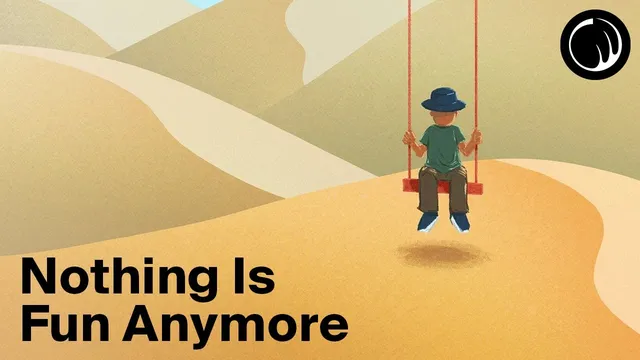
The Feeling That Nothing Is Fun Anymore
Based on Pursuit of Wonder's video on YouTube. If you like this content, support the original creators by watching, liking and subscribing to their content.
Emotional numbness can be an adaptive response to repeated uncertainty and loss, leaving people functional but feeling muted or “okay” rather than joyful.
Briefing
A long stretch of life can quietly drain joy without turning into classic depression: people often keep functioning—getting out of bed, pursuing goals, maintaining routines—while everything feels muted, automatic, and oddly “okay.” The central claim is that this numbness is a natural endpoint for someone who has accumulated enough loss, disappointment, and exposure to life’s unpredictability that their sense of safety and significance shrinks to a pinpoint. Loved ones die, hearts break, and the mind gradually learns to brace for what could happen next. Over time, the protective response becomes emotional callusing: not a deliberate choice, but a survival adaptation that reduces how much life can hurt.
The transcript frames this state as neither apathy in the simple sense nor depression in the familiar sense. Instead, it’s described as a middle condition—more like sitting on a beautiful beach while feeling detached from the visceral texture of the moment. Achievements may still happen, but they don’t land as lasting satisfaction; social life may thin out, yet the person remains capable of going places and doing things. Even when things are “nice,” the awareness can be more intellectual than felt. The unrest isn’t gone so much as managed—pain becomes background noise, and the day-to-day continues at nearly full speed without a clear “why.”
From there, the discussion pivots to philosophy as a diagnostic tool. Stoicism, Daoism, and Buddhism are presented as traditions that treat detachment—especially toward what can’t be controlled—as a way to reduce suffering. Stoic practice emphasizes distinguishing controllable from uncontrollable and responding to the latter with calm, tempered concern. Buddhism is described as aiming to end relentless attachment to worldly desires and mental fixation, while a pessimistic Western parallel is invoked through a quote about trying to get ahead of the worst by courting misfortune early.
But the transcript warns that detachment can overshoot. A fully calloused hand loses sensitivity; similarly, emotional numbness can make it harder to notice details, feel texture, and experience the richness of ordinary life. The danger of apathy isn’t only what it does—it’s that people may stop caring about its side effects, making it self-reinforcing.
The proposed remedy is not a quick mindset flip but a reversal of the process that created the callus: stop repeating the same emotional “pressure,” then allow time for sensitivity to return. That may mean changing daily life—adding challenges, hobbies, lunches, or new people—or changing how one thinks, adopting a new framework for interfacing with the world. The transcript closes with a seasonal metaphor: winter soil can still produce life, and an “invincible summer” can return as circumstances shift. Even if coldness is lifelong, adaptation and perspective can still generate comfort, meaning, and endurance—suggesting that reduced feeling isn’t necessarily permanent, just in need of conditions to heal.
A sponsored segment then pivots to mental health and wellness, emphasizing nutrition—specifically the supplement ag1—as a foundational habit supporting brain, gut, and immune health, with claims that it improves mood and sustained energy. The core message remains that there’s no one-size-fits-all fix, but building blocks like nutrition can support the broader effort to feel better.
Cornell Notes
The transcript describes a common life transition where joy fades into a muted, “okay” numbness while day-to-day functioning continues. This state is framed as an adaptive response to repeated uncertainty, loss, and the realization that horrible outcomes are possible—so the mind reduces sensitivity to protect security and significance. Philosophical traditions such as Stoicism, Daoism, and Buddhism are used to justify detachment from what can’t be controlled, but the text warns that detachment can become emotional callusing that blocks feeling and discernment. Recovery requires stopping the habits that reinforce numbness and giving time for sensitivity to return, potentially through lifestyle changes and new ways of perceiving the world. A seasonal metaphor—winter soil producing life—offers hope that “invincible summer” can return.
What does “nothing is fun anymore” look like in practice, and how is it different from depression or simple apathy?
Why does the transcript connect emotional numbness to repeated exposure to life’s worst possibilities?
How do Stoicism, Daoism, and Buddhism justify detachment, and what principle do they share?
What’s the transcript’s warning about taking detachment too far?
What does “healing the callus” require, according to the transcript?
How does the seasonal metaphor function as a hopeful conclusion?
Review Questions
- How does the transcript describe the emotional experience of numbness while still maintaining high day-to-day functioning?
- What distinction does the transcript draw between healthy detachment and harmful emotional callusing?
- What specific lifestyle or cognitive changes does the transcript suggest for reducing numbness over time?
Key Points
- 1
Emotional numbness can be an adaptive response to repeated uncertainty and loss, leaving people functional but feeling muted or “okay” rather than joyful.
- 2
The transcript frames this state as neither classic apathy nor classic depression, emphasizing continued routine and goal pursuit without the same emotional payoff.
- 3
Stoicism, Daoism, and Buddhism are used to support detachment from what can’t be controlled, but detachment can overshoot into reduced sensitivity.
- 4
A major risk of apathy is that it can make people stop caring about its own side effects, allowing numbness to reinforce itself.
- 5
Reducing numbness is likened to healing a callus: stop the repeated pressures that caused it and allow time for sensitivity to return.
- 6
Recovery may require both practical changes (new hobbies, challenges, people) and cognitive changes (a new framework for perceiving and engaging with life).
- 7
A seasonal metaphor argues that reduced feeling isn’t necessarily permanent; internal resources can reawaken as conditions shift.