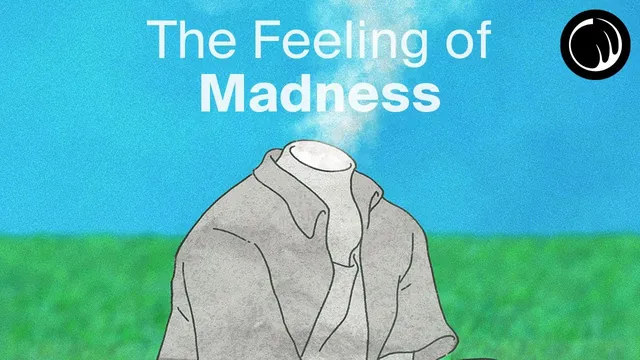
The Feeling That You're Going Crazy
Based on Pursuit of Wonder's video on YouTube. If you like this content, support the original creators by watching, liking and subscribing to their content.
Subtle madness is treated as normal, not just an extreme breakdown, and can show up as disquiet, unfamiliarity, or dreamlike perception.
Briefing
“Madness” isn’t reserved for dramatic breakdowns or diagnosable extremes; it’s a baseline feature of being human—quietly present, socially managed, and sometimes useful. The core claim is that most people carry a subtle, untraceable form of inner disquiet that only becomes obvious when it spills past what society and personal capacity can contain. That spill can look like feeling unfamiliar in the mirror, waking from a strange dream with the room still “glazed” by another reality, or staring at the world and feeling a disorienting sense of not quite knowing what one is seeing.
The transcript argues that expectations are the turning point. Childhood innocence isn’t “sanity,” but a lack of imposed standards—no pressure to be lucid, rational, impressive, or calm. As maturity arrives, the demand to behave as though one is perfectly sane becomes a kind of internal repression. The result is a “sane insanity”: a life where madness is muzzled rather than eliminated, and where the person must act as if clarity is guaranteed even while the “mad child” inside still exists—stifled, denied the right to grieve, and occasionally ready to break out.
A second thread connects this inner experience to the structure of everyday life. Society expects people to be steady and reasonable at set times—morning routines, social interactions, and the constant requirement to map a chaotic brain onto an unpredictable universe. The transcript portrays the mind as a system of electrical and chemical activity trying to narrow an ocean of time and space into something workable. In that context, the insistence on rules and certainty looks less like progress and more like another form of self-deception. Even the familiar “definition of insanity” (doing the same thing repeatedly and expecting different results) is treated as partly accurate, but insufficient: the deeper problem is that the human project keeps chasing resolution—peace, control, happiness—through cycles that rarely deliver lasting satisfaction.
Rather than treating madness as a defect to fear, the transcript urges recognition and forgiveness. If someone notices their foundations are “mired in madness,” they should accept it rather than become its victim. Letting the “light” of one’s madness show—through small acts of foolishness, jarring decisions, or moments of losing grip—can function as a kind of wisdom. The message is not that life has no meaning, but that it has no fixed rules, and that trying to force it into rigid comprehensibility misses the point of its mystery.
The closing emphasis is practical and moral: be silent and listen, admit the madness, and stop despising it. Madness is framed as a special form of spirit that clings to teachings and daily life alike, because life itself is illogical and full of craziness. In that light, sanity becomes less a destination than a social performance—and self-awareness becomes the tool for navigating it without panic.
Cornell Notes
The transcript argues that “madness” is not limited to extreme cases; subtle forms of disquiet and irrationality are normal parts of human life. Childhood lacks expectations, so it doesn’t feel like madness; adulthood brings demands to be rational and composed, which represses the inner “mad child” and turns madness into a managed, “sane insanity.” Everyday life intensifies this tension: the brain tries to impose order on a chaotic universe while society expects clarity on schedule. Recognizing this pattern should lead to self-forgiveness—small, seemingly out-of-character releases can be wise—and to humility about the absence of fixed rules in life.
Why does the transcript treat “madness” as a near-universal condition rather than a rare pathology?
What role do social expectations play in creating the feeling of going crazy?
How does the transcript connect mental life to the physical world and to daily functioning?
What critique does the transcript make of the human pursuit of resolution and happiness?
What practical advice does the transcript offer once someone recognizes their own madness?
How do the quoted ideas (Einstein attribution, Carl Jung, and the “be silent and listen” line) support the message?
Review Questions
- What changes when expectations replace childhood freedom, according to the transcript’s model of madness?
- How does the transcript justify the claim that madness is “wisdom” rather than only a threat?
- In what ways does the mind’s attempt to impose rules on life conflict with the idea that life has no fixed rules?
Key Points
- 1
Subtle madness is treated as normal, not just an extreme breakdown, and can show up as disquiet, unfamiliarity, or dreamlike perception.
- 2
Adult “sanity” is framed as social performance built on repression of an inner, impulsive self rather than true elimination of irrationality.
- 3
Expectations—especially the demand to be calm, rational, and lucid—are portrayed as the mechanism that turns inner instability into the feeling of going crazy.
- 4
The mind is described as constantly trying to impose order on a chaotic universe, making rigid certainty unrealistic.
- 5
The human pursuit of lasting peace and control is characterized as repetitive and often unsatisfying, aligning with a broad notion of insanity.
- 6
Recognizing madness should lead to self-forgiveness: small acts of foolishness or disruption can function as a release and a form of wisdom.
- 7
Madness is presented as part of spirit and daily life, so it should be neither despised nor feared but acknowledged and integrated.