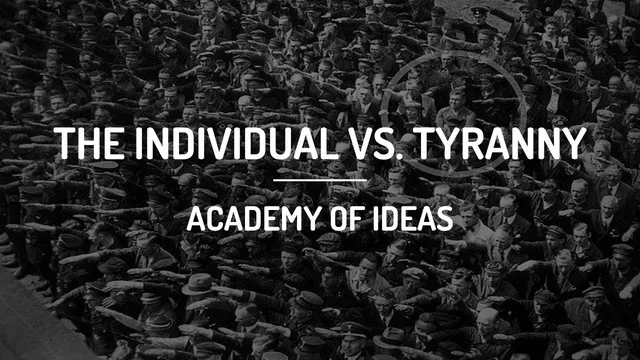
The Individual vs. Tyranny
Based on Academy of Ideas's video on YouTube. If you like this content, support the original creators by watching, liking and subscribing to their content.
Tyranny is portrayed as dependent on mind control through propaganda, not only on police power.
Briefing
Tyranny doesn’t last on force alone; it endures because rulers can capture the minds of ordinary people through collectivist indoctrination. The core claim is that freedom in an unfree world depends first on individuals “setting themselves right”—freeing their thinking from propaganda—before any collective action can genuinely produce liberty.
The argument begins with a line attributed to Alexander Solzhenitsyn: a courageous individual’s first step is refusing to participate in the lie. Solzhenitsyn’s experience under Stalin’s Gulag is used to frame a broader historical pattern: thinkers across the last few centuries—including Ralph Waldo Emerson, Friedrich Nietzsche, William James, and Carl Jung—treated the individual as the decisive unit in resisting oppression and preserving social health. In modern political culture, that emphasis has become unfashionable, replaced by the belief that social change comes mainly from collective action and that focusing on the individual is selfish. Here, collective cooperation is acknowledged as important, but it’s portrayed as ineffective for freedom unless people first develop independent judgment and resist indoctrination.
Why tyrants prefer collectivism is the centerpiece. The transcript argues that those who seek to rule don’t promote collectivist ideals because they benefit the ruled; they do it because collectivism supplies a flexible source of power. Ludwig von Mises is invoked to stress that there is no single collectivist ideology—many doctrines exist, each demanding submission to a different “collective idol,” whether defined by race, ethnicity, religion, wealth, or even country of residence. The nation-state is singled out as the most common supreme collective elevated by rulers. That elevation, the argument says, is rarely spontaneous: without propaganda, people would likely identify more with local communities and smaller circles. Politicians gain leverage by presenting themselves as leaders of the nation, so mass identification with the state increases the number of minds under control.
Carl Jung’s warning supplies the mechanism: rising dependence on the state turns a population into a “herd of sheep,” where the shepherd’s staff becomes a rod of iron. The transcript reinforces this with examples from North Korea during the 1990s famine and the Soviet Union under Stalin—settings where populations were starving and rulers possessed police, spy networks, and prisons. Even there, brute force wasn’t enough; massive propaganda was still required to glorify the collective. The conclusion is blunt: controlling minds is the most vital means of controlling a population.
From that premise, the prescription follows. The first step in countering tyranny is an inward, difficult process—freeing one’s own mind from state indoctrination. The transcript rejects the idea that this is selfish, arguing that individuals who solve their own moral and intellectual problems become role models for others. It cites Ariel Durant, Nietzsche, and Arnold Toynbee to claim that civilizations depend on individuals with clarity and will, and that creative power in individuals is essential to prevent societal breakdown. Without such role models, the transcript argues, collective movements, elections, and promises of change from above deliver only temporary relief. Meaningful social change, it concludes, either begins within individuals or does not happen at all.
Cornell Notes
The transcript argues that tyranny survives by capturing individual minds through collectivist indoctrination, not merely through police power. Because collectivist ideologies are flexible and can be built around many “collective idols,” rulers use propaganda to make people worship a particular collective—often the nation-state—so leaders can command loyalty. Historical examples (Stalin’s Soviet Union and North Korea during famine) are used to show that even extreme coercion still required mass propaganda. The proposed remedy is first-person: individuals must “set themselves right” by freeing their thinking from indoctrination and becoming role models whose clarity and courage spread to others. Collective action can matter, but it becomes effective for freedom only after individuals develop independence and moral courage.
Why does the transcript claim collectivism is attractive to would-be tyrants?
What mechanism turns a population into something tyrants can govern?
How do the North Korea and Stalin examples support the argument?
What does “setting oneself right” mean in practical terms?
Why does the transcript insist this inward work isn’t selfish?
What does the transcript say about elections, mass movements, and change “from above”?
Review Questions
- How does the transcript connect propaganda to the effectiveness of coercion in maintaining tyranny?
- What reasons does the transcript give for treating inward self-liberation as a prerequisite for successful collective action?
- According to the transcript, why does the nation-state function as a particularly useful “supreme collective” for rulers?
Key Points
- 1
Tyranny is portrayed as dependent on mind control through propaganda, not only on police power.
- 2
Collectivist ideologies are described as flexible “doctrines” that can be tailored to different identities while demanding submission.
- 3
The nation-state is framed as a common supreme collective that rulers can elevate through indoctrination.
- 4
Historical cases (Stalin’s Soviet Union and North Korea during famine) are used to argue that coercion still required mass propaganda.
- 5
The first step toward freedom is presented as freeing one’s own mind from indoctrination and developing independent judgment.
- 6
Personal self-correction is defended as socially beneficial because liberated individuals become role models for others.
- 7
Meaningful change is argued to originate within individuals; collective action without that foundation yields only temporary relief.