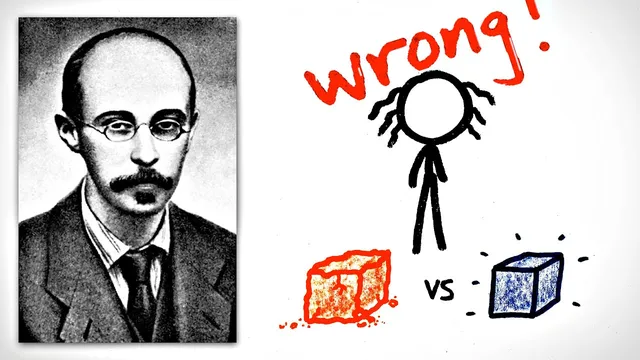
The Man Who Corrected Einstein
Based on minutephysics's video on YouTube. If you like this content, support the original creators by watching, liking and subscribing to their content.
Einstein’s general relativity passed major gravitational checks, but a technical mistake in the cosmological calculation forced a static-universe conclusion.
Briefing
Einstein’s equations of general relativity initially implied a universe that could not expand or contract—but a subtle technical mistake forced him into the wrong “static universe” conclusion. The fix came not from new observations, but from Alexander Friedmann reworking the same framework correctly, showing that the cosmos could be expanding, contracting, or static depending on the amount and balance of matter and energy. That correction mattered because it aligned relativity with the real behavior of the universe later confirmed by evidence: the large-scale universe is expanding.
After developing a more powerful mathematical description of gravity, Einstein tested it against known successes. It reproduced Newtonian gravity where Newton’s law matched experiments, explained Mercury’s orbital anomaly, predicted the bending of starlight by the Sun’s gravity, accounted for gravitational redshift of light climbing out of a gravity well, and even implied that gravitational waves should propagate through empty space. Yet when Einstein applied his equations to the universe as a whole, he predicted a static, unchanging cosmos—and that prediction conflicted with the emerging hints of cosmic recession from distant nebulae.
The root problem was a small but significant error in Einstein’s cosmological calculation. The mistake effectively constrained his equations so that they could not describe expansion or contraction, and it also led to an even more extreme implication: the equations, as handled, would not allow the universe to contain “stuff.” Einstein therefore had to invent a different mathematical workaround to keep his model from collapsing into an empty universe. Even after Friedmann later produced the correct cosmological solutions, Einstein initially failed to recognize the earlier error and published a criticism of Friedmann’s results using the same flawed reasoning.
Friedmann responded with a private, courteous but firm letter, pointing out the correct calculation and asking Einstein either to identify where Friedmann was wrong or to publish a correction. Einstein eventually rechecked the mathematics, accepted Friedmann’s correction, and retracted his earlier critique. In the end, general relativity could indeed describe an expanding or contracting universe, and the specific outcome depends on the density and energy content.
The historical irony is that both men missed the decisive observational era. Friedmann died before conclusive data established expansion, so he never learned which branch of his solutions matched reality. Einstein died before the usefulness of his earlier “workaround” was fully recognized—an approach that later became central to describing dark energy. The episode is often told as a story of Einstein regretting being wrong, but it also highlights a more durable lesson: scientific progress can hinge on admitting error quickly and graciously, especially when deep assumptions and technical complexity make mistakes hard to spot.
Cornell Notes
Einstein’s early cosmology using general relativity produced a static universe because a subtle technical mistake prevented his equations from allowing expansion or contraction. He initially validated the theory against multiple gravitational tests—Mercury’s orbit, light bending, gravitational redshift, and gravitational waves—but his universe-wide calculation went wrong. Alexander Friedmann later corrected the mathematics and found that the universe could expand, contract, or remain static depending on matter and energy balance. Einstein first criticized Friedmann using the same erroneous calculation, then rechecked and retracted his critique once Friedmann’s correction was accepted. The episode matters because it established that relativity supports an expanding universe, later confirmed by observation.
What made Einstein’s cosmological prediction differ from his successful gravity tests?
How did Friedmann change the outcome of Einstein’s equations?
Why did Einstein initially resist Friedmann’s result?
What role did communication play in correcting the scientific record?
What historical irony shaped how each scientist’s story ended?
Review Questions
- What specific kind of error constrained Einstein’s cosmological model, and how did Friedmann’s corrected calculation remove that constraint?
- List at least three gravitational predictions Einstein got right before applying his equations to the universe, and explain why those successes didn’t guarantee the cosmology result.
- How do matter and energy content determine whether Friedmann’s solutions predict expansion, contraction, or a static universe?
Key Points
- 1
Einstein’s general relativity passed major gravitational checks, but a technical mistake in the cosmological calculation forced a static-universe conclusion.
- 2
Einstein’s error effectively prevented his equations from describing expansion or contraction and led to an unphysical implication about the universe containing matter/energy under his handling.
- 3
Alexander Friedmann corrected the mathematics and showed general relativity allows expanding, contracting, or static universes depending on matter–energy balance.
- 4
Einstein initially criticized Friedmann using the same flawed reasoning, then later rechecked the math, accepted Friedmann’s correction, and retracted his critique.
- 5
Friedmann died before observational confirmation of expansion; Einstein died before the later recognition of his workaround’s importance for dark energy.
- 6
The episode underscores that scientific progress often depends on recognizing and admitting errors, even when biases and technical complexity make them hard to spot.