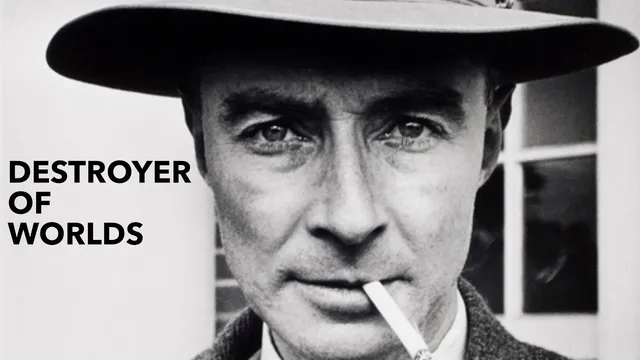
The Man Who Gave us the Power To Destroy Ourselves (Oppenheimer)
Based on Veritasium's video on YouTube. If you like this content, support the original creators by watching, liking and subscribing to their content.
Oppenheimer’s leadership at Los Alamos depended on both scientific credibility and interpersonal influence, even without a Nobel Prize or prior large-scale administrative experience.
Briefing
J. Robert Oppenheimer helped build the atomic bomb—and spent the rest of his life wrestling with the consequences of giving humanity a technology that could end civilization. The work that began as a quest to understand atomic nuclei culminated in the 1945 Trinity test and the bombings of Hiroshima and Nagasaki, while later fears shifted from battlefield use to global catastrophe: an arms race that could spiral into thermonuclear war and, in earlier discussions, even the possibility of triggering runaway fusion in Earth’s atmosphere.
Long before Los Alamos, Oppenheimer’s path was shaped by both brilliance and instability. At 21, he struggled with experimental work and grew absorbed in quantum mechanics, describing lab life as “a terrible bore.” A dark episode followed: he attempted to poison his physics tutor, Patrick Blackett, after being pushed toward experimental tasks he found miserable. Cambridge authorities learned of it, but Julius Oppenheimer intervened to avoid criminal charges, and Robert was allowed to continue under psychiatric counseling.
In 1926, Oppenheimer thrived in Göttingen under Max Born, whose mentorship placed him among the leading architects of quantum theory. Oppenheimer earned his PhD in 1927 and published extensively on quantum theory of continuous spectra. His career later expanded across nuclear physics and quantum field theory, even as colleagues criticized his working style—short on long calculations, heavy on ideas. He never won a Nobel Prize, but his influence grew through people and problem-solving rather than paperwork.
The bomb’s scientific foundation had been laid by a shift in what was thought possible. Early views treated nuclear energy as “moonshine,” and even Einstein doubted nuclear power would ever be obtainable. Yet experiments showed that nuclei could be broken: Cockcroft and Walton split lithium using accelerated protons, while the discovery of the neutron and the idea of neutron-driven chain reactions opened a path toward fission. In 1939, Otto Hahn and Fritz Strassmann’s uranium fission results—reported to Oppenheimer after Louise Alvarez encountered them in a newspaper—forced a rapid reversal. Within days, Oppenheimer moved from disbelief to recognizing that fission could release extra neutrons, enabling a self-sustaining chain reaction.
By 1942, the U.S. government had organized the Manhattan Project under General Leslie Groves, with Oppenheimer selected as science director for Los Alamos. Groves faced practical and political doubts: Oppenheimer lacked administrative experience, had no Nobel Prize, and had Communist Party ties through his wife, Catherine. Still, Groves valued his ability to connect physics with chemistry, engineering, and metallurgy.
The engineering challenge was immense. Uranium-235 required enrichment because most natural uranium is U-238, while plutonium-239 offered a smaller critical mass but demanded an implosion approach to compress the material fast enough. The Trinity test on July 16–17, 1945—delayed by a storm—worked as designed: conventional explosives squeezed the plutonium core, an “urchin” neutron initiator helped kick-start the reaction, and the yield reached nearly 25,000 tons of TNT. Hiroshima followed on August 6 with “Little Boy,” and Nagasaki on August 9 with an implosion device, killing tens of thousands immediately and many more in the months after.
After the war, Oppenheimer became a prominent voice for arms control, opposing the hydrogen bomb. That stance collided with Cold War realities. When the Soviet Union tested its first atomic weapon, U.S. leaders pushed for “The Super,” and Oppenheimer’s opposition helped trigger the suspension of his security clearance in 1953 amid allegations of Communist ties and espionage. He died in 1967, leaving behind a legacy that is both scientific and moral: the same intellect that made the bomb possible also understood how quickly power could outpace restraint.
The transcript closes by widening the lens beyond nuclear weapons, arguing that modern threats—especially climate change—also demand collective action, not just individual mitigation, echoing the central lesson of Oppenheimer’s story: once destructive capability exists, society must decide how to govern it.
Cornell Notes
Oppenheimer’s life traces a line from early struggles and quantum breakthroughs to leadership of the Manhattan Project and the creation of the first nuclear weapons. Scientific momentum accelerated after neutron-driven fission proved real in 1939, leading the U.S. to organize the atomic bomb effort and place Oppenheimer at Los Alamos. The project succeeded through two different designs: a gun-type uranium bomb and an implosion plutonium bomb, culminating in the Trinity test and the bombings of Hiroshima and Nagasaki. Afterward, Oppenheimer argued for arms control and opposed the hydrogen bomb, but Cold War politics led to the suspension of his security clearance. The lasting significance is the moral and strategic risk of technologies that can scale from research to mass destruction.
Why did the bomb program shift from early assumptions about nuclear energy to practical fission weapon design?
What made uranium-235 and plutonium-239 different fuels for a bomb?
How did the Trinity test work at the mechanism level?
What were the early scientific fears that a nuclear test could trigger wider catastrophe?
Why did Oppenheimer’s postwar arms-control stance lead to a security clearance crisis?
How did the transcript connect Oppenheimer’s scientific leadership to the human cost of nuclear weapons?
Review Questions
- What chain-reaction requirement did Szilard identify, and how did later uranium fission results satisfy it?
- Compare the reasons uranium-235 required enrichment and why plutonium-239 required implosion rather than a gun-type design.
- What combination of scientific, political, and ethical factors led to Oppenheimer’s opposition to the hydrogen bomb and his eventual security clearance suspension?
Key Points
- 1
Oppenheimer’s leadership at Los Alamos depended on both scientific credibility and interpersonal influence, even without a Nobel Prize or prior large-scale administrative experience.
- 2
Neutron-driven fission became feasible once experiments showed uranium could split and release extra neutrons, enabling a self-sustaining chain reaction.
- 3
The Manhattan Project pursued two weapon designs because uranium-235 and plutonium-239 differed in availability, critical mass, and reaction timing.
- 4
The Trinity test succeeded through implosion: conventional explosives compressed plutonium, while an “urchin” initiator helped trigger the chain reaction with a burst of neutrons.
- 5
Early fears included the possibility that a fission explosion could ignite fusion in the atmosphere, though scientists largely judged it unlikely.
- 6
After the war, Oppenheimer’s arms-control stance—especially opposition to the hydrogen bomb—collided with Cold War policy and led to surveillance and a security clearance suspension.
- 7
The transcript frames nuclear power as a governance problem as much as a physics problem, linking the bomb’s creation to later ethical and strategic consequences.