The Math Behind a Perfect Basketball Arc
Based on Duddhawork's video on YouTube. If you like this content, support the original creators by watching, liking and subscribing to their content.
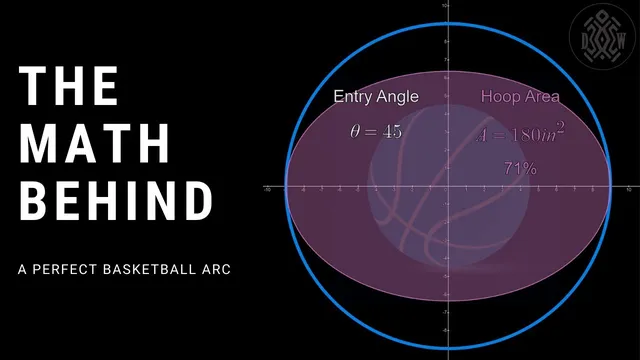
The rim’s physical shape stays circular, but the ball’s perspective turns the opening into an ellipse, changing the effective passing area.
Briefing
A basketball’s “perfect” entry angle isn’t about making the arc as steep as possible; it’s about maximizing the effective opening the rim presents to the ball. The rim stays a circle in the real world, but from the ball’s perspective the opening shrinks into an ellipse as the ball approaches at a slant—meaning the area available for the ball to pass through depends non-linearly on the entry angle.
The analysis starts by treating the ball as a point and the rim as a circular opening. When the ball approaches straight down (an entry angle near 90°), the rim’s projected opening matches the full circular area, proportional to πr². As the entry angle decreases, the projected shape becomes “squashed,” so the ball effectively sees less area than πr². That geometric effect creates a trade-off: steeper angles increase the perceived opening, but extremely steep shots are biomechanically impractical and require unrealistic release speeds.
To ground the geometry in basketball mechanics, the discussion shifts to a 2D side view using a typical free-throw setup: the hoop is about 15 feet away, the release height is about 8 feet, the rim is 10 feet high, and the ball is modeled as a 9-inch sphere. At a near-vertical release (around 90°), the entry angle at the rim is close to 90°, which would maximize the perceived area—but the required speed is roughly 90 feet per second, making it difficult to execute consistently. At the other extreme, very flat shots make the rim “tight” from the ball’s perspective; below a certain release angle, the ball won’t even clear the rim.
A third viewpoint—looking from above the rim—helps quantify the projected area. With the entry angle defined relative to the horizontal, the perceived hoop area is πr² at 90° and drops to zero at 0° (a line-drive approach). At 45°, the perceived area is not half of πr² as a simple guess might suggest; it’s about 180 square inches, roughly 71% of the full area (using a rim radius near 9 inches). The relationship is strongly non-linear: most of the gains in perceived area happen early, in the first half of the entry angle range (from 0° to 90°).
That leads to a practical takeaway: while 90° would maximize the geometric opening, real shots need a balance between available area and shootability. The analysis suggests an entry angle around 45° can be a reasonable compromise, with a workable band roughly in the 45° ± 5° range—enough arc to avoid a “too flat” failure mode, but not so much that the shot becomes mechanically unrealistic. Ultimately, there’s no single universal perfect angle; optimal choices depend on the player, release mechanics, and game context, but thinking in terms of projected area clarifies why both overly flat shots and overly steep shots can underperform.
Cornell Notes
The rim is physically circular, but the ball sees a different shape depending on how it enters the hoop. As the entry angle decreases from straight down, the projected opening shrinks from a circle (area proportional to πr²) into a squashed ellipse, reducing the effective area the ball can pass through. Using a typical free-throw geometry, near-vertical shots maximize perceived area but demand unrealistically high release speeds (around 90 ft/s), while very flat shots can make the rim too tight or even prevent the ball from clearing it. The perceived-area vs. entry-angle relationship is non-linear, with most of the area gains happening between 0° and 45°. A practical compromise is an entry angle near 45°, with a small tolerance (about ±5°), balancing room to score and biomechanical feasibility.
Why does changing the ball’s entry angle change the “size” of the rim even though the rim is still a circle?
What does the model say about the perceived hoop area at 90°, 45°, and 0° entry angles?
Why isn’t the mathematically “best” entry angle (90°) a practical basketball strategy?
How does the trade-off show up when release angles get too flat?
What does the non-linear shape of the area curve imply for choosing an entry angle?
How should a player interpret “optimal” angles in real games?
Review Questions
- If the rim is always a circle in reality, what mathematical/geometric change makes the perceived opening smaller at lower entry angles?
- Using the provided numbers, compare the perceived hoop area at 45° to the full πr² area and explain why a simple “halfway” intuition fails.
- Why does the area-vs-angle curve being non-linear support choosing something near 45° rather than aiming for 90°?
Key Points
- 1
The rim’s physical shape stays circular, but the ball’s perspective turns the opening into an ellipse, changing the effective passing area.
- 2
Perceived hoop area depends non-linearly on entry angle, with large gains happening early as the angle increases from 0°.
- 3
A near-vertical (≈90°) entry maximizes perceived area but requires extremely high release speeds (about 90 ft/s in the model).
- 4
Very flat shots reduce the perceived opening and can cross a threshold where the ball can’t clear the rim.
- 5
A practical compromise is an entry angle around 45°, with a suggested workable band of roughly 45° ± 5°.
- 6
There is no universal perfect entry angle; optimal choices vary with player mechanics and game context.