The Math Behind the 2-4 Rule in Poker
Based on Duddhawork's video on YouTube. If you like this content, support the original creators by watching, liking and subscribing to their content.
Count “outs” precisely—the specific cards that complete or improve your hand to a winning draw.
Briefing
Poker’s “2-4 rule” is a fast way to estimate how often a draw will complete by the river—without doing exact probability math. The core idea is simple: count your “outs” (cards that improve you to a winning hand), then multiply by 4 when you’re on the flop to approximate your chance of hitting by the river. In the example with King Jack suited on a flop that gives two spades and a flush draw, there are nine spades left in the deck that can complete the flush. That’s 9 outs, so the rule estimates a hit probability of 9 × 4 = 36%.
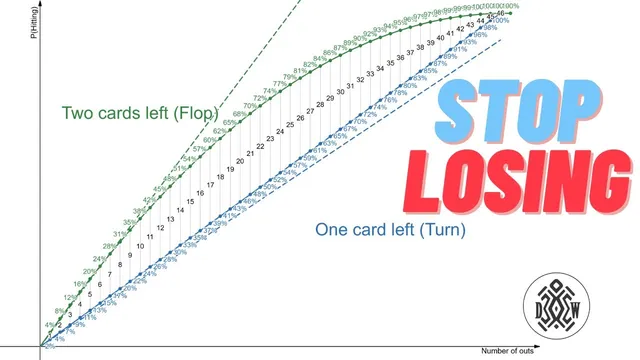
Under the hood, the exact probability comes from a two-step “hit” calculation across the turn and river. With 9 outs on the flop, there are 47 unseen cards after the flop (52 total minus 5 known cards). The chance to miss on the turn is (47 − 9)/47 = 38/47, and if the turn misses, there are 46 cards left for the river, with the chance to hit on the river becoming 9/46. Combining the branches yields an exact “hit by the river” probability of about 34.97%—close to the 36% estimate from the 2-4 rule. The approximation works well because the true probability curve is a parabola, but for typical draw sizes it’s fairly flat enough that a linear shortcut stays accurate.
The transcript also distinguishes when to use the multiplier. On the turn (one card to come), the “2 rule” applies: multiply outs by 2 to estimate the chance of completing the draw on the river. On the flop (two cards to come), the “4 rule” applies: multiply outs by 4. A chart built in Desmos visualizes this: the exact probability forms a downward-curving parabola, while the 2-4 rule is a linear approximation that stays close for smaller out counts (roughly under 9–10 outs) and starts to drift as outs grow.
Finally, the math connects directly to decision-making through expected value (EV). EV is computed as (amount you win × probability you win) − (amount you lose × probability you lose). Using the flush-draw example, the estimated win probability is about 0.36. If the pot is $45 and the bet is $20, the net win is $65 (winning the pot plus accounting for the bet), while the net loss is $20 when the draw misses. With a miss probability around 0.64, the EV comes out to roughly $10.6—meaning that averaged over many repetitions (ignoring later betting complications), calling the bet would be profitable.
In short: count outs, use the 2-4 rule to estimate completion odds quickly, and plug those probabilities into EV to judge whether a call is mathematically sound. The transcript even points to a downloadable PDF from CardsChat for common scenarios like pocket pairs (e.g., Ace-8 with only 3 outs), reinforcing the same outs-to-probability workflow.
Cornell Notes
The 2-4 rule turns “outs” into a quick probability estimate for completing a poker draw. Outs are the specific remaining cards that improve a hand to a likely winner—like the nine remaining spades that complete a flush draw. With two cards to come (on the flop), the rule multiplies outs by 4; with one card to come (on the turn), it multiplies outs by 2. The exact math for a 9-out flush draw gives about 34.97% to hit by the river, close to the 36% estimate from 9×4. Those probabilities then feed into expected value (EV), calculated as (win amount × win probability) − (loss amount × loss probability), to decide whether a call is profitable.
What are “outs,” and why do they matter for the 2-4 rule?
How does the exact probability for a flush draw work on the flop-to-river runout?
Why does the 2-4 rule use 4 on the flop and 2 on the turn?
When does the approximation start to break down?
How does expected value (EV) connect to draw probabilities?
Review Questions
- If you have a draw with n outs on the flop, what approximate probability does the 4 rule give for completing it by the river?
- For a flush draw with 9 outs, what is the exact hit probability by the river (to two decimals), and how does it compare to 9×4?
- How would you compute EV for a call if you know the pot size, bet size, and your estimated probability of hitting?
Key Points
- 1
Count “outs” precisely—the specific cards that complete or improve your hand to a winning draw.
- 2
Use the 4 rule on the flop: approximate chance to hit by the river as outs × 4.
- 3
Use the 2 rule on the turn: approximate chance to hit on the river as outs × 2.
- 4
Exact probability for a draw with n outs can be derived using turn/river branches; for 9 outs it’s about 34.97%, close to the 36% 2-4 estimate.
- 5
The 2-4 rule works well because the true probability curve is a parabola that is nearly linear over common out ranges.
- 6
Expected value (EV) turns draw odds into a decision: EV = (win amount × P(win)) − (loss amount × P(loss)).
- 7
EV calculations assume the payoff amounts and probabilities; additional betting rounds can change the real decision beyond the simplified EV.