The Modular Architecture of Intelligence
Based on Artem Kirsanov's video on YouTube. If you like this content, support the original creators by watching, liking and subscribing to their content.
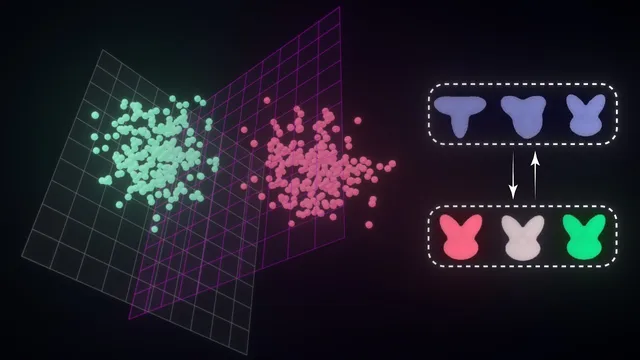
Prefrontal cortex population activity contains separable neural subspaces for features like color and for motor direction, enabling decoding of task-relevant variables from geometry.
Briefing
Biological brains may learn new tasks fast because they reuse stable “modules” of neural computation—then dynamically route and gate information using an internal belief about what rule is currently relevant. Evidence from recordings in monkeys playing a three-part visual discrimination game links compositional learning to concrete geometry in prefrontal cortex activity, showing both reusable subspaces (for color and for motor direction) and a context-dependent mechanism that switches how those subspaces are connected.
The experiment tested a compositionality idea using three tasks built from overlapping ingredients. In S1, monkeys judged shape (bunny vs. T) and moved their eyes along one motor axis. In C2, they judged color (red vs. green) and moved along a different motor axis. In C1, they judged color but moved along the same motor axis used in S1—making C1 a “composition” of the color rule from C2 and the motor output from S1. If the brain truly mixes and matches reusable components, it should not build a brand-new circuit for C1; instead, it should reuse the color-processing machinery and the motor-control machinery already present in other tasks.
Researchers implanted electrodes in prefrontal cortex and recorded activity from hundreds of individual neurons while monkeys performed the tasks. To interpret population activity, they treated each moment as a point in a high-dimensional neural space, where each axis corresponds to one neuron’s firing level. For color, trials with red and green images formed two separable “clouds.” A classifier trained on one task could decode color identity from the neural activity about half a second after stimulus onset. Crucially, color information was decodable in tasks that required color (C1 and C2) but not when monkeys focused on shape in S1, implying that irrelevant features are actively suppressed by the time signals reach prefrontal cortex.
The key compositionality test involved cross-task decoding. If the same color module is reused across tasks, then the neural direction that separates red and green in C2 should also separate them in C1. That cross-decoding worked: classifiers trained on one task generalized to the other, indicating physical reuse of the color subspace. The same pattern held for the motor-related subspace, with movement-direction decoding generalizing between S1 and C1. Together, these results suggest the brain maintains reusable, relatively stable computational “building blocks” as distinct subspaces in neural activity.
Reuse alone doesn’t solve the task; the brain must also connect the right input to the right output. Within single trials, neural activity first entered the color subspace and then flowed into the motor subspace, but the destination depended on context. In C1, the red representation routed to one motor direction; in C2, the same red representation routed to a different motor direction—functioning like a railroad switch controlled by task demands.
Selecting the correct input required another control signal. Because task blocks began without telling monkeys which rule applied, the animals had to infer whether the relevant axis implied a color or shape rule. By decoding this evolving “task belief” from neural activity, researchers found that belief didn’t just correlate with behavior—it reshaped neural geometry. When monkeys increasingly believed they were in the color task, the brain amplified the color subspace (stretching red and green clouds apart) while suppressing the shape subspace (flattening the bunny/T separation). The result is a gain-and-gating mechanism: only relevant information becomes strong enough to drive the routing switchboard.
Overall, the findings support an engineering view of intelligence: the brain maintains a library of reusable neural components for features and actions, then uses a central belief signal to tune which modules dominate and how information is routed. That combination of fixed modules plus flexible control helps explain rapid adaptation to new situations without rebuilding neural hardware from scratch each time.
Cornell Notes
Compositional learning in brains may come from reusing stable neural “modules” rather than relearning everything from scratch. In monkeys, prefrontal cortex population activity contained separable subspaces for color and for motor direction, allowing classifiers to decode red vs. green and movement direction from neural geometry. Cross-task decoding showed that the same color subspace used in C2 also separated red and green in C1, and motor subspaces generalized between S1 and C1—evidence of physical reuse. Within trials, neural activity flowed from the color subspace into the motor subspace, with the routing destination changing by context like a railroad switch. A decoded “task belief” signal acted as a gain knob: it amplified the relevant sensory subspace and suppressed the irrelevant one, sharpening the information that entered routing.
How did the three tasks (S1, C2, C1) test whether neural computation is compositional?
What does “neural subspace” mean in this study, and how was it measured?
What evidence showed that irrelevant information is suppressed in prefrontal cortex?
How did cross-task decoding demonstrate physical reuse of modules?
How did the study show context-dependent routing between subspaces?
What role did “task belief” play, and how did it reshape neural geometry?
Review Questions
- Why would cross-task decoding be expected to succeed if the brain uses compositional modules, and what would failure imply?
- Describe the sequence of neural-state changes within a trial (color subspace entry, then rotation into motor subspace) and explain how context changes the outcome.
- How does a gain knob mechanism (amplifying relevant subspaces and suppressing irrelevant ones) improve decision-making in the presence of multiple sensory features?
Key Points
- 1
Prefrontal cortex population activity contains separable neural subspaces for features like color and for motor direction, enabling decoding of task-relevant variables from geometry.
- 2
Cross-task decoding showed that the same color subspace used in C2 also separates red and green in C1, supporting physical reuse of modules rather than task-specific relearning.
- 3
Motor-related subspaces generalized between S1 and C1, suggesting reusable building blocks for action selection as well.
- 4
Task-irrelevant information is actively suppressed: color decoding fails during shape-focused S1, and shape decoding fails during color-focused C1/C2.
- 5
Within trials, neural activity flows from the relevant sensory subspace into the appropriate motor subspace, with routing destination changing by context like a railroad switch.
- 6
A decoded task-belief signal functions as a gain-and-gating controller, amplifying the relevant sensory subspace and suppressing the irrelevant one to sharpen routing inputs.