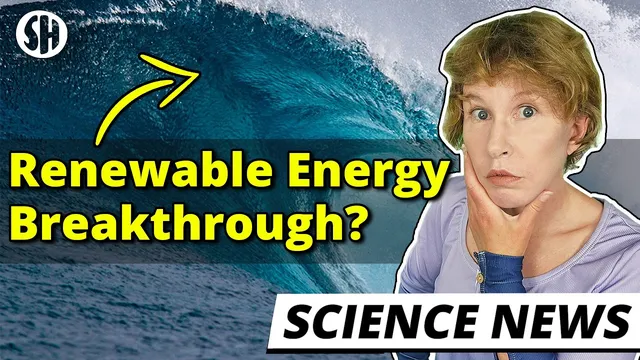
The most amazing renewable energy most people have never heard of
Based on Sabine Hossenfelder's video on YouTube. If you like this content, support the original creators by watching, liking and subscribing to their content.
Wave power converts the ocean’s continuous wave motion into electricity and can operate 24/7 across seasons.
Briefing
Wave power—capturing electricity from the constant motion of ocean waves—has enough theoretical potential to supply a major share of the world’s electricity, and recent grid connections suggest the technology may finally be maturing after years of collapse. The Intergovernmental Panel on Climate Change (IPCC) estimates global wave energy potential at over 30,000 terawatt-hours per year, nearly twice total worldwide electricity consumption. Even though that assumes using all coastlines (an unrealistic ceiling), it signals why wave power keeps returning to the renewable-energy conversation.
Wave energy stands out from solar and wind in two practical ways. First, the ocean produces waves continuously, so wave power can deliver electricity 24/7 across seasons. Second, wave energy tends to peak in winter in higher latitudes, when solar output often lags. It also has higher power density: a square meter of solar panels in good conditions yields roughly 200 watts, while offshore wind typically delivers only a few watts per square meter due to spacing constraints. In high-energy wave fields, a comparable area can produce on the order of 30 to 70 kilowatts.
Despite that promise, wave power “currently delivers basically nothing” because early technology struggled to survive real ocean conditions. The transcript points to a pattern from the early 2000s: wave-energy startups attracted attention, then repeatedly went bankrupt as devices failed in harsh seas. Examples include Palamus, which built a Portugal wave farm that delivered 750 kW in 2008 but had to be towed back after technical problems; Links in Australia, whose large device sank; Fina Vera Renewables, which abandoned a project after a prototype sank in a 2007 storm; and Aquarine Power, which couldn’t secure enough funding to turn its demo into a workable product and went bankrupt in 2015. By the mid-2010s, wave energy was largely “dead,” with the core issue summarized as survivability—devices didn’t last long enough in rough water to justify investment.
What’s changed is design philosophy and funding conditions. Newer companies aim to withstand storms by shutting down safely, submerging during extreme conditions, or moving sensitive components onshore. At the same time, renewable-energy interest has surged, making it easier for startups to raise capital. Several projects now signal a shift from pilots to grid-connected systems: Ecoave Power connected a small wave unit to the grid in Los Angeles (described as the first U.S. grid-connected wave energy system). Core Power Ocean secured €40 million from the EU for a 10 megawatt project off Portugal. In Oregon, the U.S. government completed Parkwave, its first grid-connected wave test site, while pilots proceed in Taiwan, South Korea, and Ireland.
Wave power is not one technology but several approaches. Point absorbers float and convert vertical motion into electricity. Attenuators are long, jointed structures that flex as waves pass. Overtopping devices collect water that runs over the top and drives a turbine. The Danish Wave Dragon is cited as working with an overtopping-style concept and underwater components.
Wave power is unlikely to replace solar or wind, but it could complement them—especially for countries with coastlines—by adding steady, seasonal, high-density generation. If it succeeds, the payoff is straightforward: electricity from an ocean that never stops moving.
Cornell Notes
Wave power extracts electricity from the ocean’s continuous wave motion, which ultimately comes from Earth’s rotation and solar-driven temperature differences. IPCC estimates global wave energy potential at over 30,000 TWh per year—far more than current world electricity use—though practical deployment depends on survivability and cost. Early wave-energy startups repeatedly failed because devices couldn’t withstand rough seas long enough to justify investment, leading to bankruptcies and abandoned prototypes. Newer projects aim to survive storms through shutdowns, submergence, or relocating sensitive parts onshore, alongside improved access to renewable funding. Recent grid-connected milestones in the U.S. and Europe suggest the technology may be entering a more durable, scalable phase.
Why is wave power considered potentially valuable compared with solar and wind?
What made early wave-energy efforts collapse despite big early promises?
How do newer wave-power designs try to avoid those failures?
Which grid-connected milestones signal momentum for wave power?
What are the main wave-energy technology types mentioned?
Review Questions
- What two physical characteristics of waves make wave power potentially complementary to solar and wind?
- Describe the survivability challenge that derailed early wave-energy startups and give two examples mentioned.
- How do point absorbers, attenuators, and overtopping devices differ in how they convert wave motion into electricity?
Key Points
- 1
Wave power converts the ocean’s continuous wave motion into electricity and can operate 24/7 across seasons.
- 2
IPCC estimates global wave energy potential at over 30,000 terawatt-hours per year, far exceeding current electricity demand, though full coastline use is unrealistic.
- 3
Wave energy can be strongest in winter at higher latitudes because waves are driven by temperature differences that peak when solar output slows.
- 4
Early wave-energy companies repeatedly failed because devices couldn’t survive rough seas long enough to justify investment, leading to bankruptcies and abandoned prototypes.
- 5
Newer designs target survivability through storm shutdowns, submergence, and moving sensitive components onshore.
- 6
Recent grid-connected projects—such as Ecoave Power in Los Angeles and Parkwave in Oregon—suggest wave power is moving from pilots toward operational testing.
- 7
Wave power is not a single method; point absorbers, attenuators, and overtopping devices use different mechanical strategies to capture energy.