The Most Controversial Idea In Math
Based on Veritasium's video on YouTube. If you like this content, support the original creators by watching, liking and subscribing to their content.
The axiom of choice formalizes the ability to make infinitely many selections at once from nonempty sets, even when no explicit rule for the selections exists.
Briefing
A single “obvious” rule about making infinitely many selections—known as the axiom of choice—has become one of math’s most controversial ideas because it enables proofs that also generate results that feel physically and intuitively impossible. The core tension is that choice lets mathematicians assert that a selection exists even when no explicit method can be given. That power is exactly what allows the real numbers to be well-ordered, but it also leads to constructions like non-measurable sets and even paradoxical-sounding decompositions of a ball into finitely many pieces that can be rearranged into two identical balls.
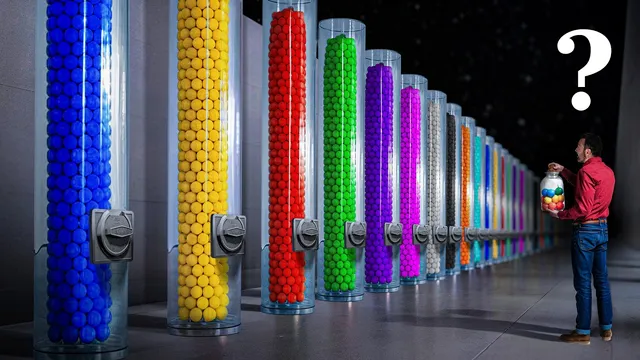
The controversy begins with the problem of selection in infinite collections. In everyday life, choosing “at random” is a human act; in mathematics, randomness isn’t truly available because formulas deterministically produce outputs. For finite sets, picking an element from each set is straightforward—follow a rule, or just pick something. For infinite sets, especially uncountable ones like the real numbers, there may be no smallest element and no consistent step-by-step procedure that tells you which element to pick next. The axiom of choice formalizes the missing permission: given infinitely many nonempty sets, it is possible to choose one element from each set simultaneously, even if the choices can’t be explicitly described.
Georg Cantor’s work set the stage. Cantor showed that some infinities are larger than others using diagonalization: the real numbers between 0 and 1 cannot be paired one-to-one with the natural numbers. He then pursued a deeper goal—well-ordering—where every subset has a first element. Natural numbers fit easily, and integers can be well-ordered by absolute value. But well-ordering the real numbers required something stronger than Cantor could prove. His well-ordering theorem was eventually established by Ernst Zermelo in 1904, and it hinged on the axiom of choice. Zermelo’s method doesn’t construct an explicit ordering; it proves one must exist by repeatedly selecting elements from shrinking subsets, with the axiom guaranteeing that the necessary selections are possible.
The backlash was swift. Giuseppe Vitali used choice in 1905 to build a set of points in the interval [0,1] that cannot be assigned a consistent length or measure. The argument relies on partitioning real numbers into equivalence classes based on rational differences, then choosing one representative from each class. When those representatives are shifted by all rational numbers in a range, they cover [0,1] without overlap—yet the “size” arithmetic becomes impossible, forcing the set to be non-measurable.
Even more unsettling, Stefan Banach and Alfred Tarski in 1924 proved a ball can be cut into five pieces and reassembled into two balls identical to the original, and iterated to generate infinitely many balls. The catch is that the required pieces are non-measurable, so the paradox lives in the gap between mathematical existence and physical constructibility.
For decades, mathematicians argued about whether choice was legitimate. The resolution came from logic: Kurt Gödel showed that if the standard axioms of set theory are consistent, then choice can be added without contradiction; Paul Cohen showed the opposite direction—that choice can also be removed while keeping consistency. In other words, choice is independent: it can’t be proved or disproved from the other axioms. The modern takeaway is pragmatic rather than dogmatic. The axiom of choice is optional, but choosing it changes what kinds of objects and theorems are available—often making proofs shorter and more powerful, while also permitting results that defy naive notions of size and construction.
Cornell Notes
The axiom of choice lets mathematicians select one element from each set in an infinite collection, even when no explicit rule tells which element to pick. Georg Cantor’s diagonalization showed that infinities differ in size, and his well-ordering ambitions for the real numbers ultimately required Zermelo’s 1904 proof using choice. That same axiom enables constructions like Vitali’s non-measurable set, where “length” cannot be consistently defined, and Banach–Tarski paradoxes where a ball can be cut and rearranged into two identical balls using non-measurable pieces. Logic later proved choice is independent: it can’t be derived from the other standard axioms, nor can it be ruled out without changing the underlying set-theory universe.
Why can’t mathematicians always “just pick the smallest” element when dealing with the real numbers?
What does Cantor’s diagonalization prove about the size of infinities?
How does Zermelo’s well-ordering proof rely on the axiom of choice?
Why does Vitali’s construction force a set to be non-measurable?
What makes the Banach–Tarski “ball duplication” paradox possible?
How did Gödel and Cohen settle the axiom of choice debate?
Review Questions
- What specific selection problem arises when trying to define a “next” real number after 1, and how does that motivate the axiom of choice?
- How does diagonalization demonstrate that the real numbers between 0 and 1 cannot be listed in a complete one-to-one correspondence with the natural numbers?
- Why do Vitali’s and Banach–Tarski constructions depend on non-measurable sets, and what does that imply about interpreting “size” in these results?
Key Points
- 1
The axiom of choice formalizes the ability to make infinitely many selections at once from nonempty sets, even when no explicit rule for the selections exists.
- 2
Cantor’s diagonalization proves that the real numbers are uncountably infinite, larger than the natural numbers.
- 3
Zermelo’s well-ordering theorem for the real numbers uses the axiom of choice to guarantee an ordering exists, without constructing it explicitly.
- 4
Vitali’s non-measurable set shows that choice can produce sets where “length” or measure cannot be consistently defined.
- 5
Banach–Tarski results enable a ball to be cut and rearranged into two identical balls because the required pieces are non-measurable.
- 6
Gödel and Cohen proved the axiom of choice is independent of the other standard axioms of set theory: it can’t be proved or disproved without changing the underlying system.
- 7
Choice remains widely used because it often shortens proofs and enables results that are difficult or impossible to obtain otherwise, despite producing counterintuitive objects.