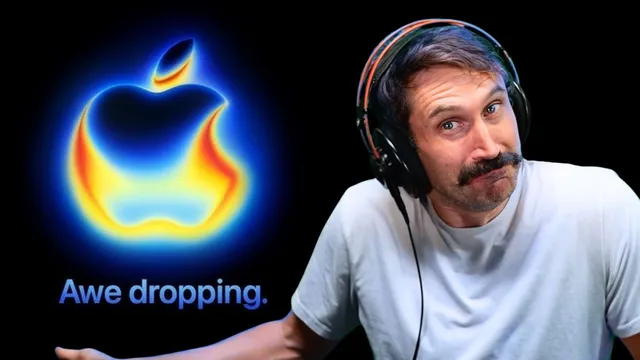
The Most Insightful Apple Commentary | The Standup
Based on The PrimeTime's video on YouTube. If you like this content, support the original creators by watching, liking and subscribing to their content.
The iPhone strap/satchel is framed as a visibility-and-status accessory that turns phone ownership into a public flex.
Briefing
Apple’s latest product push—mocked and dissected in a fast, joke-heavy roundtable—centers on turning everyday tech into visible status symbols, then layering on “premium” features that sound transformative but may land as gimmicks in real life. The most discussed example is an iPhone “strap”/satchel concept: instead of hiding the phone, it keeps it on display like a fashion accessory. That shift reframes convenience into flex culture—an iPhone as a wearable billboard for “latest Pro” ownership—while raising practical questions about who would actually carry it and how it would affect safety, especially in cities known for phone theft.
The group’s skepticism isn’t about Apple charging money; it’s about Apple’s priorities. A satchel that makes the phone harder to keep out of sight is treated as a monetization win for Apple (and a potential public-relations misstep), with comparisons to luxury “whale” marketing—special cases, special access, and pay-to-flex tiers. Even the discussion of Apple’s testing and engineering claims (like scratch resistance demonstrations) gets reframed as theatrical: elaborate simulations are praised as entertaining, but the participants keep asking what real-world scenario the tests actually represent.
On the feature side, the conversation latches onto AirPods “live translation” as the most exciting innovation—especially for travel. Yet the excitement quickly collides with doubts about accuracy and usefulness. Translation tech is portrayed as historically unreliable, and the group wonders whether it will merely amplify awkward moments (wrong phrasing, robotic delivery, or noise-canceling that makes conversations harder). There’s also a broader critique of “premium travel fantasy,” where constant translation becomes a lifestyle accessory rather than a practical tool. The participants argue that people don’t actually want to be dependent on automated translation in everyday settings; they want clarity when someone mumbles, or they want audio boosted rather than replaced.
Underneath the jokes is a recurring theme: Apple is betting on on-device AI and “local models,” but public adoption of AI features remains unclear. The roundtable notes that many users keep “Apple Intelligence” off, and that the most compelling real-world uses so far are photo-focused (like editing and combining images) rather than AI assistants that summarize text or generate outputs on demand. Hardware acceleration—discussed in terms of GPU changes and “matt mole”/AI-related compute—signals Apple is preparing for more capable on-device models, but the group treats the current AI pitch as forward-looking rather than immediately compelling.
The episode also veers into tech culture: comparisons to Android and Meta’s translation/AR ecosystems, debates about whether Apple’s status-driven approach will become trendy or just attract theft and ridicule, and a side detour into AI hype-cycle conspiracies. Still, the throughline stays consistent: Apple’s strategy is to package hardware, AI, and services into a premium identity—sometimes landing as clever, sometimes as performative, and often as a bet that users will accept the tradeoffs for the brand experience.
Cornell Notes
Apple’s newest product direction is portrayed as status-first: a phone “strap”/satchel keeps the iPhone on display, turning ownership into visible flexing rather than convenience. The group questions whether that will be stylish or practical, citing safety concerns and the likelihood that theft risk rises when phones are openly worn. AirPods live translation is treated as the most genuinely exciting feature, but doubts persist about accuracy, real-world usefulness, and whether it will replace normal communication or just create awkward moments. Meanwhile, Apple’s on-device AI push (“Apple Intelligence”) is framed as still early—many users keep it disabled, and the most convincing use cases are photo edits rather than assistant-style features. Overall, the conversation paints Apple as monetizing identity while preparing hardware for future AI adoption.
Why does the iPhone strap/satchel idea become a “flex” rather than a convenience product in this discussion?
What practical objections are raised about wearing a phone on a string around the neck?
What makes AirPods live translation both appealing and questionable?
How does the discussion connect Apple’s AI hardware upgrades to real user behavior?
How do comparisons to other ecosystems shape the critique of Apple’s “premium” approach?
Review Questions
- Which parts of the strap/satchel concept are treated as status signaling, and which parts are treated as practical risks?
- What specific concerns are raised about live translation accuracy and audio behavior in noisy, real-world settings?
- Why does the group think on-device AI readiness (hardware acceleration) may not translate immediately into user enthusiasm?
Key Points
- 1
The iPhone strap/satchel is framed as a visibility-and-status accessory that turns phone ownership into a public flex.
- 2
Safety concerns are central to the satchel critique, with predictions that openly worn phones could increase theft risk in major cities.
- 3
AirPods live translation is treated as the most exciting feature, but skepticism centers on translation accuracy and whether it will help or hinder real conversations.
- 4
Apple’s on-device AI push is portrayed as early-stage adoption: many users keep Apple Intelligence disabled, and the most useful functions mentioned are photo-editing tools.
- 5
Hardware acceleration for AI (discussed via GPU-related changes and “local model” language) suggests Apple is preparing for future on-device models, even if current features feel more forward-looking than essential.
- 6
The roundtable repeatedly compares Apple’s claims to existing competitors’ translation/AI capabilities, arguing Apple may be selling a premium narrative more than a unique breakthrough.
- 7
The scratch-resistance and durability demonstrations are treated as entertaining but questioned for how directly they map to real-world damage scenarios.