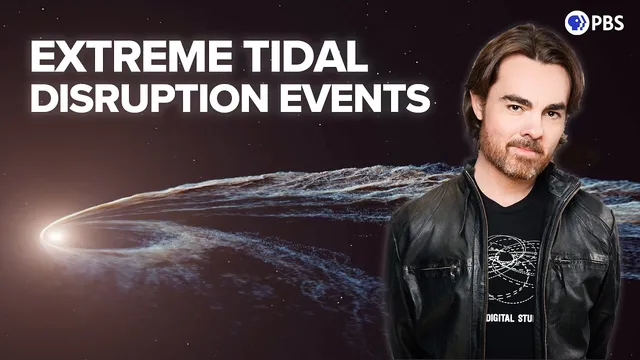
The NEW PHYSICS of Black Hole Star Capture | Extreme Tidal Disruption Events
Based on PBS Space Time's video on YouTube. If you like this content, support the original creators by watching, liking and subscribing to their content.
A star’s fate near a supermassive black hole depends on whether its orbit crosses the tidal radius and/or the event horizon.
Briefing
Tidal disruption events (TDEs) turn a star into a brief, galaxy-bright flare—and new relativistic simulations are now predicting an even rarer, more extreme class that could let astronomers probe the region just outside a black hole’s event horizon. The key insight is that the closer a star’s orbit carries it to the black hole, the more the event’s timing, brightness, and spectrum change in ways that can be matched to observations. That makes TDEs not just spectacular fireworks, but potential tools for testing how gravity behaves in warped spacetime.
When a star approaches a supermassive black hole, the gravitational pull differs across the star’s diameter, creating tidal forces that stretch the star toward the black hole and compress it sideways. Once the star crosses a critical “tidal radius,” those tidal forces overwhelm the star’s self-gravity. The result is “spaghettification”: the star becomes a fluid-like stream, with some debris flung outward and the rest falling back and heating as it spirals inward. Because the Milky Way’s Sagittarius A* has not yet produced a confirmed TDE, astronomers rely on candidate events in other galaxies and on computer models that reproduce what those flares should look like from Earth.
Modeling TDEs requires moving beyond Newtonian gravity. Near black holes, Einstein’s general relativity reshapes spacetime and twists orbital paths, eliminating stable orbits within certain distances and making trajectories more chaotic—especially around rotating black holes. Simulations therefore track geodesic motion in a warped spacetime rather than simple force-based orbits. After disruption, the debris is no longer a single object; it becomes a relativistic fluid, demanding relativistic hydrodynamics, radiation effects, and gravitational lensing to determine how light escapes and reaches observers.
The simulations distinguish several outcomes based on orbital proximity. If a star crosses the event horizon (the Schwarzschild radius for non-rotating black holes), it can be swallowed directly as a “direct capture event,” typically producing little electromagnetic signal. If the star passes close enough to shed mass but not cross the tidal radius, it can become a “partial TDE,” losing outer layers while the core survives and settles back.
The most commonly observed “common” TDE happens when the star crosses the tidal radius but avoids direct capture. In a representative scenario—an approximately three-solar-mass star passing near a 100,000-solar-mass black hole—the debris expands into a plume, then falls back. The returning stream forms an elliptical “snake biting its tail” orbit, with a sharp “nozzle shock” at closest approach that can generate observable flares. These events often brighten over about a month and fade over months, with most emission in visible wavelengths.
Simulations now predict an “extreme TDE” (eTDE) for orbits that skim very near the event horizon—around 2 to 3 Schwarzschild radii for a non-rotating black hole. In this regime, some of the star is directly captured within seconds, while the rest whips around the black hole multiple times, circularizes into a compact ring, and builds a long-lived accretion disk. As accretion powers radiation, luminosity rises rapidly until it reaches the Eddington limit, creating a temporary equilibrium before gravity wins again. The predicted observational signature is faster evolution—brightening over only a few hours for a million-solar-mass black hole—plus a spectrum dominated by X-rays, with luminosity roughly an order of magnitude higher than common TDEs.
Because eTDEs require very close approaches, they should be rarer and tend to occur around larger black holes. For a 20 million-solar-mass black hole, one estimate places the rate at about one per 15,000 years. Detecting them will likely require wide monitoring in X-rays. eROSITA, an X-ray survey instrument on Spektr-RG, resumed operations after a 2022 suspension and is expected to complete its survey soon, raising the odds of catching the first eTDEs—and, with them, a rare observational window into matter orbiting just outside an event horizon and the physics of gravity in the most extreme spacetime environments.
Cornell Notes
Tidal disruption events occur when a star ventures inside a black hole’s tidal radius, letting differential gravity tear it apart and produce a bright flare. Modeling these events requires general relativity (warped spacetime, no stable close orbits) plus relativistic hydrodynamics and radiation transport, since the debris becomes a fast-moving fluid and light is gravitationally lensed. Simulations reproduce common TDEs, where debris falls back on an elliptical orbit and a “nozzle shock” can power visible flares over weeks. New work predicts an extreme TDE (eTDE) for orbits skimming just a few Schwarzschild radii from the event horizon: partial direct capture, rapid circularization into a ring, Eddington-limited luminosity, and a much faster, X-ray–dominated flare. If eROSITA completes its X-ray survey, it may finally provide the observational data needed to identify the first eTDEs and test gravity near the horizon.
What physical threshold determines whether a star is torn apart, partially stripped, or swallowed whole?
Why do Newtonian gravity simulations fall short for TDEs near black holes?
How do common TDEs produce observable light, and what sets their timescale?
What changes in an extreme TDE (eTDE) compared with a common TDE?
Why should eTDEs be rarer, and how does black hole mass affect their detectability?
What observational strategy could catch the first eTDEs?
Review Questions
- How do the tidal radius and event horizon jointly determine whether a TDE is common, partial, or a direct capture event?
- Compare the predicted light-curve evolution of common TDEs versus eTDEs, including the expected wavelength bands.
- What role does the Eddington luminosity play in the simulated behavior of an extreme tidal disruption event?
Key Points
- 1
A star’s fate near a supermassive black hole depends on whether its orbit crosses the tidal radius and/or the event horizon.
- 2
TDEs require general relativity for accurate orbital dynamics because warped spacetime and geodesic motion replace Newtonian force-based trajectories near the black hole.
- 3
After disruption, debris behaves like a relativistic fluid, so simulations must include relativistic hydrodynamics, radiation effects, and gravitational lensing of escaping light.
- 4
Common TDEs typically brighten over about a month for a million-solar-mass black hole, with visible-wavelength emission driven by a “nozzle shock” during debris fallback.
- 5
Extreme TDEs are predicted for orbits within roughly 2–3 Schwarzschild radii, producing rapid brightening over hours and X-ray–dominated spectra.
- 6
eTDEs should be rarer because they require very close approaches and tend to occur around larger black holes, which are themselves less common.
- 7
eROSITA’s resumed X-ray survey operations may provide the wide-field monitoring needed to detect the first eTDEs.