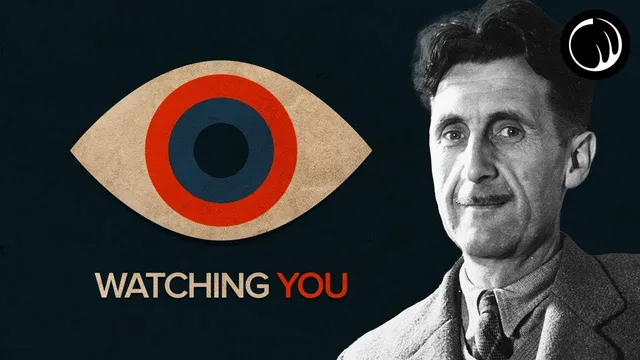
The Paradox of Being a Good Person - George Orwell's Warning to the World
Based on Pursuit of Wonder's video on YouTube. If you like this content, support the original creators by watching, liking and subscribing to their content.
Orwell’s warning centers on the abandonment of objective truth and the replacement of shared reality with ideology-driven “party lines.”
Briefing
George Orwell’s central warning is that societies slide toward totalitarian control when objective truth is abandoned and language becomes a tool for manipulating reality—regardless of whether the ruling ideology claims to be left-wing or right-wing. In that environment, truth stops being something people can verify together and becomes something the state can rewrite, making citizens’ beliefs malleable and easy to steer. Orwell saw this pattern most sharply through the distortions of wartime reporting and propaganda, and he treated it as a threat to freedom that could emerge even when intentions appear “noble” or democratic on the surface.
Orwell’s path to that warning runs through a life marked by discomfort with institutions and a fixation on ordinary people. Born Eric Arthur Blair in 1903 in Bengal (then part of the British Empire), he later adopted the pseudonym George Orwell to protect his family. His education brought both scholarships and ridicule, and his early work in the British Imperial service—especially as a colonial police officer in Burma—left him disillusioned enough to resign after five years. In Paris and London, he took low-paying jobs and developed a strong attachment to “ordinary life,” while growing suspicious of intellectual fashions. That tension—between disdain for elite posturing and a deep understanding of how power works—became fuel for his writing.
The turning point came in 1936 when Orwell traveled to Spain as a journalist covering the Spanish Civil War, then joined the Republican militia against fascists. He later described being shot in the throat, but the deeper shock was what he saw in how the conflict was reported: battles reported without fighting, massacres met with silence, brave troops labeled cowards, and “heroes” credited for victories that never happened. The pattern wasn’t just lying; it was history being rewritten according to “party lines,” replacing objective truth with ideological “subjective truths.” Orwell argued that this abandonment of truth-writing makes totalitarianism more likely—because if truth lives only in minds, it can be reshaped by authority.
Orwell’s response was to use literature as a weapon against that drift. He aimed to turn political writing into art by exposing specific lies and facts that demanded attention. Animal Farm (1945) delivered the warning through allegory: a farm revolution led by pigs Old Major, then dominated by Snowball and ultimately Napoleon, who uses manipulation, violence, and propaganda to become indistinguishable from the humans the animals overthrew. The story’s power lies in its ability to generalize beyond any single revolution while keeping the message accessible.
In 1984 (1949), the threat becomes a system. Oceania’s Party—led by Big Brother—monitors citizens through telescreens, punishes “thoughtcrime,” and rewrites reality through propaganda and newspeak, including slogans like “War is Peace; Freedom is Slavery; Ignorance is Strength.” The result is doublethink, where people hold contradictory beliefs while accepting the Party’s version of truth. Orwell’s bleak endings are less a promise of hopelessness than a warning that the future can reproduce the same mechanisms.
Orwell is often invoked today under the label “Orwellian,” but the transcript stresses that his target wasn’t socialism itself—it was totalitarianism, whatever its origin. The lasting relevance is the psychological and linguistic mechanism: when language and information are controlled, citizens can be trained to surrender freedom from the inside. The closing takeaway is direct: tyranny depends on people, and the moral is to prevent it before it becomes normal.
Cornell Notes
Orwell’s core warning is that societies move toward totalitarian control when objective truth is discarded and language and information are manipulated to serve power. In Spain during the Spanish Civil War, Orwell saw reporting that erased facts and replaced them with “party lines,” convincing him that truth-writing was being abandoned. He used literature to counter that drift: Animal Farm (1945) shows how revolutions can be captured by leaders who use propaganda and violence, while 1984 (1949) depicts a state that surveils citizens, criminalizes thought, and rewrites language through newspeak. The message matters because the same psychological and linguistic tools can undermine freedom regardless of whether the ruling ideology claims to be left or right.
What did Orwell see in Spain that convinced him truth was being replaced by ideology?
How does Animal Farm explain the way revolutions can turn into the very oppression they overthrow?
What mechanisms in 1984 keep citizens from resisting the Party’s version of reality?
Why does the transcript emphasize that “Orwellian” is not just about socialism or left-right politics?
What does Orwell’s life story add to his warning about truth and power?
Review Questions
- Which specific examples of distorted reporting in Spain convinced Orwell that objective truth was being abandoned?
- How do newspeak and doublethink function together in 1984 to prevent effective resistance?
- In what ways does Animal Farm’s pig leadership mirror the human power the animals originally revolted against?
Key Points
- 1
Orwell’s warning centers on the abandonment of objective truth and the replacement of shared reality with ideology-driven “party lines.”
- 2
Propaganda that rewrites events can make history feel correct to insiders while erasing what actually happened.
- 3
Totalitarianism is portrayed as a system that controls freedom by controlling information, language, and even permissible thought.
- 4
Animal Farm uses allegory to show how revolutions can be captured by leaders who use manipulation and violence to consolidate power.
- 5
1984 depicts a surveillance-and-language regime where telescreens, thought police, newspeak, and doublethink work together to neutralize dissent.
- 6
“Orwellian” is framed as a description of power’s methods—especially distortion of language and information—rather than a simple label for any one political ideology.
- 7
Orwell’s moral takeaway is that preventing tyranny is an individual responsibility: “It depends on you.”