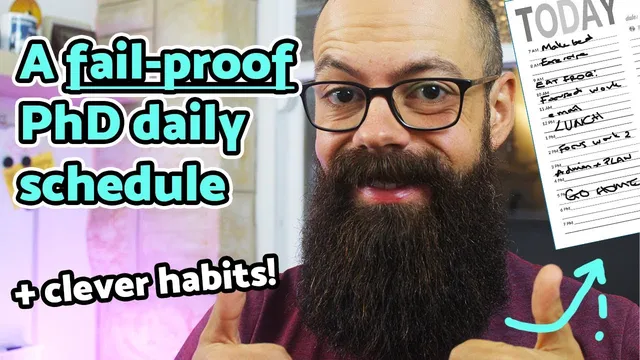
The PERFECT PhD daily schedule and clever habits!
Based on Andy Stapleton's video on YouTube. If you like this content, support the original creators by watching, liking and subscribing to their content.
Start the day with cue-based habits (e.g., making the bed) to create momentum before any lab or office work begins.
Briefing
A “perfect” PhD day is less about finding inspiration and more about locking in a repeatable routine: start the morning with small wins and mental reset, then spend the first hours of the day doing the hardest task in deep, uninterrupted blocks. The payoff is straightforward—big, anxiety-inducing work gets done early, leaving the rest of the day for lighter tasks and reducing the mental load that comes from letting major deadlines loom.
The schedule begins before any lab or office time. On waking, the routine should trigger momentum immediately—making the bed is offered as a simple example of a cue-based habit that sets the mind on the right track. Exercise is positioned as a mental-health lever: running three times per week (roughly 5 to 15 kilometers) is described as producing clarity and an endorphin-driven lift, with the practical takeaway that even a walk can deliver benefits. Breakfast is treated as an experiment as much as a meal; one approach mentioned is eating only fruit until midday, chosen more for perceived energy than for established evidence. Meditation is also built in via apps such as Insight Timer, Headspace, and Calm, with the claim that even 10 minutes can lower morning anxiety and improve readiness for whatever the day brings.
Once in the lab or office, the core rule is “eat the frog”: identify the single task that feels worst or most anxiety-provoking and do it first. Email and social media are explicitly pushed later—one practice is delaying email checks until the afternoon. If the “frog” is large, the method is to work on it for at least an hour, breaking it into incremental progress toward the bigger goal (writing, lab work, reading, or planning experiments).
After that first decisive block, the day shifts into deep work. The routine recommends about 1 to 1.5 hours of focused work—aligned with Cal Newport’s “deep work” concept—using noise masking (white/brown/green noise) to stay productive in open-office environments. This deep-work block is treated like a muscle: start smaller (even 40 minutes) and build up over time.
Lunch is protected as a reset, ideally lasting around an hour and involving conversation rather than eating at a desk. The afternoon repeats the structure: another 1 to 1.5 hours of focused, goal-advancing work, followed by “shitty jobs” such as emails, admin, paperwork, OHS forms, ordering supplies, and meetings with supervisors or students. The guiding principle is to avoid task-hopping during deep work; humans dislike monotony, but sustained focus on one task type helps thesis progress.
Finally, the habits section stresses two psychological points: don’t wait for motivation—design cues and rewards so the next action happens automatically—and when overwhelm hits, shrink the task until it takes about two minutes (e.g., open a document, write headlines, or outline). The overall message is that a PhD is a marathon, so consistent daily execution beats bursts of effort.
Cornell Notes
The routine centers on doing the hardest, most anxiety-provoking task first (“eat the frog”), then protecting deep work time early in the day. Morning habits—making the bed, exercising, eating a simple breakfast strategy, and using meditation apps—are framed as mental-health and focus foundations that reduce daily friction. In the lab or office, email and social media are delayed until after 1–1.5 hours of deep work, using tools like noise masking to maintain concentration. Lunch functions as a deliberate break for conversation and collaboration. The afternoon finishes with admin and paperwork after goal-focused blocks, and overwhelm is handled by shrinking tasks to a two-minute starting step so momentum can kick in.
What does “eat the frog” mean in a PhD context, and why does it matter?
How does the schedule use deep work to move a PhD forward?
Which morning habits are suggested before any lab or office work begins?
Why delay email and social media in this schedule?
How should lunch and the afternoon be structured to keep progress steady?
What’s the recommended response when tasks feel overwhelming?
Review Questions
- If you had to choose one “frog” task each morning, what criteria would you use to identify it from your to-do list?
- How would you adapt the deep-work block length if you currently can only focus for 30–40 minutes?
- What specific cue-and-reward change would you make to prevent email from becoming the default first action when you sit down?
Key Points
- 1
Start the day with cue-based habits (e.g., making the bed) to create momentum before any lab or office work begins.
- 2
Use exercise and meditation as morning mental-health tools to reduce anxiety and improve clarity.
- 3
Arrive at work and immediately do the single most anxiety-provoking task (“eat the frog”) before checking email or social media.
- 4
Schedule 1–1.5 hours of deep work early, focusing on one task type per block and using noise masking if needed.
- 5
Protect lunch as a real break—ideally about an hour with conversation—to refresh attention and support collaboration.
- 6
Handle admin and paperwork after goal-advancing work so deep work stays intact and thesis progress doesn’t get fragmented.
- 7
When overwhelmed, shrink the next step to a two-minute action to trigger momentum instead of waiting for motivation.