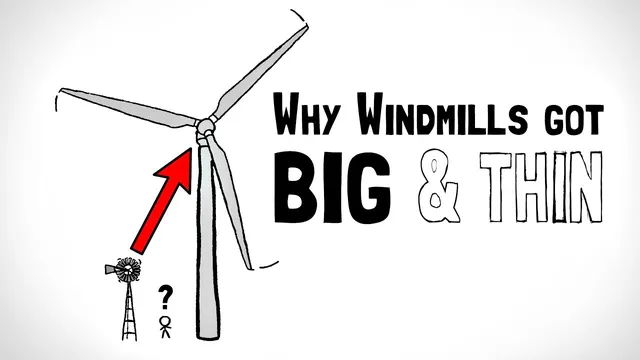
The Physics of Windmill Design
Based on minutephysics's video on YouTube. If you like this content, support the original creators by watching, liking and subscribing to their content.
Wind turbines must balance energy extraction with allowing airflow to continue; even an ideal rotor captures only about 59% of wind kinetic energy.
Briefing
Windmill design comes down to a three-part physics tradeoff: capturing as much wind energy as possible while still letting enough air pass through to keep the windmill turning. Climate change helps explain why wind power has attracted massive engineering investment, but it doesn’t tell engineers what “good” looks like. The core criteria are size, blade count, and blade shape—each constrained by how wind energy is converted into rotation without choking the airflow.
Bigger and taller windmills generally win on energy access. A larger swept area intercepts more wind, and mounting higher reduces turbulence and obstructions near the ground, where wind speeds are typically lower. More wind speed and more area both increase the amount of kinetic energy available to extract. But windmills face a built-in paradox: extracting too much energy would slow the wind so much that incoming air can’t keep flowing. In the idealized limit, a windmill can’t capture more than about 59% of the wind’s kinetic energy; the rest must remain in the passing airflow.
That limit forces a second tradeoff between blade speed and blade coverage. If the windmill extracts energy aggressively, it slows the wind; if it slows the wind too much, it reduces the total power available. The result is a choice between fast-moving blades that cover less area and slow-moving blades that cover more area. The physics behind this mirrors airplane wings: a faster-moving blade “catches” more of the wind, producing more effective turning force per unit of blade area. Roughly, fast rotors can use fewer, thinner blades, while slow rotors can use more, wider blades.
Modern wind turbines largely favor the fast, narrow-blade approach—but not because slower is inherently worse. The deciding factor is Newton’s third law. As blades are pushed sideways by the wind to spin, they push back on the air, imparting a reverse twist and giving the wind some rotational kinetic energy. That rotational energy is energy the turbine doesn’t capture. The most efficient design minimizes the twist imparted to the wind, and that leads to a counterintuitive conclusion: faster blade motion can reduce the rotational energy transferred back to the airflow. The transcript compares this to a ball bouncing off a moving block—when the block already moves in the same direction, it can absorb more of the ball’s energy during acceleration.
Blade speed also ties into practical geometry. For decent efficiency, a blade should move through the air at least about five times faster than the incoming wind speed, though different points along the blade move at different speeds, so blade shape must vary along its length. In summary, an ideal power-generating windmill is giant and tall to access strong, energetic wind; fast to improve efficiency under the airflow constraints; and narrow-bladed—often just a few blades—so the rotor doesn’t slow the wind too much while still producing torque.
The segment ends by noting the broader push for renewable energy and grid/storage expansion, and it credits a partnership with Bill Gates, inspired by his book “How to Avoid a Climate Disaster.”
Cornell Notes
Wind turbines are designed around a physics constraint: they must extract energy from moving air without stopping the wind. Even an ideal windmill can capture only about 59% of the wind’s kinetic energy, so some energy must remain in the airflow that passes through. That cap creates a tradeoff between rotor speed and blade area—fast rotors can use fewer, thinner blades, while slow rotors need more, wider blades to intercept enough wind. Efficiency also depends on Newton’s third law: the blades push back on the air, twisting it and giving the wind rotational kinetic energy the turbine can’t use. Minimizing that wasted twist helps explain why modern turbines often spin faster and use narrower blades.
Why can’t a windmill extract all the wind’s kinetic energy?
How do size and height increase the power a wind turbine can capture?
What tradeoff links blade speed to blade area?
Why does Newton’s third law push designers toward faster rotation?
What does the “five times faster” guideline mean for blade design?
Review Questions
- What physical limit (with a specific percentage) constrains the maximum energy a windmill can extract from wind?
- How do blade speed and blade area trade off, and why does that tradeoff follow from how blades interact with airflow?
- Explain how Newton’s third law leads to “wasted” rotational kinetic energy in the wind and how that affects efficiency.
Key Points
- 1
Wind turbines must balance energy extraction with allowing airflow to continue; even an ideal rotor captures only about 59% of wind kinetic energy.
- 2
Larger swept area and greater height increase available wind energy by intercepting more air and accessing faster winds.
- 3
A fundamental efficiency tradeoff exists between blade speed and blade coverage: fast rotors can use fewer, thinner blades, while slow rotors need more, wider blades.
- 4
Newton’s third law implies blades transfer rotational kinetic energy back to the air; efficient designs minimize that reverse twist.
- 5
Modern turbines often spin faster because faster blade motion can reduce the rotational energy transferred to the wind.
- 6
Blade geometry must vary along the length because different points on the blade move at different speeds; efficiency depends on maintaining strong relative motion to the wind.