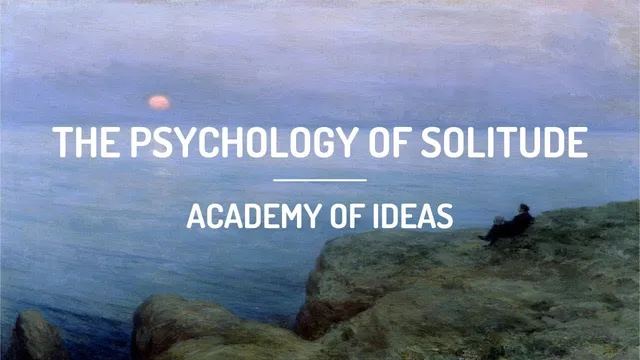
The Psychology of Solitude
Based on Academy of Ideas's video on YouTube. If you like this content, support the original creators by watching, liking and subscribing to their content.
Fear of solitude often reflects fear of the self—especially emotions and thoughts that social life normally keeps out of awareness.
Briefing
Fear of solitude isn’t just a preference—it can become a psychological trap that erodes mental stability and identity. When people avoid being alone for long stretches, they often do so because solitude threatens something deeper than loneliness: an encounter with the self, including frightening thoughts and emotions that daily social life pushes out of awareness. Ancient practices like solitary confinement and exile reflect how long humans have recognized the intensity of this fear, and modern life shows it persists in milder, more everyday forms—anxiety about being alone “for any extended period of time.”
That avoidance has consequences for relationships. Many people respond to the weight of solitude by clinging to others, not to connect freely but to prevent themselves from ever feeling alone. The result can be dependency: partners become the sole source of self-worth and identity, and if that idealized person disappoints, resentment follows. The transcript frames this as a structural problem of “meta needs”—the highest drives for truth, beauty, and goodness—arguing that no single intimate relationship can fully satisfy them. Attempts to make a partner the complete judge of good and bad reduce a person to a “reflex” of another, similar to how obedient children lose themselves in a family.
Psychological theory sharpens the mechanism. Donald Winnicott’s concept of the “false self” describes how fear of abandonment can produce over-compliance: personality becomes shaped by what others want, rather than by authentic feelings and needs. John Bowlby’s attachment-centered view is presented as influential but potentially extreme when treated as the hub of meaning throughout life; taken too far, it implies personal growth depends almost entirely on interpersonal bonds. The transcript counters that meaning and development can also be cultivated inwardly.
The proposed remedy is not forced isolation but the capacity to be alone—learning to meet solitude as a practice. Solitude becomes productive when paired with creative work that holds attention and gives form to thought. Anthony Storr argues that maturation and integration can occur within the isolated individual, because interacting with one’s work supports self-realization through “self reference,” not constant social validation. In this framing, solitude can help people forge character away from constricting external demands while preserving independence in relationships.
Still, the transcript warns against romanticizing solitude. Nietzsche’s “beast within” symbolizes the danger: confronting the darker inner life can overwhelm most people if approached recklessly. Goethe’s line—“there is nothing more dangerous than solitude”—underscores that solitude carries real psychological risk. The key move is to seek solitude voluntarily and confront its darkness deliberately, extracting benefits from the very dangers it contains. The payoff is a rare kind of self-confidence or “sovereignty over himself,” where the desire to escape solitude is no longer mistaken for a sign that solitude is harmful, but treated as part of the difficulty that proves it is worth doing.
Cornell Notes
Solitude can feel threatening because it forces a confrontation with the self—especially thoughts and emotions that social life normally suppresses. Avoiding that confrontation often leads to dependency in relationships, where a partner becomes the source of identity and self-worth, breeding resentment when the ideal breaks. Psychological concepts like Winnicott’s “false self” explain how fear of abandonment can produce compliance and erase authentic needs. The transcript argues that growth is possible when people develop the capacity to be alone, using creative work to structure attention and support self-realization. Solitude remains dangerous, but the benefits may come precisely from voluntarily facing its inner darkness rather than fleeing it.
Why does solitude provoke fear beyond simple loneliness?
How does fear of solitude distort relationships?
What role do “meta needs” play in the argument about dependency?
What is the “false self,” and how is it linked to solitude?
Why does the transcript recommend creative work during solitude?
How does the transcript reconcile solitude’s benefits with its dangers?
Review Questions
- What psychological process links fear of solitude to the emergence of dependency in relationships?
- How do Winnicott’s “false self” and Becker’s “meta needs” support the transcript’s case for learning to be alone?
- What conditions make solitude more likely to produce self-realization rather than breakdown?
Key Points
- 1
Fear of solitude often reflects fear of the self—especially emotions and thoughts that social life normally keeps out of awareness.
- 2
Avoiding solitude can produce dependency, where a partner becomes the foundation of identity and self-worth.
- 3
No single relationship can fully satisfy “meta needs” like truth, beauty, and goodness, making total fulfillment through intimacy unrealistic.
- 4
Fear of abandonment can generate Winnicott’s “false self,” turning personality into a reflex of others’ expectations.
- 5
Solitude can support growth when paired with creative work that structures attention and helps impose order on the mind.
- 6
Solitude carries real psychological danger, so the transcript emphasizes voluntary, deliberate engagement rather than forced or reckless isolation.