The Truth about Human-Caused Mass Extinction
Based on Sabine Hossenfelder's video on YouTube. If you like this content, support the original creators by watching, liking and subscribing to their content.
Geologists debate whether the Anthropocene should be formally recognized, with March 2024 voting against formal adoption due to the human signal’s relatively short duration in the geologic record.
Briefing
Human activity is undeniably reshaping Earth’s ecosystems and leaving a clear geologic footprint—but the claim that the planet is already in a “sixth mass extinction” is still more forecast than fact. The strongest message from the data is not that mass extinction has arrived, but that biodiversity loss is accelerating fast enough that it could reach mass-extinction levels within a few centuries if current trends continue.
Geologists have been debating whether this human-driven transformation is significant enough to mark a new geological epoch, the Anthropocene. The argument for it rests on sediment records that began accumulating in the mid-20th century: fallout from nuclear bomb tests, plus layers tied to industrial activity such as microplastics, ash from emissions, fertilizer residues, and isotopic signatures from burning fossil fuels. Yet in March 2024, the International Union of Geological Sciences voted against formally declaring the start of the Anthropocene. Many geologists said the contamination hasn’t lasted long enough to justify a separate epoch, triggering friction within the community. Some researchers criticized the vote as ignoring evidence of long-term human change, while others defended the discipline’s reliance on data rather than conviction. The union ultimately left the door open for informal use of the term.
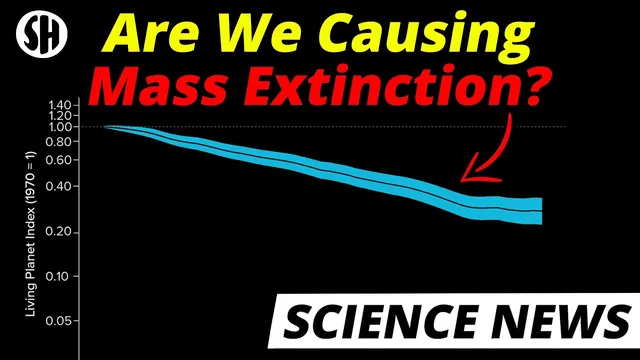
On the extinction question, the numbers are grim but not yet consistent with the strict paleontological definition of a mass extinction. “Mass extinction” typically refers to events where about 75% of species disappear. Current estimates put total losses at under 1%, which makes “mass extinction” language—at least in the technical sense—premature. Still, the trajectory is the real concern. More than 700 vertebrate species have gone extinct in roughly the past 500 years, and wild vertebrate populations have declined by nearly 70% since 1970. For invertebrates, the picture is less certain because scientists don’t know how many species have been lost. Meanwhile, the United Nations estimates around one million species are at risk of extinction.
A large comparative analysis of modern losses versus past extinction events suggests today’s die-off is likely larger than any other in the past 66 million years, the period since the dinosaurs went extinct. Even so, the transcript emphasizes that the current extinction level is not the same as a mass extinction event. The key risk is speed: ecologists estimate that if present trends continue, a true mass extinction could occur in about 300 to 400 years, with more optimistic timelines closer to a thousand years.
The discussion also contrasts human-caused pressures with past drivers of mass extinctions. Major historical mass extinctions were linked to catastrophic natural events like giant volcanic eruptions, while human-driven harms—such as overfishing—are at least theoretically stoppable. That distinction matters because it implies time for intervention, and it also undercuts the idea that extinction is inevitable. The bottom line: humans have not yet triggered a sixth mass extinction, but the accelerating decline suggests the planet is moving toward that threshold unless losses are curbed.
Cornell Notes
Humans have reshaped Earth’s ecosystems and left measurable traces in sediments, fueling debate over whether a new epoch—the Anthropocene—has begun. Geologists voted against formally declaring it in March 2024, arguing that the human signal hasn’t persisted long enough, even as evidence accumulates (nuclear fallout, microplastics, industrial ash, fertilizer residues, and fossil-fuel isotopic signatures). On extinction, current species loss is far below the paleontological threshold for a mass extinction event (about 75% of species), with total losses currently under 1%. But biodiversity decline is steep and accelerating: vertebrate extinctions exceed 700 species in ~500 years, wild vertebrate populations are down nearly 70% since 1970, and up to one million species are at risk. If trends continue, a true mass extinction could arrive in roughly 300–400 years (or up to ~1,000 years optimistically).
What does the Anthropocene claim rely on, and why did geologists vote against formalizing it in 2024?
Why does the transcript say “mass extinction” is technically alarmist right now?
What evidence suggests the situation is worsening faster than the current extinction level implies?
How do modern biodiversity losses compare with past extinction events?
What makes human-caused extinction different from some past mass-extinction triggers?
Review Questions
- What geological markers are cited as evidence for a human-driven epoch, and what criterion did geologists use to resist formalizing it?
- How does the transcript reconcile claims of a “largest die-off since the dinosaurs” with the statement that a mass extinction hasn’t happened yet?
- What timeline do ecologists estimate for reaching mass-extinction levels under continued current trends, and what assumptions make the estimate range?
Key Points
- 1
Geologists debate whether the Anthropocene should be formally recognized, with March 2024 voting against formal adoption due to the human signal’s relatively short duration in the geologic record.
- 2
Human activities have left sediment traces since the mid-20th century, including nuclear fallout, microplastics, industrial ash, fertilizer residues, and fossil-fuel isotopic signatures.
- 3
Current extinction levels are far below the paleontological mass-extinction threshold (about 75% of species), with total losses described as under 1%.
- 4
Biodiversity loss is accelerating: over 700 vertebrate species have gone extinct in ~500 years and wild vertebrate populations have fallen by nearly 70% since 1970.
- 5
Invertebrate losses remain harder to quantify, but the UN estimates about one million species are at risk of extinction.
- 6
Comparative analyses suggest today’s die-off may be larger than any other in the past 66 million years, even if it hasn’t yet reached mass-extinction proportions.
- 7
Because past mass extinctions were driven by extreme natural events, human-caused pressures are framed as more interruptible—meaning intervention could still matter before thresholds are crossed.