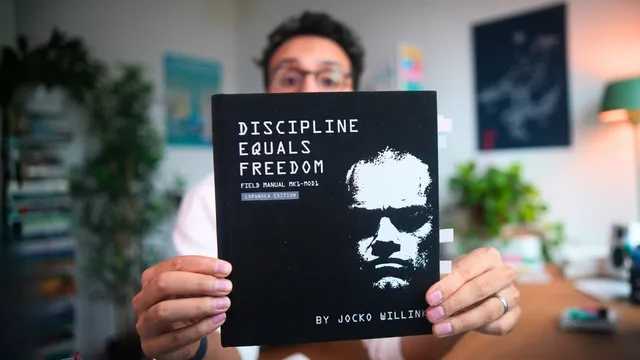
The Ultimate Guide to Discipline
Based on Ali Abdaal's video on YouTube. If you like this content, support the original creators by watching, liking and subscribing to their content.
Discipline is treated as a decision that comes from within, not a mood or a search for the perfect plan.
Briefing
Discipline is framed as an internal decision that defeats excuses, turns “I don’t feel like it” into action, and ultimately delivers freedom. Jocko Willink’s core message—quoted and reinforced throughout—is that discipline isn’t something people wait to discover; it’s something they commit to. The excuses that keep people stuck (“not today, not now… I’ll do it tomorrow”) are treated as the real enemy, because discipline is described as the driver of daily execution and the root of good qualities. From there, the practical takeaway is blunt: if someone wants to be tougher, wake up early, work out consistently, stop eating sugar, or control emotions, the path is to do the specific behavior—by deciding to be in control—rather than searching for elaborate justifications.
A major theme is the rejection of overintellectualizing. Instead of building complex plans for every difficulty, the guidance emphasizes starting the action itself. For fear-based tasks—like posting on LinkedIn or selling—confidence is portrayed as something that often arrives after exposure, not before it. The “how” becomes simpler than self-help culture tends to make it: wake up early by waking up early; post by posting; go to the gym by going. The emphasis is on lowering the barrier to action with environmental nudges (like using an alarm clock without a snooze button), but the underlying principle remains decision-first.
When motivation collapses, the advice shifts from “wait until you feel ready” to “go anyway.” On days when energy is low or the grind feels unbearable, Willink’s approach is to keep moving through the motions: lift weights even if the workout feels pointless, sprint even if the project feels heavy, get out of bed even if the day feels like it should be skipped. The logic is that taking a break can be legitimate, but postponing it until tomorrow prevents immediate gratification from hijacking the schedule. If rest is truly needed, it will still be needed later; if it isn’t, the urge to rest is treated as weakness and a pull toward the path of least resistance.
Setbacks are handled with a single word: “good.” When missions fail, promotions don’t land, funding disappears, injuries occur, or training stalls, the response is to look for what can still be gained—more time to improve, simpler focus, experience, or an opportunity to solve the next problem. The message is not forced positivity; it’s reality acceptance paired with solution focus. The “good” mindset is also linked to resilience training: if someone can repeatedly reframe bad events as containing useful upside, the mental pathway becomes easier to access under stress.
Finally, the transcript highlights a SEAL training story built around the phrase “I feel fine.” Divers are trained to respond with that line after emergencies, even when they may be physically and mentally wrecked, because the procedure is meant to prevent panic and maintain function. Over time, the response becomes a general coping tool: saying “I feel fine” can help people believe it and sustain a constructive attitude. The discussion adds nuance—feelings shouldn’t be ignored blindly, and people shouldn’t use every mood as proof they need to quit—but the overall thrust remains consistent: discipline is action, reframing, and controlled responses that keep people moving toward the life they want.
Cornell Notes
Discipline is presented as an internal commitment that defeats excuses and drives daily execution. The guidance insists that freedom comes from deciding to act—whether that means waking up early, working out consistently, or facing fear-based tasks like posting and selling. When motivation drops, the recommended move is to “go through the motions” and postpone rest until tomorrow, preventing immediate gratification from derailing consistency. Setbacks are met with the word “good,” a way to accept reality while extracting useful upside and staying solution-focused. A SEAL training story adds a coping mechanism: responding “I feel fine” can help stabilize mindset and keep performance intact, though the transcript stresses using it with nuance rather than denying real needs.
Why does the transcript treat discipline as the “root” of good qualities and daily execution?
What does “discipline comes from within” mean in practice?
How does the “go through the motions” strategy work on low-motivation days?
What is the purpose of saying “good” when setbacks happen?
Why does the SEAL story center on the phrase “I feel fine”?
Where does the transcript draw the line on using feelings as a guide?
Review Questions
- How does the transcript connect decision-making to consistency (e.g., waking up early, posting, working out)?
- What criteria does the “wait until tomorrow” rule use to decide whether rest is justified?
- How do the “good” reframing and the “I feel fine” phrase differ in what they target—emotion, interpretation, or behavior?
Key Points
- 1
Discipline is treated as a decision that comes from within, not a mood or a search for the perfect plan.
- 2
Daily execution depends on defeating excuses like “not today, not now,” because postponement becomes the habit.
- 3
For fear-based actions, confidence often follows action; posting or selling is framed as the way to reduce fear over time.
- 4
On low-motivation days, “go through the motions” keeps momentum alive and postpones rest to prevent immediate gratification from winning.
- 5
Rest is not rejected; it’s delayed until tomorrow, and taken only if the need persists.
- 6
Setbacks are met with solution-focused reframing using the word “good,” extracting upside without pretending problems don’t exist.
- 7
A coping phrase like “I feel fine” can stabilize mindset and performance, but it should be used with nuance rather than as denial of real needs.