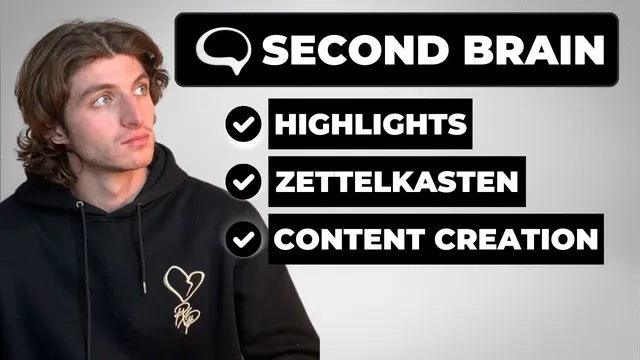
The ULTIMATE Second Brain System Inside Kortex! (With Templates)
Based on Noah Vincent's video on YouTube. If you like this content, support the original creators by watching, liking and subscribing to their content.
Cortex’s effectiveness depends on an end-to-end system: acquisition, transformation, and writing—not on templates alone.
Briefing
Cortex’s value isn’t just that it centralizes notes—it’s that it can run a complete “second brain” workflow for creators, turning scattered reading and listening into permanent knowledge and then into publishable content. The core claim is straightforward: templates alone won’t deliver results. A creator needs an integrated system that governs what gets saved, how highlights become usable notes, and how those notes feed writing—so the same ideas can be reused instead of re-learned from scratch.
The system starts with content acquisition, built around two prioritization mental models. One ranks sources by “input quality” (books over studies over articles, then newsletters, YouTube, tweets, and short-form), while the other uses the Lindy effect to favor older sources as more likely to retain universal value. From there, the workflow relies on a tool stack that funnels highlights into a single library. Readwise is positioned as the keystone: it syncs highlights across devices and content types. Kindle is used for book reading and highlighting, with those highlights syncing into Readwise. For podcasts, Snip lets users save snippets and generates transcripts plus AI summaries, so key moments don’t vanish after a commute. Reader by Readwise acts as a “read-it-later” hub for articles, PDFs, newsletters, YouTube videos, and RSS feeds, with a Chrome extension to capture pages and store highlights—explicitly framed as building an intentional feed rather than relying on algorithms.
Daily practice turns the library into a learning loop. The routine includes saving articles/newsletters/RSS into Reader, reading books on Kindle with a structured schedule inspired by the “Ty Lopez routine” (15 minutes morning, after lunch, and before bed), capturing podcast insights via Snip, and then reviewing highlights in Readwise’s daily review. Readwise’s import connections (Kindle, Twitter, Snip, Reader) keep the highlight stream consolidated, enabling spaced repetition and making the habit stick.
Next comes the Zettelkasten-style “Z cast” method for converting highlights into knowledge. Standard note-taking is criticized for isolation, lack of review, poor future usability, and inconsistent structure. The fix is a three-layer pipeline: fleeting “fitting notes” (captured quotes/highlights), “literature notes” (rewritten summaries that synthesize insights in the user’s own words), and “permanent notes” (atomic, concept-level notes connected through links, tags, and trigger questions). The goal is one note per concept, then a network that sparks new perspectives.
Finally, content creation uses the permanent-note network as a topic engine. When writing, the system recommends using Cortex’s Capture to pull prior ideas by tag, selecting an “ID,” and drafting long-form content (like a weekly newsletter) using a long-form template that supports brain dump → organization → drafting → revision. That long-form output is then repurposed into short-form posts (tweets, reels) using a short-form template guided by copywriting structures. The workflow is designed to eliminate writer’s block by making references and concept ideas immediately searchable inside the same workspace.
To make the system actionable, the creator offers a “Noah’s heart bank” of templates and SOPs, including a tag taxonomy template and copywriting structure templates for both long and short formats, plus step-by-step implementation guides for the acquisition routine, the Z cast method, and the writing pipeline.
Cornell Notes
Cortex is presented as a second-brain system for creators that works only when it’s paired with a repeatable workflow. The approach starts by prioritizing high-quality inputs using mental models (source hierarchy and the Lindy effect), then funnels highlights into a single library using Readwise as the keystone. Highlights become knowledge through the Z cast method: fitting notes (raw captures) → literature notes (rewritten synthesis) → permanent notes (atomic concepts connected by links, tags, and trigger questions). Writing then pulls from these permanent notes via Capture and templates, producing long-form content (e.g., a weekly newsletter) and repurposing it into short-form posts. The payoff is a searchable knowledge network that supports learning, reduces rework, and prevents writer’s block.
Why does the workflow emphasize systems over templates when switching from tools like Notion or Obsidian?
What mental models guide what to consume and save?
How does the tool stack turn reading and listening into a unified highlight library?
What is the Z cast method, and how does it fix common note-taking failures?
How does the system move from permanent notes to publishable content?
What daily routine keeps the learning loop consistent?
Review Questions
- If a highlight never becomes a literature note or permanent note, what part of the workflow breaks—and why?
- How do the content hierarchy and Lindy effect influence what gets saved into the library?
- Walk through the steps from Capture selecting an ID to producing both a long-form newsletter and short-form posts. What templates are involved?
Key Points
- 1
Cortex’s effectiveness depends on an end-to-end system: acquisition, transformation, and writing—not on templates alone.
- 2
Use source prioritization (content hierarchy and Lindy effect) to decide what deserves time and highlight capture.
- 3
Readwise is the keystone that consolidates highlights from Kindle, Snip, and Reader into one synced library.
- 4
The Z cast pipeline converts raw captures into usable knowledge: fitting notes → literature notes → permanent notes connected by links and tags.
- 5
Daily review in Readwise supports spaced repetition and keeps the highlight-to-knowledge loop active.
- 6
Content creation pulls from permanent-note “IDs” via Capture, then uses long-form and short-form templates to draft and repurpose efficiently.