The Universe is Hostile to Computers
Based on Veritasium's video on YouTube. If you like this content, support the original creators by watching, liking and subscribing to their content.
Vindevogel’s vote inflation of exactly 4,096 votes matches 2^12, pointing to a single binary bit (the 13th bit) flipping during tabulation.
Briefing
A Belgian election recount in 2003 uncovered a rare but plausible way cosmic radiation can corrupt computers: a single bit flip inflated one candidate’s vote total by exactly 4,096—an amount that matches a power-of-two boundary in binary counting. Maria Vindevogel’s initial tally in Schaerbeek was “mathematically impossible” under Belgium’s preferential voting rules, triggering a recount using the backup magnetic cards. After rerunning the votes through the same machines, every candidate’s totals matched the original counts except Vindevogel’s, which dropped by 4,096 votes. Extensive software audits found no bugs, and hardware tests couldn’t reproduce the fault, leaving investigators to look for a physical cause that could change a stored bit without leaving lasting damage.
The number 4,096 is the key. In binary, vote totals are represented as strings of bits, where each bit corresponds to a power of two. 4,096 equals 2^12, meaning the 13th bit (counting from the least significant bit) would need to flip from 0 to 1 to add exactly that many votes. That kind of error is consistent with “single event upset” (SEU): an energetic particle strikes a semiconductor transistor, generating charge that flips a bit. The error is “soft” because the circuit isn’t physically damaged; the bit can be corrected by rewriting memory.
Belgian investigators connected the dots to decades of semiconductor research. In the late 1970s, Intel reported spontaneous bit flips in 16 kilobit DRAM traced to radioactive contamination in ceramic packaging—uranium and thorium alpha particles ionized silicon and could flip stored bits. The broader lesson: when chips are miniaturized enough, a single ionizing particle can supply enough charge to change a bit state. That finding led manufacturers to reduce radioactive materials in packaging, but it didn’t eliminate the possibility of particle strikes from outside the chip.
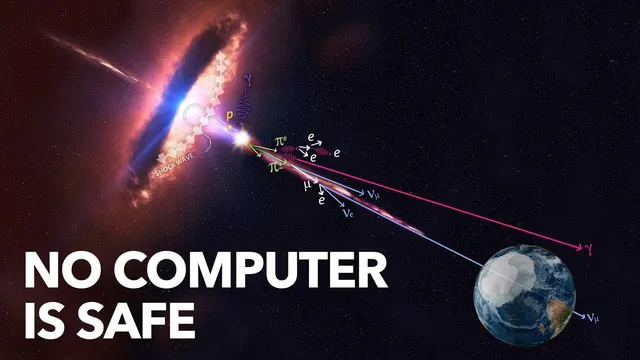
Those outside particles are often cosmic rays. Early 20th-century balloon experiments by Victor Hess showed radiation increasing with altitude, implying an extraterrestrial source. Today, cosmic rays are known to be mostly protons and helium nuclei, with a smaller fraction of heavier nuclei. As charged particles, they’re deflected by magnetic fields, making their origins hard to pinpoint. When they hit Earth’s atmosphere, they don’t reach the surface as primary particles; they trigger cascades that produce secondary particles such as neutrons and muons.
Cosmic-ray-induced bit flips happen often enough to matter for computing reliability. IBM estimated that for each 256 megabytes of RAM, about one bit flip occurs per month, with neutrons from cosmic-ray showers a major culprit. Higher elevations increase the risk: at cruising altitudes, radiation can rise enough that SEU rates increase by roughly 10 to 30 times. That elevated risk has been linked to crashes of high-end systems at places like Los Alamos National Laboratory, where neutron detectors and frequent autosave are used as mitigation.
Aviation incidents also fit the SEU pattern. In 2008, an Airbus A330 experienced severe pitch changes and injuries; investigators focused on a fault in the ADIRU computer, where a bit flip could have mislabeled altitude data as angle-of-attack information, triggering contradictory alarms and control responses. The same physics underlies why spacecraft electronics are built to be radiation hardened. The Perseverance rover’s PowerPC system, for example, is designed to withstand far more radiation than ordinary computers.
The Vindevogel case ultimately reframes “invisible” cosmic radiation as a real engineering constraint: over millions of years, countless particles have been threading through the universe, and occasionally one passes through a tiny transistor—changing a bit, a calculation, or even a life outcome.
Cornell Notes
A Belgian election recount in 2003 traced an impossible vote inflation to a likely single bit flip. Maria Vindevogel’s total dropped by exactly 4,096 after the magnetic-card recount, matching 2^12 in binary—suggesting the 13th bit flipped from 0 to 1 during tabulation. Software and hardware checks couldn’t reproduce the error, pointing to a physical “single event upset” (SEU), where an energetic particle strike temporarily flips a bit without damaging the chip. Research from the 1970s on alpha-particle effects in DRAM packaging showed how tiny charge deposits can flip memory cells, and cosmic rays provide a plausible external source. The same mechanism underlies reliability concerns in aircraft, supercomputers, and radiation-hardened spacecraft electronics.
Why does the number 4,096 matter so much in the Vindevogel recount?
What is a “single event upset” (SEU), and why is it considered “soft”?
How did Intel’s 1970s DRAM problem help establish the mechanism?
What evidence led scientists to conclude cosmic rays come from space rather than Earth or the Sun?
Why do cosmic rays become a computing problem at higher altitudes?
How do mitigation strategies differ between consumer devices and spacecraft?
Review Questions
- In the Vindevogel case, what specific binary property makes 4,096 a strong clue for a bit flip rather than a software miscount?
- Explain how an SEU can produce an incorrect result without leaving a lasting hardware trace, and why a recount could correct it.
- What experimental observations (altitude dependence and eclipse results) support the conclusion that cosmic rays originate outside Earth?
Key Points
- 1
Vindevogel’s vote inflation of exactly 4,096 votes matches 2^12, pointing to a single binary bit (the 13th bit) flipping during tabulation.
- 2
Software debugging and hardware testing failed to reproduce the error, which is consistent with a transient physical cause rather than a persistent defect.
- 3
A single event upset (SEU) describes how an energetic particle strike can flip a bit without damaging the chip, making the error “soft.”
- 4
Semiconductor research in the 1970s showed alpha particles from radioactive packaging can flip DRAM bits, establishing the plausibility of particle-induced bit errors.
- 5
Cosmic rays—mostly protons and helium nuclei—create atmospheric particle cascades that can generate neutrons and other secondaries capable of causing SEUs.
- 6
Higher altitude increases cosmic-ray exposure and can raise SEU rates by an order of magnitude or more, affecting aviation and high-performance computing reliability.
- 7
Radiation-hardened electronics for spacecraft reduce mission risk by designing systems to withstand far higher radiation levels than ordinary computers.