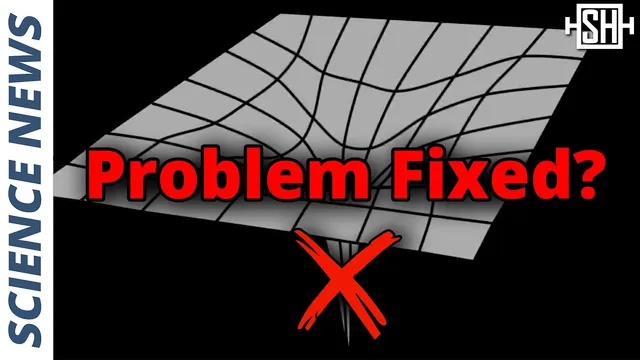
This correction of Einstein’s theory fixes black holes
Based on Sabine Hossenfelder's video on YouTube. If you like this content, support the original creators by watching, liking and subscribing to their content.
Classical general relativity predicts black hole singularities alongside event horizons via the Penrose–Hawking singularity theorem.
Briefing
A widely circulated claim that physicists have “corrected Einstein’s theory” to remove black hole singularities hinges on a technical move: adding an infinite tower of correction terms to Einstein’s equations so the would-be singularity no longer forms. The core issue is that, in classical general relativity, the Penrose–Hawking singularity theorem links black hole horizons to singularities: once matter collapses enough to create an event horizon, the mathematics predicts a breakdown at the center—often described as “time ending” and accompanied by infinite spacetime curvature. That prediction matters because singularities are also the focal point of the black hole information loss problem, where information is expected to disappear.
The transcript stresses a crucial distinction between mathematical and physical singularities. A singularity in the equations is not automatically “wrong” in the sense of being inconsistent; it often signals that the theory is being pushed beyond its domain of validity. The analogy offered is a droplet pinching off a faucet: fluid equations produce a singularity at the pinch-off point, but the physical description fails there because the right microscopic physics (atoms and molecules) takes over. In that spirit, many physicists expect that removing black hole singularities will ultimately require quantum gravity—yet the new proposal claims it can be done by modifying classical general relativity itself.
The proposed mechanism works by modifying the field equations with infinitely many additional terms. The argument for why this might help is mathematical: functions built from infinite series can behave well where finite truncations blow up. In other words, an infinite set of corrections can, in principle, tame pathologies that any finite set of terms cannot.
However, the transcript also highlights major caveats that sharply limit how “big” the claim can be. First, the solution is stated to work only in five dimensions or more, while everyday physics operates in 3+1 dimensions. That mismatch is treated as the physics equivalent of curing a disease in yeast: promising in a toy setting, but not yet a cure for the real world. Second, there are many different ways to remove the singularity by “fiddling with the equations,” so the existence of a formal fix does not automatically establish physical correctness. The transcript notes that even the same singularity can be eliminated through alternative modifications, including work by others.
Finally, even if the approach were extended to 3+1 dimensions, the corrections would need to produce observable effects—at least in principle—near the horizon. The transcript expresses doubt that the effects would be large enough to measure, though it concedes that the infinite-term framework would generically imply horizon-level corrections once translated to our dimensionality. The bottom line: the infinite correction strategy is mathematically attractive and conceptually aligned with the idea that singularities mark a breakdown of an effective theory, but it remains unproven as a physically predictive solution to black hole singularities and information loss in the dimensions we actually inhabit.
Cornell Notes
Classical general relativity predicts that black holes contain singularities: the Penrose–Hawking singularity theorem ties event horizons to a central breakdown where curvature becomes infinite and “time ends.” Many physicists interpret such singularities as signals that the theory’s description fails, not as literal physical infinities. A new proposal claims singularities can be removed by modifying Einstein’s equations with infinitely many correction terms, leveraging the fact that infinite series can yield well-behaved functions where finite truncations diverge. The approach is limited because it currently works only in five dimensions or more, and there are many alternative ways to eliminate singularities by altering the equations. Even if extended to 3+1 dimensions, the resulting corrections might be too small to detect, leaving physical validation uncertain.
Why do singularities appear in classical black hole models, and what does “singularity” mean in this context?
What’s the difference between a mathematical singularity and a physical one?
How does the proposed “fix” remove the singularity?
What are the biggest limitations of the proposal as presented?
If the method were extended to 3+1 dimensions, what would be expected physically?
Review Questions
- What does the Penrose–Hawking singularity theorem imply about the relationship between event horizons and singularities?
- Why might adding infinitely many correction terms succeed where finitely many terms fail, according to the transcript’s mathematical analogy?
- What two main obstacles prevent the proposed singularity removal from being immediately physically convincing?
Key Points
- 1
Classical general relativity predicts black hole singularities alongside event horizons via the Penrose–Hawking singularity theorem.
- 2
Singularities in equations may indicate a breakdown of the theory rather than literal physical infinities.
- 3
The proposed approach removes singularities by adding infinitely many correction terms to Einstein’s equations.
- 4
The construction currently works only in five dimensions or more, not in 3+1 dimensions.
- 5
Many distinct equation-modification schemes can eliminate singularities, so formal success doesn’t guarantee physical correctness.
- 6
Extending the method to 3+1 dimensions would generically imply horizon-level corrections, though likely too small to observe.