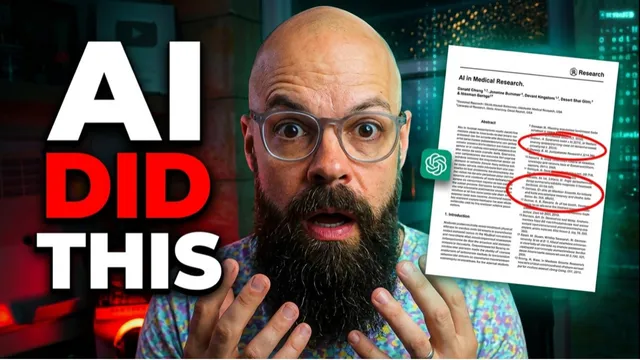
This EMBARRASSING AI-Generated Paper Exposed a Billion-Dollar Problem
Based on Andy Stapleton's video on YouTube. If you like this content, support the original creators by watching, liking and subscribing to their content.
A hospital librarian identified that a published paper’s reference list contained mostly fabricated citations (12 of 14).
Briefing
A hospital librarian discovered that a published academic paper contained mostly fake citations—12 of 14 references were fabricated—highlighting how AI-assisted “hallucinated” references can slip through peer review and remain accessible long after corrections are promised. The case began when a researcher asked Jessica Wait, a hospital librarian, to locate sources listed in a single-author paper. Instead of finding the expected literature, she found that the majority of the references appeared to be non-existent, even though they looked plausible on the page.
Once the problem was identified, the paper’s lead author, Marie Atala, was contacted and initially acknowledged the issue, offering an updated reference list. But the second attempt didn’t resolve it: 16 of 20 references were still fake. A third revision eventually produced a reference list that was larger and, at least in principle, more verifiable—yet the broader system still failed. Retraction Watch and investigators then turned to Springer Nature, the publisher responsible for the paper’s online presence, only to find that the journal’s website still displayed the older, incorrect reference list rather than the corrected one.
The situation became more alarming because the references weren’t just wrong—they were effectively untraceable. When checked through tools like Google Scholar, the cited works could not be found, and even the publisher’s own site appeared inconsistent, at times returning errors such as “Sorry, we couldn’t find this article.” Despite internal claims that the matter was being handled, the paper remained live online with the incorrect citation information.
Springer Nature’s response pointed to the complexity of reference checking, arguing that authors format citations in many ways and that some automated tools can produce false positives. The underlying complaint from the investigation was simpler: if references are proven to be fabricated, retraction or correction should follow quickly and transparently. The timeline also raised eyebrows—acceptance occurred just two days before publication—suggesting there was little time for thorough verification, even as the publisher later referenced AI tools aimed at identifying irrelevant references.
The case ultimately landed on the people who rely on academic literature for real-world decisions. Jessica Wait described the impact on hospital information work and evidence-based practice: if clinicians and researchers can’t trust the citations in major publications, the downstream consequences extend far beyond academia. The story ends up as a cautionary tale about “AI-generated” shortcuts—especially when authors use large language models to draft reference lists without checking whether the cited papers actually exist—and about the gatekeeping responsibilities that journals and publishers carry once errors are detected.
In short, the scandal isn’t only that fake references were created; it’s that multiple rounds of correction still left incorrect material accessible online, forcing librarians and integrity investigators to do the verification work that should have happened before publication and should have been promptly enforced afterward.
Cornell Notes
A hospital librarian, Jessica Wait, found that a published paper’s reference list was largely fabricated: 12 of 14 citations appeared to be fake. The lead author, Marie Atala, provided revised reference lists, but subsequent versions still contained many non-existent references (16 of 20). After Retraction Watch contacted Springer Nature, the publisher’s website continued to show the older, incorrect reference list rather than the updated one, and checks via Google Scholar failed to locate the cited works. The episode matters because clinicians and researchers depend on accurate citations for evidence-based practice, and the case shows how AI “hallucinations” can persist when verification and correction processes lag.
How did the fake-reference problem get detected, and what was the initial scope?
What happened after the author was notified, and why didn’t the first correction fix it?
What role did the publisher’s online record play in keeping the problem visible?
Why did Springer Nature argue the issue was hard to solve, and what counterpoint emerged?
Why does this matter beyond academic integrity?
Review Questions
- What specific evidence showed that the paper’s references were fabricated, and how many were fake at each stage?
- How did the publisher’s website behavior affect the persistence of the incorrect reference list?
- What practical risks did Jessica Wait describe for evidence-based practice when citations can’t be relied on?
Key Points
- 1
A hospital librarian identified that a published paper’s reference list contained mostly fabricated citations (12 of 14).
- 2
Multiple revised reference lists from the author still included large numbers of fake references (16 of 20 in a second version).
- 3
Springer Nature’s online record reportedly continued to display the older, incorrect reference list rather than the corrected one.
- 4
Checks using Google Scholar failed to locate the cited works, indicating the references were not just inaccurate but effectively non-existent.
- 5
The case underscores that AI-generated reference “hallucinations” can bypass review when basic existence checks aren’t performed.
- 6
The downstream impact is real: clinicians rely on accurate citations for evidence-based practice, so citation failures can distort decision-making.
- 7
The dispute centers on gatekeeping: once fabrication is confirmed, publishers should correct or retract quickly and clearly.