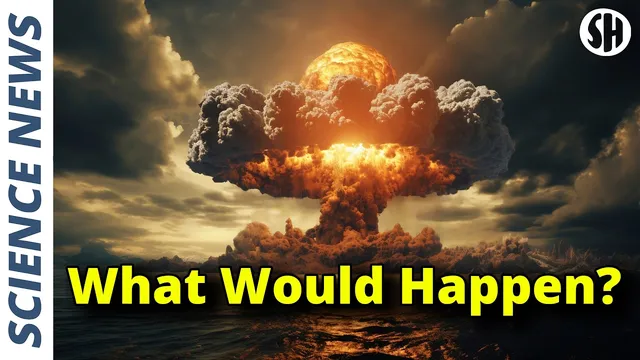
This Is What Happens After A Nuclear War.
Based on Sabine Hossenfelder's video on YouTube. If you like this content, support the original creators by watching, liking and subscribing to their content.
Nuclear winter’s long-term threat is driven by soot and ash lofted into the upper atmosphere, not just by radioactive fallout.
Briefing
A nuclear war’s deadliest legacy may not be the initial blasts but the long, planet-scale “nuclear winter” that follows—an outcome tied to how soot and ash would block sunlight for years, triggering severe cooling and global crop failure. The central warning is stark: even a limited exchange could produce enough firestorms to loft dark particles into the upper atmosphere, where they would not wash out quickly, reducing sunlight and driving temperatures down roughly 5 to 20°C for 5 to 10 years. That cooling window matters because modern agriculture depends on stable growing conditions; once sunlight and temperatures drop, famine can follow fast—within less than a year in the most pessimistic scenarios.
The transcript places this risk in today’s nuclear landscape. During the Cold War, the world stockpile exceeded 70,000 warheads; it’s now about 12,000. Active warheads are described as concentrated in Russia (roughly 4,000) and the United States (roughly 4,000), with China also around 600 and additional smaller numbers in countries such as France and the UK. Symbolically, the Doomsday Clock is set to 89 seconds to midnight—closer than ever—framing nuclear escalation as an unusually acute danger.
Mechanically, the aftermath is portrayed as a chain reaction: nuclear detonations aimed at cities would ignite widespread fires, which could merge into firestorms that pull burning material high into the atmosphere. While radioactive fallout is an immediate hazard, the transcript argues the larger, longer-term driver is the soot and ash—much of it from synthetic materials—that rises into the upper air and then disperses globally. With sunlight blocked, temperatures fall quickly, and the duration depends on how much of the urban landscape is destroyed.
That same atmospheric-ash logic is used to connect nuclear war to supervolcano eruptions, described as “almost certain to come” and largely unavoidable. The Earth is said to have about a dozen supervolcanoes capable of ejecting more than a thousand cubic meters of material in a single blast. Yellowstone is cited as a well-known example, with three mega eruptions over the past 2 million years; the claim is that it will erupt again, with only the timing uncertain.
Debate has existed over how severe nuclear winter would be. In the 1990s, skeptics argued for a milder “nuclear autumn.” More recent studies in 2018 and 2020 suggested firestorms might be less damaging, but the transcript characterizes those as outliers. Most research, it says, still points to devastating outcomes—especially crop collapse.
Two studies anchor the famine argument: a 2022 Rutgers study estimates a large US–Russia nuclear war could indirectly kill about 5 billion people through starvation in the following decade. A newer Penn State study is presented as more pessimistic, adding that soot could damage the ozone layer and increase ultraviolet radiation, further harming crops. The proposed mitigation is practical but politically and logistically difficult: avoid using nuclear codes, and—if catastrophe occurs—prepare to rapidly shift to less cold-sensitive crops such as potatoes or kale. The most resilient edible option highlighted is seaweed, because it grows quickly and could be scaled within months, assuming the capacity to do so exists.
Finally, the transcript pivots to preparedness as a broader mindset, comparing existential threats to asteroid risk. It ends with a call to support Planet Wild, a community-based environmental organization focused on ecosystem restoration and pollution cleanup, presented as a way to contribute to long-term planetary resilience.
Cornell Notes
The transcript argues that nuclear war’s most catastrophic effects may unfold after the initial attacks through “nuclear winter.” City-targeted detonations would likely ignite massive firestorms that loft soot and ash into the upper atmosphere, where it would block sunlight globally. That sunlight reduction could cause rapid cooling—about a 5 to 20°C drop—for roughly 5 to 10 years, with crop failure following quickly because modern agriculture depends on stable temperature and light. Research cited includes a 2022 Rutgers estimate of up to 5 billion indirect deaths from starvation after a US–Russia nuclear war, and a newer Penn State study that could push the outcome even worse by factoring ozone damage and increased UV. The practical takeaway is to reduce nuclear risk and prepare contingency food systems, including fast-growing, cold-tolerant options like seaweed.
Why does the transcript treat soot and ash as the main driver of nuclear winter rather than fallout alone?
How do firestorms form, and why are they hard to stop?
What does the transcript say about the debate over nuclear winter severity?
What mechanisms link nuclear winter to mass starvation?
What contingency food strategy is proposed, and why is seaweed singled out?
How does the transcript connect nuclear war risk to supervolcano eruptions?
Review Questions
- What atmospheric process described in the transcript determines how long nuclear winter could last?
- How do the Rutgers and Penn State studies differ in their assumptions about indirect deaths after a nuclear war?
- Why does the transcript argue that modern crop systems are especially vulnerable to reduced sunlight and temperature?
Key Points
- 1
Nuclear winter’s long-term threat is driven by soot and ash lofted into the upper atmosphere, not just by radioactive fallout.
- 2
Firestorms can form when city fires merge, pulling burning material high enough to spread globally and resist quick removal.
- 3
Blocking sunlight could cause rapid global cooling of roughly 5–20°C for about 5–10 years, depending on how much urban area burns.
- 4
Crop failure is presented as the main pathway to mass starvation, with modern wheat, corn, and rice systems highly sensitive to temperature and sunlight changes.
- 5
A 2022 Rutgers estimate places indirect deaths from starvation after a US–Russia nuclear war at about 5 billion over the following decade.
- 6
A newer Penn State study adds ozone damage and increased ultraviolet radiation as additional crop stressors, potentially worsening outcomes beyond earlier estimates.
- 7
Preparedness includes both reducing nuclear risk and planning rapid shifts to less cold-sensitive foods, with seaweed highlighted as a fast-growing option.