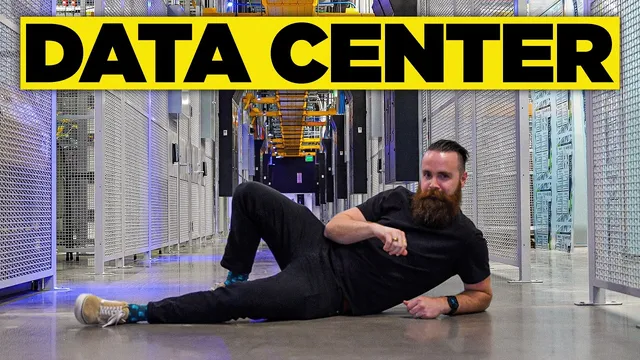
THIS Is Where the Internet Lives
Based on NetworkChuck's video on YouTube. If you like this content, support the original creators by watching, liking and subscribing to their content.
Equinex’s DA11 and the Infomart create a local “internet neighborhood” where networks and clouds connect directly, reducing latency and unpredictability versus routing over the public internet.
Briefing
The internet’s fastest, most reliable connections often bypass the public web entirely—by running through a handful of ultra-connected data centers where major networks and cloud providers sit side by side. In Dallas, Equinex’s DA11 and the nearby Infomart function like a physical “internet neighborhood,” packed with fiber, multiple internet exchanges, and hundreds of networks peering at terabit speeds. The result is lower latency and fewer quality-of-service surprises for businesses that need dependable links to AWS, GCP, Azure, and other providers.
Inside DA11, the tour emphasizes how connectivity and security are built together. Entry requires layered physical controls: badge and fingerprint authentication, a man-trap that prevents tailgating, and additional access gates that restrict staff to only the floors and cages they’re authorized to reach. Even within the facility, access is segmented so customers can only reach their own equipment. That cage-level separation is reinforced by design choices—some cages are open, others fully enclosed or shielded—while staff are constantly monitored and escorted, including for routine movement like getting coffee. The point is clear: protecting equipment worth billions also protects the infrastructure that carries core internet traffic.
The facility’s operational details underline why it can support modern AI workloads. Customers can bring in fully loaded racks, including racks described as “dripping with LPUs” for an AI customer identified as Grok (with a clarification that it’s “this Grok”). Equinex also handles much of the heavy lifting for customers, including preconfiguration and cage management. Cooling and power are engineered for scale: instead of raised floors, the site uses slab floors and pushes air from the side, with hot air routed upward through ventilation. Cooling is likened to liquid-cooling principles, with self-contained cooling containers, buffer water tanks, and a generator yard designed to run on diesel generators for 36 hours at full load.
The most distinctive idea comes next: skipping the slow, failure-prone path of “the big bad wild internet.” Equinex’s approach relies on being extremely well connected locally—DA11 sits next to the Infomart, a building built in the 1980s and modeled after the London Crystal Palace, now positioned on major fiber routes. Equinex helped pioneer a carrier-neutral model, letting many networks connect on a level playing field rather than being dictated by a single telecom. Over time, that attracted more networks, turning the building into a dense hub where cross connections are plentiful.
But the real acceleration is Equinex Fabric. Instead of ordering many physical cross connects to reach different clouds and providers, customers can buy one port and create multiple virtual connections quickly—splitting a single 10 Gbit link into segments for AWS, Azure, GCP, AT&T, and Verizon, for example. Fabric uses software-defined networking to make what used to be cable-and-months work into a portal-based, near-instant setup. For customers with workloads in other states, the pitch is that once on Equinex’s network, traffic rides an internal “HOV lane” across Equinex’s distributed data centers rather than traversing the public internet.
Ultimately, the tour credits the people behind the infrastructure—long-tenured staff and technicians who build, test, and maintain the systems that keep the internet’s most important links running.
Cornell Notes
Dallas’s Equinex data centers (DA11) and the nearby Infomart operate as a physical hub where major networks and cloud providers connect directly, reducing latency and avoiding the unpredictability of the public internet. DA11’s security is layered down to the cage level, using man-traps, badge-and-fingerprint authentication, and strict access boundaries so customers only reach their own equipment. Cooling and power are engineered for continuous AI-scale operations, including side-airflow cooling on slab floors and diesel generator capacity for 36 hours at full load. The key connectivity upgrade is Equinex Fabric: one physical port can be turned into many virtual connections to providers like AWS, Azure, GCP, and carriers via software-defined networking, often within seconds. That design helps businesses build reliable hybrid and cloud links without waiting months for individual cross connects.
Why does direct connectivity inside a data center matter more than “using the internet” the usual way?
What does “layered security” look like in DA11, beyond just cameras?
How does Equinex Fabric reduce the need for many physical cross connects?
What infrastructure choices help DA11 handle heavy AI hardware like GPU/AI racks?
Why is the Infomart’s location and carrier-neutral model important to the connectivity story?
Review Questions
- How do man-traps and cage-level access controls work together to prevent common physical security attacks like tailgating?
- Explain the difference between a physical cross connect and a virtual connection created through Equinex Fabric.
- What cooling and power strategies are described for DA11, and how do they support continuous operation at full load?
Key Points
- 1
Equinex’s DA11 and the Infomart create a local “internet neighborhood” where networks and clouds connect directly, reducing latency and unpredictability versus routing over the public internet.
- 2
DA11 uses layered physical security—badge and fingerprint checks, man-traps, and additional access gates—so entry is tightly controlled down to floors and cages.
- 3
Blue lighting and cage design choices help limit information leakage about customer equipment and networking details.
- 4
AI-scale operations depend on engineered cooling and power: side-airflow cooling on slab floors, self-contained cooling containers, backup water buffers, and diesel generators rated for 36 hours at full load.
- 5
Equinex Fabric turns one physical port into multiple virtual connections to clouds and carriers using software-defined networking, avoiding the time and cost of ordering many cross connects.
- 6
The Infomart’s carrier-neutral model and fiber-rich location helped attract many networks, increasing interconnection density over time.
- 7
Once traffic is on Equinex’s network, it can ride internal connectivity across Equinex data centers rather than traversing the public internet for multi-region access.