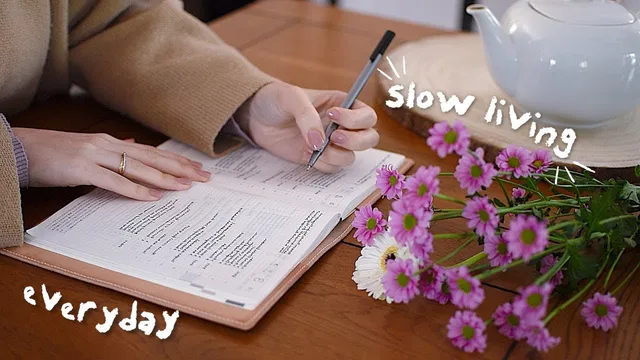
Tips for Slow Living
Based on Mariana Vieira's video on YouTube. If you like this content, support the original creators by watching, liking and subscribing to their content.
Productivity is reframed as doing what’s valuable to you or others, without losing the “sense of the whole.”
Briefing
Modern life has become “lazier, more tired, more stressed, and more dependent,” a shift tied to a culture of hustling that treats constant output as proof of human worth. That mindset—corporate ladder thinking, micromanagement, and squeezing more tasks into every minute—has left many people feeling their work is oddly meaningless, measured by degrees, responsibilities, travel, and bank balances rather than by what actually matters.
A new definition of productivity is offered as the antidote: being productive means doing what’s valuable to you (or to people you care about) without losing “the sense of the whole.” The hardest part isn’t getting more done; it’s staying connected to purpose while moving through daily routines. Slow living is presented as a practical way to keep that wholeness intact. Swapping a short, repetitive workout for a long walk in nature illustrates the point: the effort still counts, but attention shifts outward to sounds, movement, and the environment—making room for reflection and letting the mind wander instead of staying trapped in a narrow output loop.
Slow living isn’t framed as anti-work. It functions as a filter that improves the experience of enjoyable tasks and restores pleasure in ordinary activities that convenience culture labels as “time wasters.” Drying laundry on a rack instead of using a tumble dryer, growing herbs on a windowsill rather than buying packaged greens, cooking at home instead of ordering takeout—these choices may take longer, but they can deliver health and environmental benefits while also encouraging a more thoughtful relationship with time and effort. The underlying challenge is whether productivity has been “turned upside down” by a world that prizes convenience above all.
There are also direct cognitive benefits. A slower pace can strengthen “scatter focus,” an attentional mode that directs attention inward so the mind can wander freely. That mental drift supports creativity, helps people make connections, and creates space to solve problems—suggesting that focus and wandering are two sides of the same coin. When slow living creates room for deeper reflection, it can improve what gets prioritized: the right people, ideas, and projects.
The guidance then becomes lifestyle and habit-based. Minimalism is described as removing distractions and unwanted noise so slower living has space to work. Gardening is highlighted as a concrete practice that naturally encourages deceleration. The approach is meant to be accessible to anyone—not just people in cottages or those already committed to meditation.
Three starting principles anchor the shift. First, re-evaluate a full calendar: constant busyness is linked to burnout and forces people to ignore small but relevant needs. Cutting back activities that don’t add value frees time for rest and high-value reflection. Second, embrace boredom and idleness as a creativity and relaxation booster rather than something to eliminate. Third, reduce superficial connection and media consumption: attention is being pulled toward brands, breaking-news notifications, and curated lives online, while real connections with family, friends, nature, and everyday moments get sidelined. The prescription is to consume less media, digest what’s watched or read before moving on, and be more mindful before purchasing—choosing fulfilling paths over the easy route.
Finally, the transcript includes a sponsor pitch for Notion, positioned as an all-in-one tool for habit tracking, reading lists, task management, goal setting, and personal planning, offered as a free account with no word or block limits.
Cornell Notes
Slow living reframes productivity as doing what’s valuable without losing the “sense of the whole.” Instead of chasing output and convenience, it encourages decelerating daily life through intentional routines—like long nature walks, line-drying laundry, home cooking, and growing herbs—so people stay connected to purpose and reflection. The approach also supports creativity via “scatter focus,” where inward attention and mind-wandering help generate ideas and solve problems. Slow living pairs well with minimalism, gardening, and other practices that reduce distractions and create space for rest. It’s presented as practical for anyone, with starting principles focused on trimming an overloaded calendar, embracing boredom, and consuming less media to protect real relationships and attention.
How does the transcript redefine “productivity,” and why does that change matter?
What does “the sense of the whole” mean in practice, and how does slow living protect it?
Why isn’t slow living presented as anti-work?
What is “scatter focus,” and how does slowing down support it?
What are the three practical principles for starting to live more slowly?
How does minimalism fit into slow living?
Review Questions
- How would you measure “productivity” using the transcript’s value-based definition rather than an output-based one?
- Which part of your routine most threatens the “sense of the whole,” and what slow-living swap could address it?
- What changes would you make to reduce “superficial connection” and media consumption without cutting yourself off from everyone?
Key Points
- 1
Productivity is reframed as doing what’s valuable to you or others, without losing the “sense of the whole.”
- 2
Slow living is presented as compatible with productive work, acting as a filter that increases enjoyment and meaning.
- 3
Convenience-driven choices can be replaced with slower alternatives (line-drying, home cooking, growing herbs) that may improve health and the environment.
- 4
A slower pace can boost creativity through “scatter focus,” which relies on inward attention and mind-wandering.
- 5
Trimming a full calendar helps prevent burnout and creates space for rest and high-value reflection.
- 6
Embracing boredom and idleness is treated as a legitimate way to support creativity and relaxation.
- 7
Reducing media and superficial online attention helps restore real connections and everyday presence.