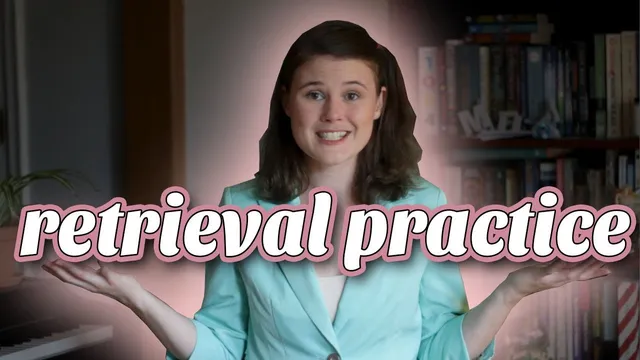
Understanding and Applying Retrieval Practice in Lesson Planning
Based on morganeua's video on YouTube. If you like this content, support the original creators by watching, liking and subscribing to their content.
Retrieval practice (testing effect) improves long-term memory because forced recall helps organize and consolidate information in long-term storage.
Briefing
Retrieval practice—actively recalling information instead of rereading it—is one of the most reliable ways to strengthen long-term memory, and it can be built into lessons with two low-prep classroom routines. The core idea is the “retrieval effect” (also called the testing effect): information is stored and consolidated more effectively when students are forced to retrieve it at multiple points during learning. That matters not only for exam performance, but also for how well students can think critically and creatively later, because higher-level work depends on having a solid base of “remembering” knowledge to draw from.
Morgan frames retrieval practice as both necessary and uncomfortable. Many instructors avoid it because recall feels hard, getting answers wrong can be embarrassing, and classroom questioning can be awkward—especially when teachers already know the answer and students hesitate. Yet those negative emotions are treated as part of the learning mechanism: learning requires effort. The practical goal becomes making retrieval practice manageable and structured so students experience the challenge without stalling the class.
For the beginning of a lecture or tutorial, the recommended routine is a “pop quiz.” Students answer short questions drawn from prior course material, using tools such as Zoom polls, an overhead projector, or an online learning platform. The quiz should function as a learning activity rather than a high-stakes assessment—ideally ungraded or only lightly tied to participation. Crucially, retrieval practice only works when students receive immediate feedback on whether their answers are correct. Morgan suggests collecting responses right after the quiz so students who know the answers can share them with the rest of the class. Placing this at the start also primes memory: students retrieve what they already know, making it easier to connect new information to earlier concepts.
For the end of the session, the second routine shifts from quick testing to a discussion-based retrieval task. Students close their textbooks and raise their hands to name a topic covered in the day’s lecture, forcing them to retrieve freshly learned content. The instructor can capture the resulting list on a chalkboard for in-person classes or in a shared Google Doc for synchronous online sessions, with the added benefit of sharing the list afterward as collaborative notes.
To push retrieval into critical and creative thinking, Morgan adapts James Lang’s “one-minute thesis.” From the topic list, three students each select a term. Students then silently write a one-minute thesis that incorporates all three terms—an exercise that requires not just recall, but connection and argument. The format can be tailored to course goals; for example, in a theater context, students might write a one-minute play concept that integrates the three theories. The takeaway is to end class by having students remember and recombine ideas immediately, then carry that momentum into future lesson planning.
Cornell Notes
Retrieval practice strengthens long-term memory by forcing students to recall information, which leads to better storage and consolidation than passive rereading. The “retrieval effect” (testing effect) works best when students get immediate feedback on whether their answers are correct. Morgan recommends two routines: a pop quiz at the start of class to reactivate prior knowledge, and a topic-retrieval discussion at the end of class where students close their textbooks and name what they learned. For higher-order thinking, the one-minute thesis (from James Lang) has students combine three selected terms into a short argument, pushing them from remembering toward critical/creative work.
Why does retrieval practice improve memory more than rereading notes?
What makes a “pop quiz” a learning tool rather than a stressful assessment?
How does starting with retrieval help students learn new material during the same class?
Why insist that students close textbooks during end-of-class retrieval?
How does the one-minute thesis turn recall into critical or creative thinking?
Review Questions
- What conditions must be met for retrieval practice to work effectively (consider feedback and timing)?
- Design a pop quiz for the start of a lecture: what sources of questions would you use, and how would you deliver and review answers?
- How would you adapt the one-minute thesis for a course where the learning outcomes emphasize application or creativity rather than argumentation?
Key Points
- 1
Retrieval practice (testing effect) improves long-term memory because forced recall helps organize and consolidate information in long-term storage.
- 2
Immediate feedback is essential; retrieval attempts only strengthen learning when students learn whether their answers are correct.
- 3
Use a low-stakes pop quiz at the start of class to reactivate prior knowledge and make it easier to connect new material.
- 4
End sessions with a textbook-closed retrieval routine where students name topics from the lecture, and capture the list for later review.
- 5
To reach critical or creative thinking, combine retrieval with synthesis using a one-minute thesis that integrates three selected terms.
- 6
Structure retrieval so students experience productive difficulty without turning the activity into embarrassment or awkward silence.