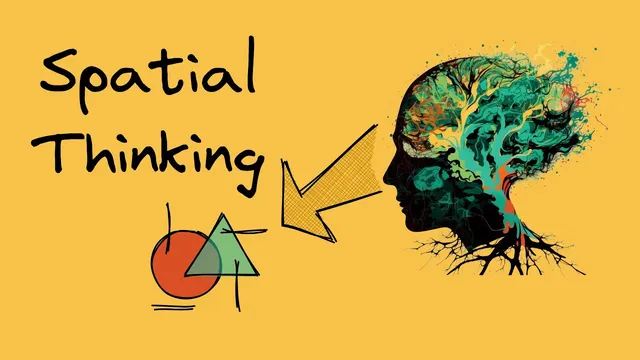
Unlock Your Creativity with Visualization: The Power of Spatial Thinking
Based on Zsolt's Visual Personal Knowledge Management's video on YouTube. If you like this content, support the original creators by watching, liking and subscribing to their content.
Obsidian’s vault-level graph can reveal clusters, but a local graph that rearranges itself undermines orientation and navigation.
Briefing
Spatial thinking—backed by how humans evolved to navigate physical environments—can make ideas easier to understand, connect, and manage. The core claim is that turning thoughts into a stable, spatial layout (rather than relying on shifting link graphs and linear text) creates orientation: people know where things are, how they relate, and what to look for next.
A practical example comes from Obsidian. At the vault level, Obsidian’s graph view looks impressive and reveals clusters—such as older notes from a previous system (“the brain”) still forming a separate cluster even after years of importing. But the local graph view is described as frustrating: it moves around when nodes are touched, directions aren’t clear, and orientation is lost. In contrast, the creator’s “Excalidraw”/“Excalidraw brain” view for a single document is presented as structured and repeatable. Parent nodes sit at the top, child nodes flow downward, related lateral thoughts appear on the sides, and connection types (e.g., related to source/author) are encoded through an ontology layer. Colors and icons distinguish document types, and—crucially—the layout stays fixed and alphabetically organized, so the same page always “looks the same.” That stability is framed as the difference between a helpful spatial map and a confusing tangle.
The theory section ties this preference to human cognition. Language itself is offered as evidence: people talk about the future as “up ahead” and the past as “behind,” reflecting a spatial mental model. The talk also invokes the ancient Greek “method of Loki” (memory palace). In the legend of Simonides of Ceos, survival after a hall collapse is attributed to remembering where each person sat; later, memory champions supposedly memorize long sequences by walking through a familiar place in their minds and placing items at specific locations. Another proposed reason early childhood memories fade is that infants are less mobile, lacking the “scaffolding” of self-directed movement to anchor memories.
From cognition to practice, the transcript argues that mental images alone often miss details. A tiger visualization exercise—building a detailed mental picture—still leaves most people unable to answer how many stripes it has, because the image wasn’t externalized. Drawing, by contrast, forces details and orientations to appear, including ones the thinker didn’t consciously articulate. That leads to a concrete recommendation: offload ideas onto physical space—Post-it notes, a whiteboard, or canvases such as Excalidraw and Obsidian canvas—preferably on a larger surface so body movement changes perspective and encourages detachment.
Finally, the talk imagines future knowledge systems inspired by games and environments. Townscaper-like “districts” could represent document stores; Witcher-like worlds could host AI characters standing in for projects and people; and “fantasy maps of content” could place documents as objects in a navigable landscape. The takeaway is straightforward: externalize thoughts into a spatial layout and treat creativity as something you can navigate, not just type linearly—using drawings and physical or canvas-based space to gain orientation and insight into your own ideas.
Cornell Notes
The transcript argues that humans are naturally spatial thinkers, and that knowledge tools work better when they preserve orientation. Obsidian’s shifting graph view is contrasted with a fixed Excalidraw-based “brain” layout where parent nodes, child nodes, and related lateral ideas occupy consistent positions, supported by colors, icons, and an ontology of connections. The cognitive rationale links spatial language and memory-palace techniques (like the method of Loki) to how people store and retrieve information. Practical exercises emphasize externalizing ideas—drawing instead of only imagining, and placing notes on physical surfaces or canvases—to reveal details and help people detach and re-orient their thinking. The result is a more navigable, creativity-friendly knowledge management approach.
Why does a stable spatial layout matter more than a graph that rearranges itself?
What does the tiger-stripes exercise claim about mental imagery versus drawing?
How does the transcript connect spatial thinking to language?
What is the method of Loki (memory palace) used to illustrate?
What practical steps does the transcript recommend to improve thinking using spatial externalization?
How do game-inspired metaphors translate into a knowledge management system?
Review Questions
- How does the transcript justify that spatial thinking is “natural” for humans, and what evidence does it cite?
- What specific features make the described Excalidraw-based document view more usable than Obsidian’s graph view?
- Why does the transcript treat drawing as a way to discover details that mental imagery misses?
Key Points
- 1
Obsidian’s vault-level graph can reveal clusters, but a local graph that rearranges itself undermines orientation and navigation.
- 2
A fixed spatial layout (parents top, children bottom, lateral related ideas on the sides) can turn a document map into a reliable mental “coordinate system.”
- 3
Colors, icons, and an ontology of connection types help users quickly orient themselves and interpret relationships.
- 4
Spatial cognition is linked to human evolution and reinforced by spatial language metaphors about time and direction.
- 5
Drawing and externalizing ideas can surface details that mental imagery alone fails to capture.
- 6
Placing thoughts on physical or canvas surfaces (Post-it notes, whiteboards, Excalidraw, Obsidian canvas) supports detachment and a new perspective through body movement.
- 7
Game-like environments and fantasy maps offer metaphors for building navigable, spatial knowledge systems where documents live in rooms, districts, or locations.