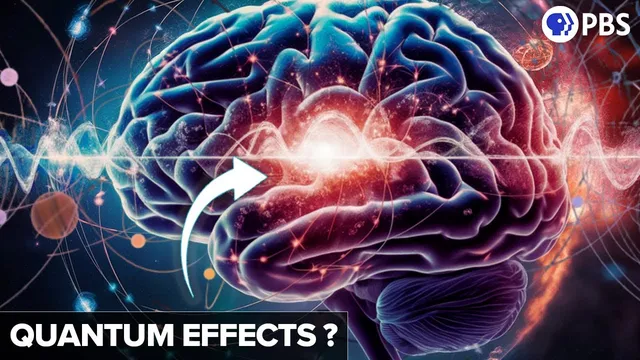
Was Penrose Right? NEW EVIDENCE For Quantum Effects In The Brain
Based on PBS Space Time's video on YouTube. If you like this content, support the original creators by watching, liking and subscribing to their content.
Penrose’s consciousness proposal relies on the idea that wavefunction collapse introduces non-algorithmic randomness tied to the measurement problem.
Briefing
Roger Penrose’s long-running claim that consciousness may depend on quantum physics is getting a fresh reality check—not because the brain has been proven conscious in a quantum way, but because microtubules may show quantum behavior that survives longer and over larger distances than expected in warm, wet biology. The new push comes from evidence that microtubules (via tryptophan in tubulin) can exhibit “ultraviolet superradiance,” a collective light-emission effect that typically requires entangled groups of molecules rather than independent, classical emitters.
Penrose’s argument starts with Gödel’s incompleteness theorems and the Penrose–Lucas line of reasoning: if human mathematical understanding can reach truths that no algorithmic system can guarantee, then consciousness cannot be purely computational. Penrose then points to quantum mechanics as the only plausible “escape hatch” from algorithmic limits, focusing on wavefunction collapse. In quantum theory, measurement forces a system out of superposition into a single outcome, and the collapse is tied to randomness through the measurement problem. Penrose’s proposal is that if collapse is genuinely non-algorithmic, then consciousness could draw on that non-computable element rather than on ordinary computation.
The central objection has always been environmental: quantum coherence is notoriously fragile. Quantum states usually require isolation and low temperatures; they decohere quickly in warm, noisy settings. That’s why quantum computers are hard to build and why the brain—described as macroscopic, chaotic, and “gooey”—seemed an unlikely host for sustained quantum processing.
Enter Stuart Hameroff’s microtubule hypothesis, developed after he connected with Penrose in the early 1990s. Microtubules are abundant, highly regular protein structures inside cells, built from repeating tubulin units. Hameroff and Penrose proposed that microtubules could store and process quantum information (qubits), with entangled superpositions spanning tubulins and collapsing in a way that Penrose associates with “objective reduction.” Their broader framework, orchestrated objective reduction, aims to link repeated collapse events to conscious experience.
The new evidence doesn’t settle whether consciousness works this way. Instead, it strengthens the weaker premise: that microtubules can support large-scale quantum phenomena. A 2013 report suggested microtubules show long-range quantum resonance. More recently, Nathan Babcock and Phillip Kurian (Howard University) and collaborators published “Ultraviolet Superradiance from Mega-Networks of Tryptophan in Biological Architectures,” claiming that ultraviolet excitation of tryptophan within tubulin produces superradiant emission. In superradiance, many excited molecules act like a single entangled emitter, producing a brighter, shorter radiation burst—analogous in spirit to how lasers work, but arising from collective spontaneous emission. Their modeling argues that the observed light intensity (hundreds of times above fluorescence expectations) and the simulated coherence length along microtubules are consistent with entangled, collective excited states.
Still, major gaps remain. Penrose and Hameroff estimate that a substantial fraction of microtubules across neurons would need to be entangled to generate consciousness, a requirement that critics view as implausible in warm biology. Even if microtubules contribute to cognition, the transcript argues that this likely doesn’t bring artificial general intelligence with human-like consciousness any closer—unless quantum computers are used, and even then the orchestrated objective reduction mechanism would imply near-term AI won’t replicate consciousness.
The bottom line: the strongest new claim is narrower than consciousness. Microtubules may host quantum effects such as superradiance, but proving quantum information processing in vivo—and connecting it to the specific collapse-based mechanism required for consciousness—still demands far more work.
Cornell Notes
Penrose’s consciousness idea hinges on Gödel’s incompleteness and the claim that human understanding isn’t fully algorithmic. To make that leap, Penrose points to quantum mechanics, especially wavefunction collapse, which he treats as non-algorithmic and potentially beyond Gödel-style limits. Critics have long argued that quantum effects can’t persist in the brain’s warm, noisy environment. New experimental and modeling work on microtubules—particularly ultraviolet superradiance involving tryptophan in tubulin—suggests quantum-like collective behavior may last longer and spread farther than expected. That strengthens the plausibility of quantum processes in biology, but it does not yet prove that such processes create consciousness.
What is the Penrose–Lucas argument, and why does it matter for consciousness claims?
How does Penrose try to link Gödel incompleteness to quantum mechanics?
Why has the brain been viewed as a poor environment for quantum effects?
What role do microtubules play in the Penrose–Hameroff hypothesis?
What is superradiance, and what does the new microtubule evidence claim?
What are the remaining obstacles before microtubule quantum effects can be tied to consciousness or AI?
Review Questions
- How do Gödel’s incompleteness theorems motivate the claim that consciousness might not be algorithmic?
- What experimental signature distinguishes superradiance from ordinary fluorescence, and why does that matter for the microtubule hypothesis?
- What specific environmental challenge has to be overcome for quantum coherence to plausibly persist in the brain?
Key Points
- 1
Penrose’s consciousness proposal relies on the idea that wavefunction collapse introduces non-algorithmic randomness tied to the measurement problem.
- 2
The Penrose–Lucas argument connects Gödel incompleteness to the claim that human understanding can exceed what computation can guarantee.
- 3
A longstanding objection is that quantum coherence should decohere rapidly in the brain’s warm, noisy environment.
- 4
Hameroff’s microtubule hypothesis proposes that tubulin structures could store qubits and support entangled superpositions that collapse in a consciousness-relevant way.
- 5
New modeling and evidence claim microtubules can exhibit ultraviolet superradiance involving tryptophan, implying collective quantum behavior over longer distances than expected.
- 6
Even with quantum effects in microtubules, the leap to consciousness requires large-scale entanglement levels that remain disputed.
- 7
If consciousness depends on orchestrated objective reduction, near-term AI progress may not produce human-like consciousness without quantum computing.