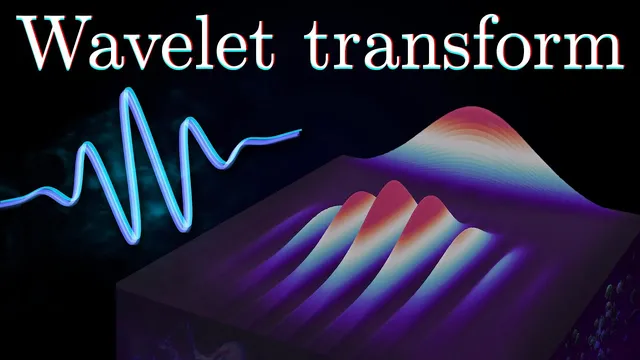
Wavelets: a mathematical microscope
Based on Artem Kirsanov's video on YouTube. If you like this content, support the original creators by watching, liking and subscribing to their content.
Wavelet transform is designed to reveal how frequency content changes over time, addressing Fourier transform’s time-blindness.
Briefing
Wavelet transform is presented as a “mathematical microscope” for signals that are noisy, irregular, and structured at multiple time scales—letting analysts quantify what’s happening when, not just what frequencies exist. The core problem is that Fourier transform, while powerful at decomposing a signal into frequency components, collapses time information: it can tell which frequencies are present but not when they occur. That limitation becomes critical in real-world scenarios where patterns appear, evolve, and disappear.
The explanation starts with time–frequency duality using a simple two-number example: sending the sum and difference of two values preserves all information, just in a different representation. Extending that idea to signals leads to Fourier transform, which decomposes a function into a sum of sines and cosines. Each frequency’s contribution can be read from the frequency domain, and an inverse transform can reconstruct the original signal. But Fourier’s single-resolution trade-off is unavoidable: perfect time resolution and perfect frequency resolution cannot coexist. The traffic-light analogy makes the point. Whether the colors occur in a fixed order, a scrambled order, or even overlap simultaneously, the Fourier transform still shows the same frequency peaks—because it is blind to temporal dynamics.
Wavelets enter as the compromise tool. Instead of using sine waves that extend infinitely in time, wavelet transform uses localized “little waves” that are confined to finite time windows. A wavelet is defined as a family of functions (not a single one) that satisfy two key constraints: zero mean (no zero-frequency/average component) and finite energy (the integral of the squared function over all time is finite), which enforces time localization. The Morlet wavelet is highlighted as a common choice: a cosine (or complex exponential) damped by a Gaussian envelope.
The mechanics of wavelet transform are built step-by-step. A mother wavelet is modified by two parameters: translation in time (shifting by b) and scaling (stretching or compressing by a, equivalently changing frequency). For each (a, b), the method computes how well the scaled-and-shifted wavelet matches the signal locally. That “match” is expressed as an integral of the product of the signal and the wavelet—mathematically equivalent to a dot product, capturing similarity through sign-aligned agreement. Sliding the wavelet across time resembles convolution, producing a short-lived oscillatory response when the signal’s local frequency aligns with the wavelet’s.
To convert that response into a meaningful measure of frequency power over time, the transform uses the complex form of the Morlet wavelet. Convolution is computed with both real and imaginary parts; the magnitude (absolute value) of the resulting complex coefficient gives the intensity of a frequency component at each time. Plotting magnitude across scales and times yields a wavelet scalogram, which makes evolving frequency content visible—such as a sine wave whose frequency increases over time, or brain rhythms that show distinct bouts of low-frequency activity with higher-frequency components riding on top.
Finally, wavelet transform is framed as respecting the uncertainty principle rather than violating it. The time–frequency plane is described using “Heisenberg boxes”: low frequencies get better frequency precision but poorer time precision (wide, short boxes), while high frequencies get better time precision but poorer frequency precision (tall, narrow boxes). The result is an optimal, frequency-dependent balance that reveals when patterns begin and end—exactly the information Fourier transform tends to miss.
Cornell Notes
Wavelet transform is a time–frequency method designed for signals whose structure changes over time. Unlike Fourier transform, which identifies which frequencies exist but loses when they occur, wavelets use localized analyzing functions that are confined in time. By scaling and shifting a mother wavelet and computing a convolution-like similarity (dot product) with the signal, the transform produces coefficients indexed by time and scale. Using the complex Morlet wavelet, the magnitude of those coefficients gives the power of frequency components as they evolve, visualized in a wavelet scalogram. The method does not defeat the uncertainty principle; it manages the trade-off with Heisenberg boxes whose shape depends on frequency, giving good time resolution for brief high-frequency events and good frequency resolution for sustained low-frequency rhythms.
Why does Fourier transform struggle to detect when a frequency component appears or disappears?
What makes a function qualify as a wavelet?
How do the scale (a) and translation (b) parameters change the wavelet being compared to the signal?
What does the wavelet transform coefficient measure at a specific (a, b)?
Why use the complex Morlet wavelet and take the absolute value of the convolution result?
How does wavelet transform handle the time–frequency uncertainty trade-off?
Review Questions
- In the traffic-light malfunction scenario, what specific information does Fourier transform fail to capture, and why does the frequency spectrum remain unchanged?
- Explain how translation and scaling parameters (b and a) affect the daughter wavelet and what that implies for the frequencies being detected.
- Why does taking the magnitude of the complex wavelet coefficients provide a clearer measure of frequency power over time than using only the real-part convolution?
Key Points
- 1
Wavelet transform is designed to reveal how frequency content changes over time, addressing Fourier transform’s time-blindness.
- 2
Fourier transform decomposes signals into global sine/cosine components, preserving frequency content but discarding when those frequencies occur.
- 3
Wavelets use localized analyzing functions (“little waves”) that satisfy zero mean and finite energy, enabling time-local frequency analysis.
- 4
Scaling (a) changes the wavelet’s effective frequency, while translation (b) moves it across time; scanning all (a, b) produces a time–scale map.
- 5
Wavelet coefficients come from a convolution/dot-product-like integral measuring local similarity between signal and wavelet.
- 6
Using the complex Morlet wavelet and taking the absolute value yields a power-like intensity measure that tracks when components begin and end.
- 7
Wavelet transform manages the uncertainty principle with Heisenberg boxes: low frequencies get better frequency precision, high frequencies get better time precision.