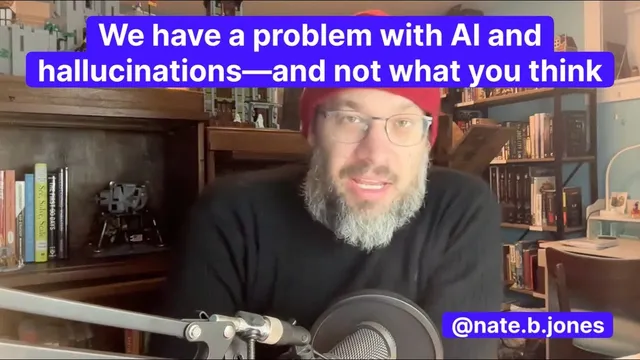
We have a problem with AI and hallucinations—and not what you think
Based on AI News & Strategy Daily | Nate B Jones's video on YouTube. If you like this content, support the original creators by watching, liking and subscribing to their content.
The transcript argues that AI is often held to a perfection standard that humans are not, despite AI’s speed making verification cost-effective.
Briefing
Hallucinations are being treated as a deal-breaker for AI—yet the real problem is a credibility gap: early, high-profile errors led many people to assume AI is mostly lying, and that misconception now drowns out the fact that modern systems can already produce useful work. The core insight is that society holds AI to a stricter standard than humans, even though AI’s speed and productivity can outweigh the cost of checking its outputs. That mismatch matters because it shapes public trust, adoption, and how organizations design workflows around AI.
The argument starts with a comparison of error tolerance. If a human researcher—say, an intern—turns in a 40-page report with a few mistakes, it’s still considered valuable. But when an AI system delivers a similar report in minutes and includes a few errors, people often dismiss it as “not good enough” and demand perfection. The reasoning offered is practical: if AI cuts turnaround time by orders of magnitude, then a small number of mistakes can be acceptable when the work is still more useful than the time required to verify everything. That doesn’t mean hallucinations don’t matter; it means they should be managed through verification and better prompting rather than treated as proof that AI is fundamentally unreliable.
A key supporting point is that hallucination rates vary dramatically by task. The same model can show very different error levels depending on what it’s asked to do and how it’s constrained. Context, prompting structure, and source requirements can reduce hallucinations, and many “hallucination fixes” end up aligning with general best practices for getting reliable outputs from AI. The speaker also emphasizes that expecting 100% no-hallucination models soon is unrealistic—and even if they arrive, the bigger impact may be on public perception rather than real-world utility.
The transcript links this to how people interpret computers. For decades, deterministic computing and software behavior have trained users to expect correctness. Movies reinforce the idea that computers are precise, so an AI that generates plausible-sounding text without a built-in factual world model feels like a violation of expectations. Yet the ability to produce low error rates at all is framed as remarkable: these systems generate probabilistic tokens rather than consulting a guaranteed factual database.
Finally, the discussion turns to psychology and incentives. People who feel threatened by AI—especially around jobs—are more likely to adopt a harsh “it lies” narrative, while those using AI responsibly tend to design tasks that reduce failure modes. The conclusion is that AI is already crossing a threshold where it can be more reliable than many humans in many domains, so the focus should shift from obsessing over AI hallucinations to improving how humans verify and use information. Public belief is slow to change, much like stubborn resistance to safer technologies in other areas, but education and workflow discipline are presented as the path forward.
Cornell Notes
The transcript argues that “AI hallucinations” have become a public obsession that obscures a more practical reality: modern AI can already deliver useful work, and hallucination risk depends heavily on the task and prompting. It contrasts human and AI error tolerance—people accept a few mistakes from humans but demand near-perfection from AI, even though AI’s speed can make verification worthwhile. Hallucination rates are said to vary by up to an order of magnitude across tasks, with context and structured prompting reducing errors. The speaker also predicts that eliminating hallucinations entirely won’t happen soon and may not matter as much for real work as it does for perception. The takeaway: manage hallucinations with best practices and verification, and shift attention toward how humans handle uncertainty.
Why does the transcript claim people hold AI to a harsher standard than humans?
How does task design affect hallucination risk, according to the transcript?
What does the transcript say about the idea of “no hallucinations” models?
What role does verification play, and where is it still non-negotiable?
Why does the transcript connect hallucination beliefs to human psychology and incentives?
What “threshold” does the transcript suggest AI has crossed?
Review Questions
- What does the transcript claim is the correct way to set an error tolerance bar for AI outputs compared with human work?
- How do context and prompting constraints change hallucination rates, and why does that matter for real deployments?
- Why does the transcript argue that even a future reduction in hallucinations might not automatically change real-world outcomes as much as it changes public perception?
Key Points
- 1
The transcript argues that AI is often held to a perfection standard that humans are not, despite AI’s speed making verification cost-effective.
- 2
Hallucination risk is highly dependent on the task, with reported rates varying by roughly an order of magnitude across different measures and prompts.
- 3
Structured prompting, clear constraints, and requiring sources are presented as practical best practices that also reduce hallucinations.
- 4
High-stakes domains still require human verification, including legal citation checking and medical reasoning review.
- 5
Eliminating hallucinations entirely is framed as unlikely soon, and even then may matter more for perception than for day-to-day utility.
- 6
Beliefs that AI “lies” are portrayed as sticky and sometimes tied to perceived job threats, making education and workflow design crucial.
- 7
The transcript concludes that attention should shift from blaming AI hallucinations to improving how humans verify and use information.