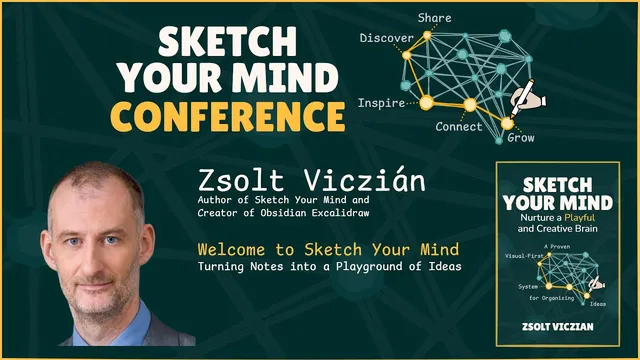
Welcome to Sketch Your Mind - Session 1 at the Sketch Your Mind Conference, 2025
Based on Zsolt's Visual Personal Knowledge Management's video on YouTube. If you like this content, support the original creators by watching, liking and subscribing to their content.
Treat text and visuals as equal partners: illustrations should function as notes, not just decoration, with text providing precision, sources, and meaning.
Briefing
Sketch Your Mind’s Session 1 makes a central case for “4D PKM”: personal knowledge management that treats text and visuals as equal partners, then connects visual “Lego blocks” into a nonlinear network. The payoff is detachment and reflection—capturing ideas in a way that lets people step back from their own thoughts—while also turning note-taking into a playful, flow-friendly process rather than a linear, folder-bound chore.
The talk starts by framing a tension many knowledge workers feel: writing is thinking, yet images compress meaning and can be understood at a glance. The proposed resolution isn’t to choose one over the other, but to bind them tightly. A key quote is used to sharpen the point: a picture is worth a thousand words only if those words are actually invoked. That leads to the “mindset framework,” built around ambidextrous thinking—using visuals not as decoration, but as notes in their own right, with text as the supporting layer that adds precision, sources, and context.
From there, the session introduces a dimensional ladder for how notes evolve. One-dimensional thinking is disconnected scraps—like individual Post-it notes that require linear reading. Two-dimensional thinking is folders and notebooks that reduce mess but still rely on flipping through pages. Three-dimensional thinking adds links between text notes, creating relationships but leaving the visual half of cognition underused. Four-dimensional thinking is the leap: notes become spatial and visual, interconnected as a network of nonlinear “visual notes” that still carry text support.
The “Lego approach” is the practical mechanism. Ideas are broken into standardized, modular icons—visual pieces that can be reconfigured into larger concept visuals, storyboards, and frameworks. The talk emphasizes three constraints that make the system work: standardized icon sizes, a consistent color palette, and a card-based canvas that focuses attention even while the overall system remains flexible. The result is meant to support flow: experimentation with components until understanding “falls into place.”
A live demonstration uses Obsidian and Excalidraw (via the Obsidian Excalidraw plugin) to show how modular visuals behave like linked parts. Editing one colored region ripples through every place that region appears, updating upstream visuals. Each visual component also has backlinks, so the system can answer “where else does this idea show up?”
The session adds a second model: a “front and back” postcard metaphor. The front is the illustration; the back is the text in markdown—links, references, and talking points—so hybrid notes live in one place without forcing a choice between image-first and text-first.
To make the ideas tangible, the talk runs a “Lego duck” style exercise adapted to a quote by Albert Einstein: “Play is the highest form of research.” Participants use a library of icons in Excalidraw to build an illustration for the quote, then attach the exported PNG to a chat so the group can review each other’s interpretations. The session ends with Q&A on starting 4D PKM, scaling card sizes for large canvases, and organizing for navigation and search—highlighting structured file naming, tags, folder logic, and link-based navigation (an “idea compass”). The throughline is consistent: notes should behave like a living, modular system—part map, part territory—where visuals and text reinforce each other instead of competing.
Cornell Notes
Session 1 argues for “4D PKM,” a personal knowledge management approach that treats text and visuals as equal partners. It proposes a shift from visuals as one-off tools to visuals as a system: modular, standardized “Lego blocks” that can be rearranged into nonlinear concept networks, while still carrying text support. The talk demonstrates how Obsidian + Excalidraw (via the Obsidian Excalidraw plugin) can update shared visual components through ripple effects and backlinks. A “front/back postcard” model keeps illustrations on the front and markdown text (links, sources, talking points) on the back, enabling hybrid notes. The session also uses a group exercise based on Einstein’s “Play is the highest form of research” to practice turning abstract ideas into visual structures and then articulating their meaning in text.
Why does the talk treat visuals as “notes” rather than decoration?
How does the dimensional ladder (1D to 4D) define progress in note-taking?
What is the “Lego approach,” and what constraints make it usable?
How do Obsidian and Excalidraw work together in this system?
What does the “front and back postcard” model add to hybrid notes?
How does the session turn theory into practice during the group exercise?
Review Questions
- What distinguishes 3D PKM from 4D PKM in the talk’s framework, and why does the distinction matter for cognition?
- Describe the Lego approach’s three constraints and explain how they support modular recombination of ideas.
- How does the front/back postcard model help integrate visuals with markdown text for navigation and recall?
Key Points
- 1
Treat text and visuals as equal partners: illustrations should function as notes, not just decoration, with text providing precision, sources, and meaning.
- 2
Move from linear note consumption (scraps, folders) to nonlinear networks by adopting 4D PKM—spatial visual notes linked together with text support.
- 3
Use modular “Lego blocks” for concept visuals, supported by constraints: standardized icon sizes, a consistent color palette, and card-based canvases for focus.
- 4
Leverage Obsidian + Excalidraw (via the Obsidian Excalidraw plugin) to enable ripple updates and backlinks so shared visual components stay consistent across the system.
- 5
Adopt a front/back postcard structure: illustration on the front, markdown text (links, references, talking points) on the back to enable true hybrid notes.
- 6
Practice the system with constrained creative exercises (e.g., illustrating Einstein’s quote) to convert abstract ideas into visual structures and then articulate them in text.
- 7
For scaling and retrieval, rely on structured file naming, tags, folder logic, and link-based navigation (an “idea compass”) rather than only visual layout.