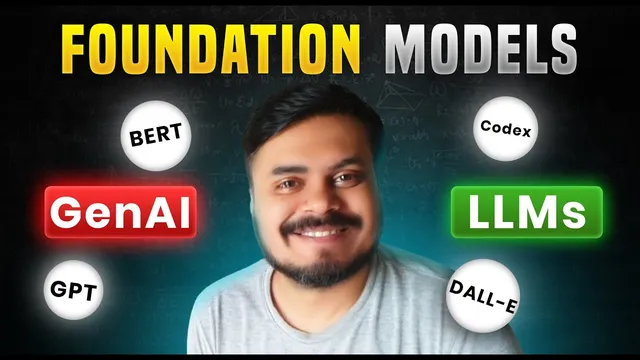
What are Foundation Models? | Generative AI | In-depth Explanation in Hindi | CampusX
Based on CampusX's video on YouTube. If you like this content, support the original creators by watching, liking and subscribing to their content.
Foundation models replace task-by-task AI building with a reusable base model trained on massive data for broad, transferable capabilities.
Briefing
Foundation models are the big shift behind today’s generative AI boom: instead of building a separate AI system for every task, teams train one large, general-purpose model on massive data and then adapt it to many jobs. That approach matters because it dramatically lowers the cost and effort needed to deploy capable AI—turning “AI engineering” from task-by-task model building into selecting a strong base model and fine-tuning it for a specific use case.
At the core, a foundation model is a huge neural network architecture trained on enormous datasets to solve a broad, often general task. The transcript breaks this into three ingredients: (1) a large neural network architecture with lots of parameters, (2) massive and diverse data (to reduce bias and improve generalization), and (3) a task that’s broad enough to produce transferable learning. The architecture is expected to be big, scalable, and state-of-the-art. Transformers are highlighted as the dominant example, with other architectures like GANs for vision-focused models and autoencoders also mentioned.
Data requirements are equally central. Foundation models typically train on data at the scale of hundreds of GBs, and they benefit from diversity—because narrow training data can bake in biases. The transcript uses a social-bias example: if a model only “sees” rural life, it may learn incorrect generalizations about gender roles; exposure to more varied data can help correct those patterns. Modality also matters: language models learn from text, vision models from images, and multimodal models from combinations. The transcript contrasts a general medical Q&A model (trained broadly on internet-scale text) with a smaller, domain-specific medical model trained on medical books—both can work, but their knowledge depth and scope differ.
The “task” used during pretraining is designed for transfer. Instead of narrow regression or classification, foundation models are trained on broad objectives. Two examples illustrate why: next-word prediction forces the model to learn language structure, which then supports related tasks like sentiment analysis; image captioning requires understanding both visual content and language, which can transfer to image classification.
Foundation models operate in three stages. First comes pretraining, where the model learns general concepts from massive data and a broad task—this is compute-heavy and time-consuming. Next is alignment, where techniques and human feedback (ranked responses with rewards) steer outputs toward safer, more appropriate behavior. Finally, fine-tuning adapts the pretrained model to a specific downstream task using smaller, task-focused datasets—such as text classification, summarization, or question answering.
The transcript also frames why foundation models became so important: they enable a paradigm shift away from scratch-building task-specific systems toward reusing a strong pretrained base (e.g., choosing a model like GPT) and adding a thin layer of task data. That reduces data, compute, and team-size requirements, boosting adoption—though the approach may not fit extremely specialized tasks where no suitable base capability exists.
Common categories include language-based models (LLMs like GPT and BERT), vision-based models (e.g., DALL·E), multimodal models (e.g., CLIP), and domain-specific models such as BloombergGPT and OpenAI’s Codex (and its connection to GitHub Copilot). Despite the upside, the transcript warns about risks: bias from training data, ethical concerns around sensitive information and permissions, misinformation from confident but incorrect outputs, security vulnerabilities, lack of explainability (black-box behavior), and environmental costs from large-scale training. Even with these drawbacks, foundation models are presented as a major technology shift—and a must-know concept for anyone aiming to work in generative AI and LLM engineering.
Cornell Notes
Foundation models are large neural networks trained on massive, diverse datasets to learn general capabilities from broad tasks. Their value comes from transfer: once a model learns language, vision, or multimodal patterns during pretraining, it can be adapted to many downstream jobs through alignment and fine-tuning. The transcript lays out three stages—pretraining (learn general concepts), alignment (steer outputs using feedback and ranking), and fine-tuning (train on smaller task-specific data). This approach changes AI development from building task-specific systems from scratch to reusing a strong base model and adding a thin layer of task knowledge. It also brings risks such as bias, misinformation, security issues, weak explainability, and high environmental cost.
What makes a model a “foundation model” rather than a task-specific AI system?
Why does “transferability” matter, and how do next-word prediction and image captioning demonstrate it?
What are the three stages of foundation model development, and what happens in each?
How do data choices influence bias and model behavior?
Why can fine-tuning reduce the need for large teams and huge datasets?
What risks does the transcript associate with foundation models?
Review Questions
- How do pretraining, alignment, and fine-tuning differ in purpose and data requirements?
- Give one example of a pretraining task and explain how it can transfer to a different downstream task.
- What kinds of risks arise from training on massive datasets, and why are they difficult to eliminate?
Key Points
- 1
Foundation models replace task-by-task AI building with a reusable base model trained on massive data for broad, transferable capabilities.
- 2
A foundation model’s quality depends on a large, scalable architecture, huge diverse datasets, and a pretraining task designed for transfer.
- 3
Pretraining builds general concepts, alignment steers outputs toward safer and more appropriate responses, and fine-tuning adapts the model to specific downstream tasks.
- 4
Language, vision, and multimodal foundation models differ mainly by the modality of training data and the kinds of tasks they can handle.
- 5
Adoption rises because fine-tuning typically needs less data, compute, and team capacity than training from scratch.
- 6
Foundation models still carry major risks: bias, ethical and permission issues, misinformation, security weaknesses, weak explainability, and high environmental cost.