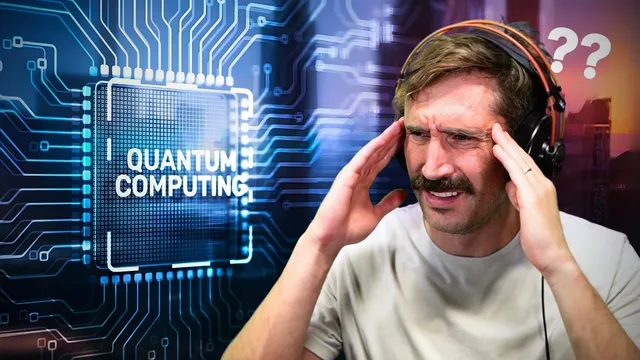
What even is Quantum Computing?!
Based on The PrimeTime's video on YouTube. If you like this content, support the original creators by watching, liking and subscribing to their content.
Qubits can represent superpositions of 0 and 1, and entanglement links qubits so their joint state can’t be treated as independent parts.
Briefing
Quantum computing is best understood as a machine for running carefully engineered probability-and-interference math on fragile quantum states—not as a general-purpose “faster computer” that automatically breaks encryption or solves every problem. The core promise comes from how quantum bits (qubits) can exist in superposition and, when entangled, behave as linked systems whose combined state represents multiple possibilities at once. But turning those possibilities into useful answers requires suppressing noise and controlling interference so the “right” outcomes are amplified and the “wrong” ones cancel out.
The conversation starts by contrasting classical bits with qubits. Classical bits hold a definite 0 or 1, so with n bits a computer is effectively in one of 2^n states at a time. Qubits instead live in superposition—think of it as a wave-like combination of 0 and 1—so multiple outcomes are represented simultaneously as probabilities. When qubits are entangled, their states become inseparable in the sense that no operation can treat them as independent pieces; the system’s joint state encodes all combinations with specific probabilities. This is why scaling qubits matters: the number of joint possibilities grows extremely fast, making quantum state spaces enormous.
That fragility is the limiting factor. Quantum systems must be kept extremely cold (often near absolute zero) and isolated from background disturbances, because noise drives decoherence—effectively washing out the quantum behavior needed for interference. The discussion ties this to fundamental physics limits like the Heisenberg uncertainty principle: you can’t make measurement perfectly precise without inducing uncertainty elsewhere, and absolute zero is unattainable. The result is a practical reality: quantum hardware is hard to build, hard to keep stable, and hard to run reliably.
Where quantum computing becomes relevant is in specific algorithms that exploit interference and entanglement. Shor’s algorithm is the flagship example: it can factor integers in polynomial time, which is why it threatens widely used public-key cryptography (e.g., RSA). The key nuance is that quantum speedups don’t come from “one-shot” magic. Algorithms still require repeated runs and careful measurement; the quantum part is the structured transformation of amplitudes so that the correct answer becomes much more likely after interference and measurement. The conversation also highlights that many quantum algorithms resemble search and estimation methods, including quantum versions of random-walk-style approaches.
The Google angle centers on a reported result using “quantum echoes,” described as a way to scramble and then reverse a quantum process on a chip with 105 qubits, producing reproducible outcomes and enabling predictions of molecular structures. Even here, the takeaway is constrained: such chips are likely specialized, and changing the task may require redesigning the circuit/gates rather than simply running a new program like on a laptop. That’s why generalized “quantum programming languages” aren’t broadly available yet—most work resembles constructing circuits at an assembly-like level.
Finally, the discussion pushes back on hype. “Quantum AI supremacy” and similar clickbait claims are treated as mostly empty until there’s clear, practical advantage. Near-term impact is framed as research acceleration—especially in chemistry and drug discovery—where quantum methods may help search for molecular shapes and orientations that determine how medicines bind. For most people, access will remain limited for years, and the biggest near-term bottleneck is still engineering: keeping qubits coherent long enough to make the math pay off.
Cornell Notes
Quantum computing uses qubits, which can be in superposition of 0 and 1, and entanglement, which links qubits so their joint state can’t be separated into independent parts. Those properties let quantum algorithms manipulate probability amplitudes so interference amplifies correct answers and cancels wrong ones—often requiring repeated runs and careful measurement. The hardware must be kept extremely cold and isolated because noise causes decoherence, destroying the quantum behavior. Practical advantages are therefore algorithm-specific: Shor’s algorithm can factor integers in polynomial time, threatening RSA, while other approaches target structured search problems like molecular-structure prediction. The current limitation is engineering and programmability—many quantum chips are effectively specialized, and “general-purpose” quantum programming is still immature.
How do qubits differ from classical bits in what they represent at any moment?
What does entanglement mean operationally, beyond the “they’re connected” intuition?
Why is quantum hardware so sensitive to the environment?
What makes Shor’s algorithm a big deal, and what nuance prevents it from being “instant factoring”?
What does “quantum echoes” (as described) claim to do, and why is it still not a universal quantum computer?
Why don’t generalized quantum programming languages exist in the same way as classical ones?
Review Questions
- What roles do superposition and entanglement play in how quantum algorithms represent multiple possibilities at once?
- Explain why decoherence and noise are central obstacles to practical quantum computing.
- Why does Shor’s algorithm matter for cryptography, and what does the transcript say about how results are obtained (one-shot vs repeated runs)?
Key Points
- 1
Qubits can represent superpositions of 0 and 1, and entanglement links qubits so their joint state can’t be treated as independent parts.
- 2
Quantum speedups depend on controlled interference—amplifying correct outcomes and canceling incorrect ones—rather than simply “trying all answers.”
- 3
Noise and decoherence are the main engineering bottlenecks, which is why quantum systems are typically operated at extremely low temperatures.
- 4
Shor’s algorithm is the standout example of a quantum advantage because it can factor integers in polynomial time, threatening RSA-style encryption.
- 5
Many current quantum chips are effectively specialized for particular circuits/algorithms, so “general-purpose” quantum programming remains limited.
- 6
Near-term practical value is framed around research acceleration—especially chemistry and molecular-structure prediction—where quantum methods can help with structured search problems.