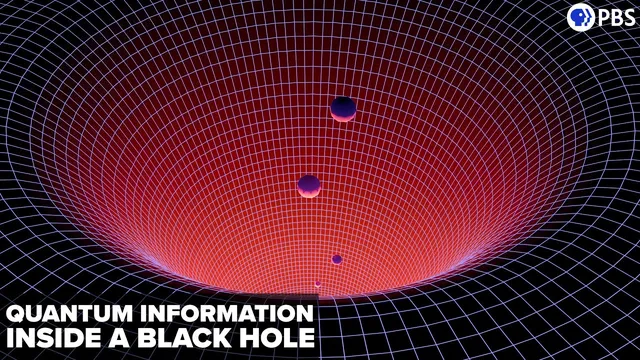
What Happens To Quantum Information Inside A Black Hole?
Based on PBS Space Time's video on YouTube. If you like this content, support the original creators by watching, liking and subscribing to their content.
Bob’s gamma-ray observations make the qubit box appear to freeze near the event horizon, with the qubit’s information effectively scrambled across the horizon.
Briefing
A black hole doesn’t just swallow matter—it scrambles quantum information in a way that forces physics to choose between incompatible principles. The thought experiment follows two perspectives on the same “qubit” (a single electron’s spin) dropped toward Sagittarius A*, and the mismatch between what each observer can say about where that qubit ends up becomes the core contradiction behind the black hole information problem.
From Bob’s viewpoint, Alice’s descent appears to slow dramatically as she nears the event horizon. Gravitational time dilation and redshift stretch her gamma-ray pulses, and the qubit box seems to freeze at the horizon. But the freeze is only apparent: Bob’s instruments eventually lose Alice entirely as her signals become too faint, and the last observable event is the qubit’s information getting scrambled across the event horizon. When the black hole later emits Hawking radiation—faint, thermal radiation set by the black hole’s temperature—Bob tries to recover the qubit from that radiation. For Sagittarius A*, the temperature is about 10^-14 Kelvin, implying Hawking photons with wavelengths over 100 million kilometers. Bob therefore builds an enormous “Dyson sphere” detector around the black hole and waits out the long evaporation era.
Alice’s perspective tells a different story. In free fall, she experiences no dramatic g-forces or tidal stretching until well inside the hole, consistent with the equivalence principle: locally, free-falling space looks like ordinary space. As she approaches the horizon, the “true” event horizon still behaves like a boundary that she can cross without noticing any local marker. Crucially, she can see the qubit box only as it was just before crossing; once she crosses the horizon herself, she cannot catch up to the box. After crossing, the outside universe becomes a shrinking “fisheye” view that collapses into a terminus of space and time. From her frame, the qubit continues inward and merges with the singularity rather than lingering at the horizon.
The contradiction is sharp because quantum information is governed by rules that don’t tolerate sloppy bookkeeping. Quantum mechanics forbids deleting information (so Bob expects the qubit’s information to survive in Hawking radiation) and forbids cloning (so the qubit can’t be both inside the black hole and also duplicated in the outgoing radiation). If the qubit appears frozen at the horizon for Bob but falls through for Alice, then either unitarity fails—meaning probabilities can’t consistently sum to one—or the equivalence principle breaks, meaning Alice never truly crosses the horizon in the way general relativity predicts. The unresolved fork is therefore: break unitarity by duplicating or deleting the qubit’s information, or break the equivalence principle by revising what “crossing the horizon” means.
The narrative then projects the stakes forward. Bob eventually detects faint correlations in the Hawking radiation after collecting an astronomically long stream of data—on the order of 10^87 years—recovering the qubit and even reconstructing Alice’s qubits into a digital form. Yet that “happy ending” doesn’t settle the physics, because it corresponds to one observer’s account of where the information resides. The real payoff is the paradox itself: two observers end up with irreconcilably different answers to where the qubit is, and resolving that mismatch is what motivates next-step ideas like black hole complementarity and the possibility of a firewall at the event horizon.
Cornell Notes
A qubit dropped toward a black hole behaves differently for two observers: Bob sees the qubit freeze and get scrambled at the event horizon, while Alice sees it cross the horizon and continue inward. Bob’s later attempt to recover the qubit from Hawking radiation relies on quantum rules that forbid deleting information and forbid cloning quantum states. Those rules clash with the idea that the qubit could be both “stuck” at the horizon and also escape in Hawking radiation. The resulting contradiction forces physics toward a choice: violate unitarity (probability conservation) or violate the equivalence principle (the local “no drama” crossing of the horizon).
Why does Bob conclude the qubit’s information ends up on the event horizon rather than disappearing?
How does Alice’s experience avoid the “freezing” that Bob sees?
What quantum-mechanical constraints make the “where is the qubit?” question so dangerous?
What does unitarity mean in this context, and why does it matter?
Why does Bob need an enormous detector and an extreme waiting period?
What does the “digital Alice” ending change—and what it doesn’t?
Review Questions
- In what specific way do Bob’s observations of time dilation and redshift differ from Alice’s observations under the equivalence principle?
- How do the no-cloning theorem and the prohibition on deleting quantum information jointly constrain where a qubit can be after Hawking evaporation?
- What are the two main “breaks” proposed as ways out of the contradiction, and what principle does each break?
Key Points
- 1
Bob’s gamma-ray observations make the qubit box appear to freeze near the event horizon, with the qubit’s information effectively scrambled across the horizon.
- 2
Alice’s free-fall perspective follows the equivalence principle: she crosses the horizon without local “freeze” effects and sees the qubit box only as it was just before crossing.
- 3
Hawking radiation provides the only plausible route for Bob to recover the qubit without violating the rule against deleting quantum information.
- 4
The no-cloning theorem blocks the idea that the qubit can both remain inside the black hole and also escape as a duplicate in Hawking radiation.
- 5
Resolving the mismatch forces a choice between breaking unitarity (probability conservation) or breaking the equivalence principle (the “no drama” crossing).
- 6
Even if information can be reconstructed from Hawking radiation, the observer-dependent accounts of the qubit’s location remain the central contradiction.