What If Gravity Isn’t Quantum? New Experiments Explore
Based on PBS Space Time's video on YouTube. If you like this content, support the original creators by watching, liking and subscribing to their content.
Directly quantizing gravity has been difficult because the graviton would be extraordinarily hard to detect and because spacetime geometry is the background that other fields are quantized against.
Briefing
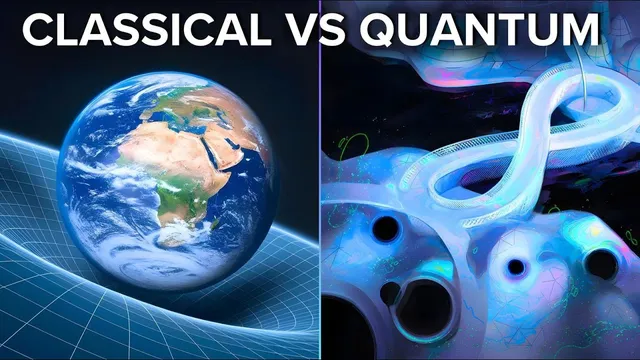
The central question driving today’s quantum-gravity experiments is whether gravity itself behaves quantum mechanically—or whether classical gravity can still produce quantum effects like wavefunction collapse. That distinction matters because it determines what kind of “master theory” could reconcile quantum mechanics with general relativity, and it also changes what experiments are worth building: either look for quantum signatures in gravity, or look for quantum systems being forced into classical outcomes by gravity.
A common strategy has been to quantize gravity directly, treating spacetime geometry like other fields that can be promoted to quantum operators. But the graviton—the hypothetical force-carrying particle of gravity—would be so weakly energetic that direct detection is effectively out of reach, and quantizing spacetime itself has resisted clean, testable formulations. That bottleneck has motivated an alternative framing: keep gravity fundamentally classical and ask how quantum matter could generate classical gravitational behavior. In this “gravitize the quantum” view, gravity acts on quantum superpositions in a way that can trigger collapse.
Two prominent objective-collapse-style ideas illustrate the logic. In the Diosi–Penrose model, quantum matter in superposition would correspond to competing gravitational configurations; once the mismatch (“tension”) between the matter distribution and a single classical spacetime curvature becomes large enough, the wavefunction collapses. In Oppenheim’s postquantum gravity, the gravitational field contains intrinsic random fluctuations—described as gravitational diffusion—that disrupt quantum superpositions and drive collapse. Both approaches imply a stochastic character to gravity’s influence, which could show up as an intrinsic limit on how precisely mass can be measured. Existing high-precision mass experiments have already ruled out versions with rapid diffusion, suggesting any gravity-induced collapse from this mechanism must be very weak. Future tabletop tests are aimed at tightening those constraints.
Another route flips the measurement target: instead of hunting for randomness in gravity, search for when superposition fails. Objective collapse theories predict that collapse becomes more likely as objects grow in mass or size, implying a practical ceiling on how large a system can remain in superposition for meaningful times. So far, no sharp cutoff has been observed, but experiments have achieved interference with increasingly large molecules, and those results already constrain scenarios where gravity would cause strong collapse.
If gravity is classical, these collapse signatures are the main battleground. If gravity is quantum, the emphasis shifts to entanglement. Quantum entanglement links outcomes across separated systems, and producing it via gravity would require the gravitational field itself to participate in the quantum correlations—effectively implying spacetime is in superposition. One proposal, QGEM (Quantum Gravity-induced Entanglement of Masses), originally developed by Sougato Bose and collaborators in 2017, uses a Stern–Gerlach interferometer setup. The experiment conceptually places spin superpositions into spatial superpositions and brings two interferometers close enough that only particular paths can gravitationally interact. With many nanodiamonds—each hosting an unpaired electron spin used as a quantum degree of freedom—gravity-induced correlations between the interferometers could emerge. In particle-physics language, such correlations would be consistent with graviton exchange; in general-relativity language, they could be interpreted as superpositions of spacetime geometries. A positive result would be strong evidence that gravity is quantum, while continued null results would further support the classical-gravity-with-collapse picture.
Either way, the experimental direction is clear: tabletop precision and interference experiments are increasingly capable of distinguishing whether gravity carries quantum information or merely enforces classicality on quantum matter.
Cornell Notes
The key fork in quantum-gravity research is whether gravity is fundamentally quantum or whether classical gravity can still drive quantum wavefunction collapse. Quantizing gravity directly has been hard because the graviton would be extremely difficult to detect and because spacetime geometry is the “background” that other fields are quantized on. Alternative models keep gravity classical and predict collapse mechanisms: Diosi–Penrose links collapse to a mismatch between superposed mass distributions and a single spacetime curvature, while Oppenheim’s postquantum gravity attributes collapse to random gravitational diffusion. Precision mass measurements and large-molecule interference experiments already limit how strong such gravity-induced collapse can be. A different test targets quantum entanglement: QGEM uses closely spaced Stern–Gerlach interferometers and nanodiamonds to look for gravity-mediated correlations that would imply spacetime participates in quantum superposition.
Why do Diosi–Penrose and Oppenheim both predict something testable about gravity’s randomness?
How do experiments constrain gravity-induced collapse without directly measuring gravitons?
What would count as evidence that gravity is quantum rather than merely classical?
How does the QGEM concept use Stern–Gerlach interferometers to test gravity’s role in entanglement?
Why nanodiamonds, and what quantum resource do they provide?
How do different theoretical languages interpret a positive QGEM result?
Review Questions
- What experimental signatures distinguish a “classical gravity drives collapse” model from a “gravity is quantum and can entangle” model?
- How do Diosi–Penrose and Oppenheim differ in the mechanism that collapses a quantum wavefunction while still sharing a stochastic prediction?
- Why does QGEM focus on correlations between two interferometers rather than attempting to detect gravitons directly?
Key Points
- 1
Directly quantizing gravity has been difficult because the graviton would be extraordinarily hard to detect and because spacetime geometry is the background that other fields are quantized against.
- 2
Keeping gravity classical but allowing it to affect quantum matter leads to testable collapse mechanisms, including Diosi–Penrose’s curvature-mismatch tension and Oppenheim’s gravitational diffusion.
- 3
Both collapse frameworks imply stochastic gravitational influence, motivating precision mass measurements that can bound intrinsic diffusion-driven uncertainty.
- 4
Objective-collapse theories predict that superposition should become harder to maintain as mass or size increases, so interference experiments with larger systems can constrain gravity-induced collapse strength.
- 5
No sharp superposition cutoff has been observed yet, but existing large-molecule interference results already rule out scenarios with strong gravity-driven collapse.
- 6
Entanglement offers a different discriminant: gravity-mediated entanglement would require the gravitational field (and thus spacetime) to participate in quantum superposition.
- 7
QGEM uses closely spaced Stern–Gerlach interferometers and nanodiamonds to search for gravity-induced correlations between interferometers, providing indirect evidence consistent with graviton exchange if successful.