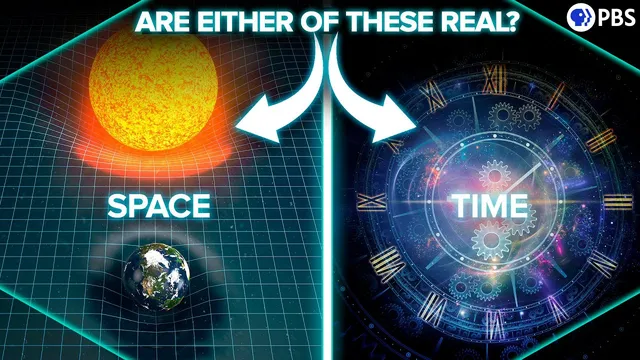
What If Space And Time Are NOT Real?
Based on PBS Space Time's video on YouTube. If you like this content, support the original creators by watching, liking and subscribing to their content.
Relational spacetime treats geometry as a description of relationships among objects, while absolute spacetime treats space and time as independent entities that exist even without matter.
Briefing
Space and time may not be fundamental features of reality at all. The most consequential thread running through the discussion is that physics has repeatedly replaced “obvious” background ideas—first by reframing motion and simultaneity in Einstein’s relativity, and later by confronting a breakdown between general relativity and quantum mechanics at the Planck scale. If spacetime is not a fixed stage, then the next generation of theories has to explain what replaces it: how distances, durations, and geometry emerge from something deeper.
The episode starts by contrasting two long-running conceptions of spacetime. A relational view treats space as nothing more than a web of positional relationships among objects; an absolute view treats space as an entity that exists independently, with objects embedded inside it. Ancient Greek geometry leaned relational: a triangle is defined by side lengths and angles, not by an underlying coordinate grid. The shift toward absolute space accelerated after the Cartesian coordinate system made it natural to label points in “empty” space with x, y, and z coordinates. Descartes still tied space to the extension of matter, but the mathematical machinery of coordinates made it easier to imagine space as a real container.
Newtonian mechanics then cemented the absolute picture. Newton’s framework relies on coordinates plus a universal clock, and it assumes an absolute notion of stillness tied to a master inertial frame. Galileo’s relativity had already shown that velocity depends on the observer, but Newton treated the difficulty of selecting a preferred inertial frame as a human limitation rather than a property of the universe. Newton’s success helped make absolute space and time feel not just useful but physically real.
That absolutist intuition faced a rival in Gottfried Wilhelm Leibniz, who argued that both space and time are relational. The episode illustrates the idea with a thought experiment: if particles have internal degrees of freedom (like a dial value X) and those values influence each other only when they are close, then the pattern of interactions can mimic particles moving through space—even if no spatial location exists as a fundamental ingredient. The point isn’t that the toy model is literally the universe; it’s that “spatial behavior” can, in principle, emerge from relationships among non-spatial properties.
Nineteenth-century physics complicated the Newtonian comfort. Electromagnetism introduced fields—properties with values at points in space—suggesting that space itself might carry intrinsic properties. Quantum mechanics added further pressure through vacuum energy, implying energy can exist even where particles are absent. Yet Einstein’s relativity delivered the sharpest blow to the absolute stage. Special relativity fused space and time into four-dimensional spacetime, linking motion through space with motion through time. General relativity went further: mass and energy warp spacetime, and gravity becomes the geometry of that field. Einstein even emphasized that there is no “empty space” without field—coordinates are not a backdrop but a feature of the gravitational field.
Still, general relativity fails at extremely small distances—below roughly 10^-35 meters (the Planck length)—where it conflicts with quantum mechanics and makes shorter distances and times meaningless in the usual sense. That mismatch is a major driver of modern attempts to rethink dimensions, whether by adding more dimensions (as in string theory) or by making geometry emerge from non-spatial elements (as in loop quantum gravity, cellular automata approaches, holographic ideas, and other proposals). The episode closes by returning to Leibniz’s core question: if spacetime is emergent, then the “realness” of space and time may live in relationships, not in an absolute fabric.
A final segment shifts to audience questions from earlier episodes, including Earth’s motion relative to the cosmic microwave background (368 km/s), what lies ahead in the Galaxy (the interstellar medium and heliosphere), and clarifications about Yukawa’s role in the strong force, virtual particles in force mediation, and the nuclear “island of stability.” The tone stays playful, but the underlying theme remains: intuition about fundamental structure keeps getting revised.
Cornell Notes
The episode contrasts absolute and relational views of spacetime. Newton treated space and time as independent entities: objects move through a real 3D space and a universal clock ticks even without change. Leibniz argued instead that space and time are relational—emerging from how objects’ properties influence one another. Einstein’s relativity undermined the absolute stage by making spacetime a field whose geometry is tied to mass-energy, leaving “empty space” as a misleading concept. Yet general relativity breaks down near the Planck length (~10^-35 m), forcing modern theories to rethink how spacetime (and geometry) might emerge from deeper, possibly non-spatial ingredients.
What is the difference between relational and absolute spacetime, and why does it matter?
How did the Cartesian coordinate system help shift physics toward an absolute notion of space?
What role did Newtonian mechanics play in making absolute space and time feel physically real?
How does the Leibniz-style thought experiment show space could be emergent?
Why did Einstein’s relativity undermine the Newtonian picture of an absolute stage?
What forces spacetime rethink at the Planck scale?
Review Questions
- How do relational and absolute views differ in what they claim exists “out there,” and how does that affect the meaning of empty space?
- What specific changes do special and general relativity make to the relationship between space, time, and gravity?
- Why does the Planck length (~10^-35 m) act as a boundary where general relativity and quantum mechanics can’t both remain fully valid?
Key Points
- 1
Relational spacetime treats geometry as a description of relationships among objects, while absolute spacetime treats space and time as independent entities that exist even without matter.
- 2
The Cartesian coordinate grid made it easier to think of empty space as a meaningful “place” where points can be labeled, helping shift intuition toward absolute space.
- 3
Newtonian mechanics relies on a universal clock and an absolute notion of stillness, and its success helped cement absolute space and time in mainstream thinking.
- 4
Leibniz-style reasoning suggests spatial behavior could emerge from internal degrees of freedom and their interactions, even if no fundamental spatial location exists.
- 5
Einstein’s relativity replaces a fixed spacetime backdrop with a field whose geometry is shaped by mass-energy, making “empty space” without field a misleading concept.
- 6
General relativity breaks down near the Planck length (~10^-35 meters), pushing modern theories to explain how spacetime and geometry might emerge from deeper principles.
- 7
Audience Q&A connects relativity ideas to measurable effects, such as time dilation relative to the cosmic microwave background (368 km/s for Earth’s motion).