What is Lean Forward Learning? Online Education Needs It!
Based on Linking Your Thinking with Nick Milo's video on YouTube. If you like this content, support the original creators by watching, liking and subscribing to their content.
Lean forward learning prioritizes skill-building through active practice, because passive video watching tends to reduce engagement and slow progress.
Briefing
Online learning improves most when it forces learners to “lean forward”—actively practicing the exact skills they want, not passively consuming instruction. The core contrast is simple: watching creates a blank-screen, low-engagement “lean back” mode, while doing creates faster, stickier learning through immersion and repeated reps. That distinction matters because it explains why a student who moves to Spain to learn Spanish typically advances far beyond someone who only watches videos—real progress comes from engagement with the real environment, not just information intake.
Nick Milo frames his approach as an extension of “learn by doing” (associated with John Dewey), but tailored to online education’s current “wild west” conditions. The goal is to design learning products that make students grab the controls and pilot their own knowledge—turning a course into a mini world where practice is unavoidable. He argues that teachers and course builders should treat course design as skill-building and habit-building, not just information transfer. If a program doesn’t require repetitions, learners will have to supply them themselves; if it does, breakthroughs happen when students get uncomfortable, stuck, and then push through.
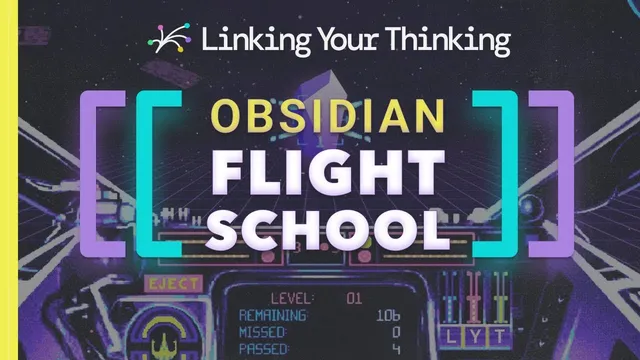
That philosophy underpins Obsidian Flight School, an educational starter kit aimed at making learners faster, more skilled, and more confident in using Obsidian. It’s positioned for people who feel overwhelmed after downloading Obsidian and want hands-on speed and joy, but it’s not for everyone: it assumes keyboard use because it relies heavily on keyboard shortcuts, and it’s not meant for those seeking training to build custom PKM systems or to develop long-term thinking habits—those are directed toward the Linking Your Thinking workshop.
Flight School’s structure is built around six “lean forward learning” principles. First, it’s curated yet non-linear, giving learners agency to choose pathways while still offering guided entry points. Second, it embeds hands-on repetitions with the exact tasks learners want—so progress depends on interacting, clicking, and practicing. Third, it’s intentionally uncomfortable: exercises and tests can frustrate, and that “getting stuck” is treated as the mechanism for deep, durable learning. Fourth, it’s immersive, functioning like a self-contained learning world even though it uses plain-text notes rather than high-end graphics. Fifth, it’s measurable through timed tests and recorded performance thresholds. Sixth, it offers multiple avenues of engagement, though Milo rates this as the weakest area because the forum component is lightweight and the experience remains mostly self-guided.
In practice, the course boots into an “arrival” area with navigational options like a checklist, a “hanger” (the recommended narrative path), and a map view with portal-like jump points. Learners can move through basic training, piloting, instruments, and resources, including simulations and obstacle courses that track time. The takeaway is not that every online course must include every principle—podcasts, for instance, are meant for lighter consumption—but that course designers should ask a decisive question: is the aim only to transfer information, or to build skills and habits? If it’s the latter, lean forward design principles provide a blueprint for making online learning feel like practice, not viewing.
Cornell Notes
Lean forward learning is presented as the antidote to passive “lean back” online education. Instead of relying on watching, effective programs force learners into immersive, hands-on repetitions of the exact skills they want—often making them uncomfortable and stuck before breakthroughs happen. Obsidian Flight School is offered as a concrete example: a keyboard-focused starter kit with 240+ lessons, embedded videos, exercises, simulations, and timed tests. Its design is rated against six principles—curated yet non-linear, unavoidable reps, productive discomfort, immersion, measurability, and multiple engagement pathways (with the forum component rated as weaker). The practical message: online courses should be built for skill and habit formation, not just information transfer.
Why does passive video watching tend to underperform for skill learning?
What is Obsidian Flight School, and who is it for?
How do the six lean forward learning principles translate into course design?
What does “measurable” look like inside Flight School?
Where does Flight School fall short on the “multiple avenues of engagement” principle?
Review Questions
- Which lean forward principle most directly explains why learners improve faster when they practice the skill repeatedly rather than only watching instruction?
- How does Flight School’s navigation (arrival/checklist/hangar/map portals) support “curated yet non-linear” learning without removing structure?
- If a course is mainly about information transfer (not skill/habit building), which lean forward principles might be unnecessary—and why?
Key Points
- 1
Lean forward learning prioritizes skill-building through active practice, because passive video watching tends to reduce engagement and slow progress.
- 2
Online course design should aim to build habits and reps, not just transfer information; the decisive question is whether learners will practice the target skills.
- 3
Obsidian Flight School is a keyboard-dependent starter kit for becoming faster and more confident in Obsidian, with 240+ lessons, embedded videos, exercises, simulations, and lifetime updates.
- 4
The six principles—curated yet non-linear, hands-on repetitions, productive discomfort, immersion, measurability, and multiple engagement avenues—provide a practical checklist for course creators.
- 5
Timed tests and performance thresholds turn practice into measurable progress, reinforcing motivation and iteration.
- 6
Not every online course needs every principle; lighter-consumption formats (like podcasts) may not require deep reps.
- 7
When social engagement is minimal, the “multiple avenues of engagement” principle may be the limiting factor even if practice is strong.