What Sam Altman and Dario Amodei Disagree About (And Why It Matters for You)
Based on AI News & Strategy Daily | Nate B Jones's video on YouTube. If you like this content, support the original creators by watching, liking and subscribing to their content.
OpenAI’s safety philosophy emphasizes iterative deployment and user feedback as the path to learning what’s safe, while Anthropic treats safety as a precondition for scaling.
Briefing
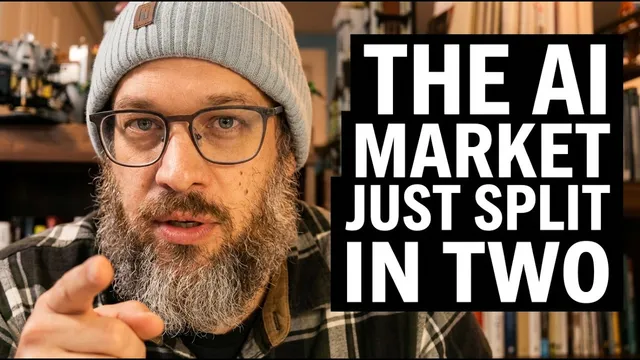
The central divide shaping AI in 2026 isn’t “reckless vs cautious.” It’s two different theories of how to achieve safety and progress: OpenAI’s approach treats deployment and real-world feedback as the path to learning what’s safe, while Anthropic’s approach treats safety as a prerequisite that must be demonstrated before scaling. That philosophical split—rooted in the backgrounds of Sam Altman and Dario Amodei—has produced increasingly different products, different markets, and different expectations for what AI should do for people.
Altman’s worldview is traced to Y Combinator’s startup doctrine: ship quickly, learn from users, and iterate. The transcript argues that OpenAI applies this logic to AI safety by releasing models once internal testing meets a threshold, then using millions of users as a “tight feedback loop” to surface problems and improve systems. It cites Altman’s stated position that the best way to make an AI system safe is to iteratively and gradually release it so society can adapt and co-evolve with the technology. Internal safeguards still exist—model cards, safety frameworks, and extensive pre-release testing—but the emphasis after release is on rapid iteration based on observed behavior.
Amodei’s worldview is presented as the mirror image: safety must be proven before deployment, not something that emerges from public exposure. The transcript links this to Amodei’s scientific training and a career focus on understanding how systems work at a fundamental level, including his work in computational neuroscience and his experience with the timing of medical breakthroughs. It also points to Anthropic’s “constitutional AI” approach and Amodei’s argument that market forces will drive benefits, but risks require active intervention—someone willing to “pump the brakes.”
Anthropic’s safety posture is illustrated through governance and standards modeled on biosafety levels. At ASL3, the transcript says, systems could meaningfully assist in bioweapons creation, so Anthropic would need to demonstrate no meaningful catastrophic misuse risk before deployment. It also claims Anthropic is willing to pause training or slow down if safety assurance can’t keep up with scaling.
The divergence shows up not only in safety philosophy but in product strategy. Anthropic is portrayed as building a focused “operating system” for professional judgment: Claude is optimized for reasoning density, code reliability, interpretability, reduced hallucinations, and tool use, with less emphasis on broad consumer features like video or companion-style chat. By contrast, OpenAI is framed as pursuing an “engine of abundance,” treating intelligence as a horizontal interface that touches many parts of life—video, health, search, voice, images—so adoption becomes habitual across use cases.
By 2026, the transcript argues, comparing Claude and ChatGPT like-for-like is increasingly misleading. They’re likened to different kinds of buildings—both powered by electricity, but designed for different purposes. The practical takeaway: expect Claude to keep strengthening high-stakes, judgment-heavy workflows, while OpenAI continues aggressive experimentation across media and domains. The “winner” depends on the kind of work—abundant output generation versus complexity management and decision support—people need AI to handle.
Cornell Notes
The transcript frames AI’s 2026 landscape as a clash of two safety philosophies. OpenAI, shaped by Y Combinator’s “ship fast” culture, emphasizes deployment and user feedback as the mechanism for learning what is safe, with iterative releases and co-evolution between society and technology. Anthropic, shaped by Dario Amodei’s scientific orientation and governance focus, treats safety as a precondition for scaling and uses stringent misuse-risk standards (including biosafety-level analogies) before broader release. These different theories don’t just affect safety—they drive product design and target markets: Claude is positioned for professional judgment and complex work, while ChatGPT is positioned as a broad, consumer-like super app for abundant intelligence outputs. The practical implication is to stop asking which model is “better” and instead ask what kind of work needs AI support.
What’s the key safety disagreement between OpenAI and Anthropic, and why does it matter?
How does Y Combinator’s “ship fast” doctrine connect to Altman’s view of AI safety?
What does Amodei’s “understand before deploying” principle look like in practice?
Why does the transcript say comparing Claude and ChatGPT is like comparing a hospital to a television studio?
How do the companies’ product visions reflect their safety and experimentation philosophies?
What does the transcript suggest about “Codex” versus “Claude Code”?
Review Questions
- How does the transcript connect Altman’s Y Combinator background to OpenAI’s approach to AI safety after release?
- What governance and risk-assurance mechanisms does the transcript attribute to Anthropic, and how do they affect scaling decisions?
- According to the transcript, what kinds of work fit better with Claude versus OpenAI’s broader super-app strategy?
Key Points
- 1
OpenAI’s safety philosophy emphasizes iterative deployment and user feedback as the path to learning what’s safe, while Anthropic treats safety as a precondition for scaling.
- 2
The transcript links OpenAI’s approach to Y Combinator’s “ship fast” doctrine and the belief that real-world interaction teaches what internal testing can’t.
- 3
Anthropic’s approach is framed as governance-first, with misuse-risk standards modeled on biosafety levels and willingness to pause or slow training when assurance lags.
- 4
Product strategy follows philosophy: Claude is positioned for professional judgment and high-stakes correctness, while ChatGPT is positioned as a broad, experimental interface meant to drive habitual adoption.
- 5
The transcript argues Claude and ChatGPT increasingly serve different “purposes,” making direct model comparisons less useful than matching AI tools to specific work needs.
- 6
Even in coding, Codex and Claude Code are portrayed as pursuing different priorities—correctness at scale versus agentic, general-purpose tool use.