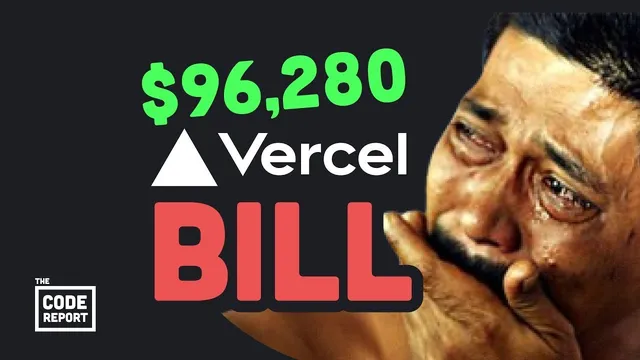
when your serverless computing bill goes parabolic...
Based on Fireship's video on YouTube. If you like this content, support the original creators by watching, liking and subscribing to their content.
Serverless functions are metered compute that scales automatically, so legitimate traffic spikes can produce rapidly growing bills.
Briefing
A legitimate, fast-growing app triggered a “serverless tax” that ballooned into a roughly $96K bill—highlighting how serverless platforms can become financially unpredictable when traffic scales without strict guardrails. The case centers on Cara.app, a free website and social network that filters out artificial content and quickly surged to more than 500,000 users. Instead of the expected windfall of popularity, the developer received a Vercel serverless functions bill that kept growing “by the second,” turning success into a cost shock.
The bill’s mechanics point to a broader problem: serverless isn’t magic, it’s metered compute that scales automatically. Vercel acts as a developer-experience layer on top of major cloud infrastructure—described here as a proxy for AWS and Cloudflare—optimized for Next.js. That setup can be profitable for both sides, but it also means pricing is designed so Vercel can charge more than the underlying providers. The transcript frames Vercel’s pricing strategy as intentionally confusing: a free hobby tier that burns through cash, with the expectation that only a small fraction of users will “mature” into profitable customers. In that model, viral growth can be financially disastrous if the app isn’t quickly monetized or capped.
Cara’s situation is treated as avoidable. Vercel reportedly responded to the developer’s public complaint by confirming it sent multiple emails warning that the app was blowing up, and that the developer failed to set a budget limit. Without a budget cap, the platform continues running serverless functions as usage rises, so costs can accelerate rapidly—especially on “infinitely scaling” systems. The transcript contrasts this with a prior viral incident involving a Netlify user who received a $100,000 bill after a DDoS attack; that bill was eventually reduced and then waved after public attention.
The takeaway is less about one company and more about operational discipline. The transcript argues that developers need to understand how their platform’s pricing scales, set hard budgets, and avoid assuming that “serverless” will automatically stay affordable. It also recommends practical escape hatches: maintain a self-hosted backup plan (the example suggests a few hundred dollars per month on AWS or Hetzner), containerize with Docker for portability, and use infrastructure tooling such as SST to reduce complexity. For those who want more control, it mentions Coolify as an open-source way to host a private Vercel-like setup.
Finally, the transcript turns personal: the narrator admits to being “addicted” to serverless and urges viewers to share alternatives in the comments. The core message is clear—serverless can be a dream for shipping fast, but without budgets and portability, it can also turn growth into a parabolic bill.
Cornell Notes
Cara.app’s rapid growth—over 500,000 users—led to a Vercel serverless functions bill that reached about $96K and kept increasing quickly. The situation is framed as a predictable outcome of metered compute on an “infinitely scaling” platform, where costs rise with traffic unless budgets and limits are configured. Vercel reportedly sent warnings and confirmed the developer didn’t set a budget cap that would have paused the project after spending thresholds were hit. The incident is used to argue that developers must understand pricing scaling, set hard limits, and plan portability (e.g., Dockerized self-hosting) to avoid a serverless cost shock.
Why did Cara.app’s success translate into a massive serverless bill?
What role does Vercel play in the cost equation?
What specific mitigation did Vercel say was missing?
How does the transcript compare this incident to earlier viral serverless billing stories?
What practical steps are recommended to avoid a “serverless tax”?
Review Questions
- What happens to serverless costs when traffic scales rapidly, and why does a missing budget cap matter?
- How does the transcript describe Vercel’s relationship to AWS/Cloudflare and Next.js, and how does that connect to pricing?
- Which portability and tooling strategies are suggested to reduce dependency on serverless pricing surprises?
Key Points
- 1
Serverless functions are metered compute that scales automatically, so legitimate traffic spikes can produce rapidly growing bills.
- 2
Cara.app’s bill ballooned because serverless execution continued as usage rose, with no budget limit configured to pause spending.
- 3
Vercel reportedly sent warnings about the app’s growth; the missing budget cap is presented as the key preventable mistake.
- 4
Cloud providers’ free tiers can be financially risky because they may burn through cash before a small fraction of users becomes profitable.
- 5
Developers should set hard budget limits and treat them as non-optional guardrails on scaling platforms.
- 6
Containerize workloads with Docker and maintain a self-hosted backup plan to reduce lock-in to any single pricing model.
- 7
Infrastructure tools like SST and self-hosting options like Coolify are suggested as ways to regain control and reduce surprise costs.