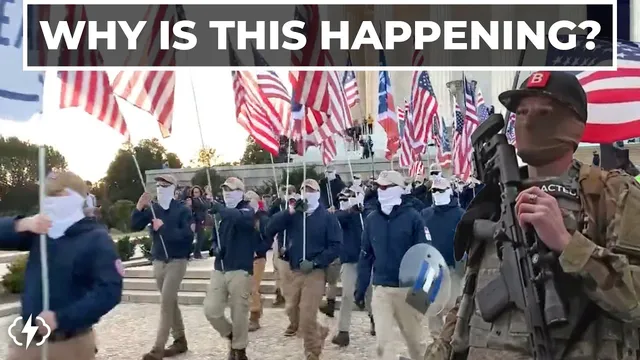
Why American Fascism Is On The Rise
Based on Second Thought's video on YouTube. If you like this content, support the original creators by watching, liking and subscribing to their content.
The transcript argues fascist politics is spreading by migrating from fringe groups into mainstream conservative culture, especially after January 6.
Briefing
The rise of fascist politics in the United States isn’t being driven only by fringe militias—it’s increasingly being absorbed into mainstream conservative life, with demographic and belief patterns pointing to a broadening base for insurrectionist ideas. After January 6, the far right’s public momentum accelerated even as some groups lost members; the movement’s growth is attributed to narratives that migrated into wider Republican culture, making authoritarian and ethnonationalist themes more socially acceptable and politically useful.
January 6 is framed as a turning point for the American far right, followed by aggressive law-enforcement action: more than 700 people have been arrested and charged, with ongoing trials aimed at identifying central figures. Yet the crackdown is treated as only part of the story. The far-right ecosystem also gained visibility through intimidation and “shows of force,” including infiltration of police forces by more extremist members. Even when groups like the Proud Boys shrank on certain platforms after 2020—amid platform crackdowns and internal disruption after leader Enrique Tario was outed as an FBI informant—the broader movement continued to expand.
A key claim is that the January 6 crowd was not made up primarily of stereotypical militant extremists. Using data from a George Washington University Program on Extremism analysis, the transcript says only about 13% of those charged were formal members of militant groups such as the Proud Boys, the Three Percenters, or the Oath Keepers; roughly 87% are described as “inspired believers,” including typical Trump supporters and independent far-right extremists. The charged attendees are also described as older (around two-thirds over 35), less likely to be unemployed, and disproportionately represented by business owners and white-collar workers—demographics presented as closer to Republican constituency profiles than to fringe militia archetypes. The implication: mainstream politics has not merely tolerated violent extremism; it has become comfortable embodying it.
The transcript then traces how specific conspiratorial and ethnonationalist narratives helped move extremist ideas into everyday conservative discourse. Election denial is cited as widespread—about 60% of Republicans are said to believe the election was stolen, aided by repeated messaging from Donald Trump. QAnon is also highlighted, with the claim that one in four Republicans buy into the conspiracy that satan-worshipping cannibalistic blood-sucking pedophiles run the government.
More central is the “great replacement” theory, described as a classic neofascist belief that white people and white culture are being displaced through immigration from majority non-white countries, leading to persecution and the need for violent “rebirth.” The transcript links the theory to past mass violence (including the Christchurch and El Paso shootings) and argues it has found a home among a substantial portion of the Republican electorate. It cites a statistic attributed to Robert Pape: 4–8% of Americans at the high end believe both election theft and that Trump should be reinstated by force; 63% are said to believe the great replacement theory, and among motivations, belief in replacement is presented as the most significant trigger turning election-deniers into people willing to commit insurrectionist violence.
Finally, the transcript places these narratives within longer structural conditions. Fascism is portrayed as having existed for decades, but its current form is intensified by failures of the neoliberal era—economic insecurity, declining union power, job loss, and repeated crises—creating fertile ground for opportunists who promise stability through authoritarian ultranationalism. In that framing, the mainstreaming of extremist beliefs is not a sudden anomaly; it’s the latest step in a long political trajectory, now made more explicit and more violent by contemporary crises like the pandemic and the culture-war backlash around mandates and “hoaxes.”
Cornell Notes
The transcript argues that U.S. fascist politics is expanding because extremist narratives have moved from fringe cells into mainstream conservative culture—especially after January 6. Data from the George Washington University Program on Extremism is used to claim that most charged participants were not formal members of militant groups; instead, many resembled typical Republican constituency demographics. The “great replacement” theory is presented as a particularly important belief that helps convert election-denying supporters into people willing to justify insurrectionist violence. Election theft denial and QAnon are also described as widely held conspiracies that help knit together far-right networks. The broader explanation ties these belief shifts to long-running economic instability and declining trust in democratic institutions, which create openings for authoritarian nationalism.
Why does the transcript treat January 6 as a turning point rather than an isolated riot?
What does the George Washington University Program on Extremism data say about who was charged after the Capitol attack?
Which narratives are credited with moving far-right ideas into mainstream Republican discourse?
How is the “great replacement” theory described, and why is it treated as especially dangerous?
What structural explanation is offered for why these narratives gained traction?
Review Questions
- Which belief does the transcript claim most strongly predicts willingness to engage in insurrectionist violence, and what supporting statistic is cited?
- How does the transcript use the charged-participant demographics to argue that mainstream Republican constituencies are implicated in far-right momentum?
- What long-term economic and political conditions are presented as the “fertile ground” for fascism’s expansion?
Key Points
- 1
The transcript argues fascist politics is spreading by migrating from fringe groups into mainstream conservative culture, especially after January 6.
- 2
Law-enforcement actions after the Capitol attack are described as extensive, but the movement’s growth is attributed to narrative mainstreaming rather than only recruitment from militias.
- 3
A George Washington University Program on Extremism analysis is used to claim most charged participants were not formal militant members and often matched typical Republican demographics.
- 4
Election theft denial, QAnon, and the “great replacement” theory are presented as key narratives that helped extremist ideas become politically normalized.
- 5
The “great replacement” theory is framed as a neofascist worldview tied to ethnonationalist persecution fears and linked to past mass violence.
- 6
A cited Robert Pape estimate claims belief in the great replacement is the strongest motivator converting election-deniers into supporters of insurrectionist force.
- 7
The transcript connects the rise in authoritarian politics to long-running economic instability and declining trust in democratic institutions, not just to extremist rhetoric.