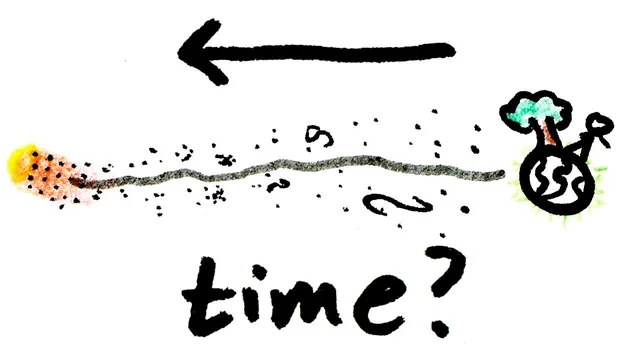
Why Doesn't Time Flow Backwards? (Big Picture Ep. 1/5)
Based on minutephysics's video on YouTube. If you like this content, support the original creators by watching, liking and subscribing to their content.
Microscopic physics equations don’t inherently prefer a direction of time, treating past and future on equal footing.
Briefing
Physics at the microscopic level treats past and future symmetrically: equations like F=ma, gravity’s inverse-square law, and Schrödinger’s equation don’t build in a “forward” direction for time. They relate what happens now to what happened earlier and what will happen later without distinguishing whether time runs one way or the other. The one widely accepted macroscopic exception is the second law of thermodynamics, which ties time’s direction to entropy—an isolated system tends to move toward greater disorder.
That entropy rule creates the familiar “arrow of time.” A cup of cold milk and hot coffee naturally mix into a lukewarm state, but the reverse process—spontaneous unmixing—doesn’t occur. Once a system reaches equilibrium, there’s no remaining thermodynamic gradient to define a direction of increasing entropy. So the fact that people experience time as flowing in one direction implies the universe is not in equilibrium right now.
Two broad scenarios can account for this. Either the universe happens to be in a special, low-entropy configuration at the present moment, with entropy increasing away from it in both time directions; or the universe began in an even lower-entropy state in the distant past, after which entropy has been rising ever since. The account given favors the second option: the universe’s initial conditions.
The low-entropy starting point is identified with the Big Bang, about 13.8 billion years ago, when the cosmos was hot, dense, smooth, and expanding rapidly. “Smoothness” may sound unstructured, but at extremely high density gravity becomes so strong that gravitational clumping is the natural tendency. In that setting, a smooth distribution is not the equilibrium state—it is a delicately balanced, low-entropy arrangement. The universe then evolves toward higher-entropy configurations by forming increasingly concentrated structures: proto-stars, proto-galaxies, and eventually black holes.
What would equilibrium look like at the largest scale? The narrative points to emptiness. As the universe expands and matter thins, stars burn out and black holes evaporate, leaving little more than dilute space. In that far-future limit, the thermodynamic basis for a time arrow would fade, and processes like life and consciousness would become impossible.
The central takeaway is that time’s one-way flow is not a built-in feature of the fundamental microscopic laws. Instead, it emerges from the universe’s special low-entropy beginning. The subsequent history—from galaxy and star formation to the origin of life—is framed as a long-running story of increasing entropy, with the arrow of time sustained by the initial conditions rather than by any intrinsic asymmetry in the core equations of physics.
Cornell Notes
Microscopic physics treats time symmetrically, but the second law of thermodynamics supplies a one-way arrow through increasing entropy. People experience time moving forward because the universe is not in equilibrium; equilibrium would remove any thermodynamic direction. The favored explanation is that the universe started in an unusually low-entropy state in the distant past—identified here with the Big Bang—so entropy has been rising ever since. In that early, extremely dense environment, smoothness is a delicate low-entropy condition because gravity strongly drives matter toward clumping. Over cosmic time, that trend leads from structure formation to a far-future state of emptiness, where the time arrow would effectively disappear.
Why don’t the fundamental laws of physics determine whether time runs forward or backward?
How does the second law of thermodynamics create an arrow of time?
What does equilibrium imply for time’s direction?
What two explanations can account for the universe not being in equilibrium today?
Why is the Big Bang described as a low-entropy state even though it was hot and dense?
What is the far-future fate of the entropy-driven time arrow?
Review Questions
- How do time-reversal-symmetric microscopic laws coexist with a one-way macroscopic arrow of time?
- What role do initial conditions play in maintaining the entropy gradient that defines time’s direction?
- Why does gravitational clumping make “smoothness” a low-entropy state in the early, high-density universe?
Key Points
- 1
Microscopic physics equations don’t inherently prefer a direction of time, treating past and future on equal footing.
- 2
The second law of thermodynamics introduces a macroscopic time arrow via increasing entropy in isolated systems.
- 3
Equilibrium removes the thermodynamic basis for a time direction, so the observed arrow implies the universe is not in equilibrium.
- 4
Time’s arrow can be explained either by a special low-entropy condition at the present moment or by a much lower-entropy beginning in the distant past.
- 5
The Big Bang is framed as that low-entropy beginning, with smoothness acting as a delicate state against strong gravitational clumping.
- 6
Cosmic evolution—from structure formation to stellar death and black hole evaporation—tracks increasing entropy toward a far-future emptiness where the time arrow fades.