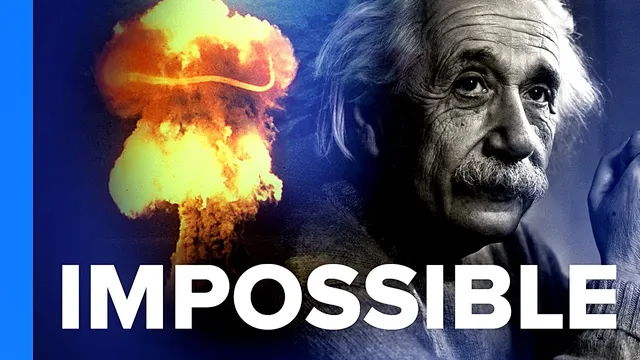
Why Einstein Thought Nuclear Weapons Were Impossible
Based on Veritasium's video on YouTube. If you like this content, support the original creators by watching, liking and subscribing to their content.
Early skepticism about nuclear power and weapons was grounded in the lack of a controllable way to force nuclei to split, not in the absence of observed radioactivity.
Briefing
Nuclear weapons weren’t inevitable because the physics needed to make nuclear energy controllable—and repeatable—was missing for decades. Early luminaries treated tapping the atom as a fantasy: Nobel laureate Robert Millikan called it unachievable, and Ernest Rutherford dismissed any hope of power from transforming atoms as “moonshine.” Their skepticism had a basis in what scientists could actually observe. Radioactivity appeared to be a natural, random decay process of unstable isotopes, releasing huge energy per atom but tiny energy on human and planetary scales.
The breakthrough path began with the mystery of where the energy came from. Henri Becquerel’s experiments showed uranium ore could expose photographic film even when it hadn’t been in sunlight—contradicting the earlier idea that uranium merely fluoresced by absorbing and reradiating light. That puzzle—an apparently inert rock emitting energy “unprovoked”—only made sense once Albert Einstein’s mass–energy equivalence, E = mc², provided a mechanism: a small amount of mass could convert into a large amount of energy. Even then, the leap from “energy exists” to “energy can be triggered on demand” remained blocked.
Before 1932, the only known particles inside atomic nuclei were protons. Trying to alter a nucleus by firing protons at it ran into a fundamental barrier: both protons are positively charged, so they repel. Even a successful hit would affect at most a single nucleus, far too little to matter. That’s why nuclear weapons seemed out of reach—scientists could observe decay, but they couldn’t reliably force nuclei to react.
The turning point came with the discovery of the neutron. Because neutrons carry no electric charge, they can penetrate nuclei without being repelled, allowing one nucleus to be transformed by another particle. This enabled the key insight associated with Leo Szilard: find an element that, when it absorbs a neutron, splits and releases additional neutrons. Uranium-235 fits the bill. When it absorbs a neutron, it can fission and release about two and a half neutrons on average per split, creating a chain reaction where each event increases the number of future events.
That same mechanism explains both the power and the danger. A bomb relies on an exponentially accelerating reaction—too many neutrons absorbed and the system races out of control; too few and the reaction either dies or becomes unstable. A power plant instead aims for a “knife-edge” balance where, on average, each fission causes one more fission, producing a steady release of energy rather than a runaway surge. In short, the neutron didn’t just make nuclear reactions possible—it made controlled, scalable nuclear reactions feasible, transforming nuclear physics from a curiosity of decay into a tool for energy and weapons.
Cornell Notes
Early scientists doubted nuclear power and nuclear weapons because they could only observe natural radioactive decay, not a controllable way to force nuclei to split. Einstein’s E = mc² explained that energy could come from converting a tiny amount of mass into energy, but the practical problem remained: how to trigger nuclear reactions on demand. The discovery of the neutron solved the biggest obstacle. Neutrons can enter nuclei without electric-charge repulsion, enabling reactions that release more neutrons. Leo Szilard’s chain-reaction idea—especially with uranium-235, which releases about 2.5 neutrons per fission on average—made exponential growth possible for bombs and steady, balanced reactions possible for power plants. The neutron is therefore central to both the feasibility and the control problem of nuclear technology.
Why did early scientists think tapping nuclear energy for power or weapons was unrealistic?
What role did Einstein’s E = mc² play in making nuclear energy seem physically possible?
How did the discovery of the neutron change the feasibility of triggering nuclear reactions?
What chain-reaction condition did Leo Szilard identify, and why does uranium-235 matter?
Why is controlling a neutron chain reaction so delicate in practice?
Review Questions
- What specific experimental result with uranium ore forced scientists to move beyond the fluorescence explanation?
- How does neutron neutrality remove the main obstacle faced by proton-driven attempts to alter nuclei?
- In chain-reaction terms, what does it mean for a system to be “balanced,” and how does imbalance relate to bomb versus power-plant behavior?
Key Points
- 1
Early skepticism about nuclear power and weapons was grounded in the lack of a controllable way to force nuclei to split, not in the absence of observed radioactivity.
- 2
Becquerel’s uranium experiments showed energy emission without sunlight, undermining the idea that uranium ore was merely fluorescing.
- 3
Einstein’s E = mc² supplied a mechanism for how nuclear energy could exist: tiny mass changes can yield large energy.
- 4
Before neutrons were known, proton-based nuclear triggering was hindered by electric repulsion and would affect too few nuclei to matter.
- 5
The neutron’s neutrality enables it to penetrate nuclei and initiate transformations that release additional neutrons.
- 6
Szilard’s chain-reaction concept depends on a fission process that produces more neutrons than it consumes, enabling exponential growth.
- 7
Uranium-235’s average neutron yield supports both explosive runaway (bomb conditions) and steady output when tuned to near-critical balance (power-plant conditions).