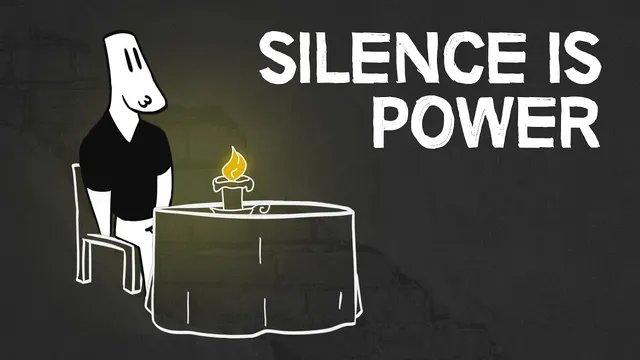
Why Silence is Power | Priceless Benefits of Being Silent
Based on Einzelgänger's video on YouTube. If you like this content, support the original creators by watching, liking and subscribing to their content.
Silence is framed as an intentional form of communication, especially in public rituals of grief and protest where words would distract from the core meaning.
Briefing
Silence functions as a form of communication and self-regulation—cutting through noise to sharpen perception, unlock creativity, and improve mental health. Across cultural rituals and everyday interactions, brief stretches of quiet are portrayed as more than absence: they carry meaning, force attention, and create psychological space where insight can surface.
The argument begins with how silence gains power in public grief and protest. Dutch “Silent March” traditions are traced to Catholic processions in Amsterdam that survived a Protestant ban: the march could proceed without prayers, singing, religious garments, or other prohibited elements. The result was a ritual where quiet becomes the message—especially after violence—because it leaves no room for distraction. The annual Dutch Remembrance of the Dead similarly uses two minutes of silence on 4 May, positioning quiet as a direct counter to war’s “culture of noise.” In this framing, silence resists the loudness of violent people and the hollow chatter that often follows tragedy.
From there, the benefits of being quiet are organized into four practical claims. First, “the quieter you are, the more you hear.” Quiet listening is presented as the gateway to both external awareness and internal signals: people miss important sounds and intuitions when they keep talking over themselves. The text links this to a cluster of philosophical and spiritual ideas—Rumi’s “voice that doesn’t use words,” Emerson’s “inner knowing,” Pythagoras’s contrast between speech and wisdom, and Lao Tzu’s view that those who know do not talk. In addition to learning about the environment and spotting danger or opportunity, silence is said to help people observe thoughts without treating them as the self, aligning with Buddhist teachings that regard thoughts as fleeting mental aggregates.
Second, silence is credited with boosting creativity. Einstein is cited for treating quiet as a condition for breakthroughs—stopping active thinking and “swimming in silence” until the needed information arrives. The same logic is reinforced through neuroscience-oriented claims attributed to David Rock: “aha” moments are described as quieter neural events that are easier to notice when overall brain activity is low, such as during relaxed states or repetitive focus.
Third, silence is framed as a powerful message in conversation. Rightly timed pauses can communicate more effectively than words, and the Remembrance ritual is offered as a proof point: the two minutes of silence are described as the ceremony’s most impactful moment. In interpersonal settings, silence can also create productive pressure—awkward gaps can make people uneasy because uncertainty feels uncomfortable, prompting the other person to act to end the tension. Silence is also portrayed as safer than speech when someone lacks knowledge, since listening avoids the risk of appearing foolish while still signaling engagement.
Finally, silence is presented as a route to well-being. Research is cited for links between silence and relaxation, improved sleep, and reduced insomnia, including a claim that two minutes of silence can calm more than relaxing music. Noise exposure is described as raising stress hormones and disrupting sleep structure, while Florence Nightingale’s warning about “unnecessary noise” is used to argue that excessive input harms functioning. The closing emphasis is that silence creates a mental “emptiness” that allows recalibration—helping people think better, question their baseline, and escape the constant flow of information.
Cornell Notes
Silence is portrayed as an active force: it communicates respect in public rituals, improves perception, and creates mental conditions for insight. Quiet listening helps people notice both external information and internal signals like intuition and bodily cues, while also enabling reflective awareness of thoughts as transient rather than as “the self.” Silence is also linked to creativity, with Einstein’s practice of pausing and “swimming in silence” used to illustrate how breakthroughs can emerge when mental activity quiets. In conversation, well-timed pauses can be more persuasive than words and can even shift outcomes by increasing uncertainty. Finally, silence is presented as beneficial for well-being, with research claims connecting quiet to relaxation and better sleep while noise is framed as a stressor that disrupts health.
Why are Dutch silent rituals treated as evidence that silence can carry meaning stronger than words?
How does “the quieter you are, the more you hear” connect silence to learning and self-awareness?
What mechanisms are offered for why silence boosts creativity?
How can silence function as a strategic communication tool in conversation?
What does the transcript claim about silence and mental health or sleep?
Review Questions
- Which specific cultural examples are used to argue that silence can communicate respect and grief more powerfully than speech?
- How does the transcript connect quietness to both creativity (“aha” moments) and self-awareness (observing thoughts without identifying with them)?
- What conversational effects are attributed to silence, including timing (e.g., the four-second threshold) and the role of uncertainty?
Key Points
- 1
Silence is framed as an intentional form of communication, especially in public rituals of grief and protest where words would distract from the core meaning.
- 2
Quiet listening is presented as a skill that improves perception of both external cues and internal signals like intuition and bodily discomfort.
- 3
Silence is linked to creativity by lowering overall mental activity so subtle cognitive connections can emerge as insights.
- 4
In conversation, well-timed pauses can strengthen a message, increase pressure through uncertainty, and reduce the risk of speaking when unprepared.
- 5
Silence is portrayed as beneficial for mental health and sleep, with claims that short periods of quiet can calm more than relaxing music.
- 6
Noise is treated as a physiological stressor that can raise stress hormones and disrupt sleep patterns, making silence a practical countermeasure.
- 7
The transcript emphasizes that silence creates “emptiness” or mental space that helps people recalibrate their baseline and think more clearly.