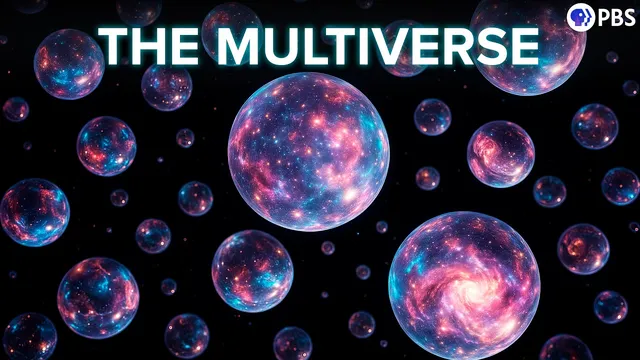
Why The Multiverse Could Be Real
Based on PBS Space Time's video on YouTube. If you like this content, support the original creators by watching, liking and subscribing to their content.
Different meanings of “universe” (observable region vs. connected spacetime with potentially different laws) determine whether multiverse proposals are coherent.
Briefing
The multiverse idea sits at the center of a high-stakes physics debate: whether positing many universes is a legitimate way to explain why our universe’s laws and constants seem “finely tuned” for life—or whether it’s a shortcut that collapses under scrutiny. The core claim in favor of the multiverse is that selection effects can make our particular universe look special without requiring a single, uniquely designed set of physical parameters. If countless universes exist with different vacuum states and physical laws, then observers inevitably find themselves in the rare regions where conditions permit complex chemistry, stars, and eventually life.
That argument starts with how “universe” is used in modern cosmology. It often means the continuous spacetime traced back to a big bang, bounded observationally by the particle horizon—everything light has had time to reach. But physics could allow regions beyond that horizon to behave like separate “universes” if the laws of physics change across vast distances. Several mechanisms have been proposed for such variation. Eternal inflation imagines a rapidly expanding background spacetime that spawns “bubble” regions, each potentially with different physics. A “quilt multiverse” allows connected regions where physical laws differ over extreme distances. Other proposals generate different universes through black-hole interiors (as in cosmological natural selection) or through cyclic scenarios where laws shift between cycles.
The most detailed route to different physics comes from changing the vacuum state of fields. In the Higgs sector, the Higgs boson mass—and thus the masses of other particles—depends on the Higgs field’s ground-state energy. If the ground state can take different local minima, then different Higgs masses follow, and for almost all choices the resulting universe would be uninhabitable. String theory offers a related picture through the “string landscape,” where extra dimensions are compactified on a Calabi–Yau manifold. Different geometries and topologies yield different particle spectra and interaction strengths, producing an enormous number—on the order of 10^500—of possible vacuum configurations.
The multiverse then connects to the anthropic principle: observers should not be surprised to find themselves in a universe compatible with observation. Our biosphere is rare within our own universe, yet that rarity is not shocking because observers must arise where conditions allow them. The same logic extends to the multiverse: if only a tiny fraction of universes support life, then it’s expected that we would measure the particular constants that make life possible.
Critics argue the multiverse violates Okam’s razor by multiplying entities and risks becoming unfalsifiable. The defense offered here is that Okam’s razor targets unnecessary assumptions, not necessarily the size of the structures those assumptions generate. If a multiverse emerges as a consequence of a deeper theory—rather than being bolted on as an extra hypothesis—then it may not be the kind of “overfitting” Okam’s razor warns against. On falsifiability, the argument is more nuanced: strict Popper-style falsification is only one definition of science. Even without direct access to other universes, anthropic reasoning can yield testable predictions for what should be observed in our universe. A prominent example is Steven Weinberg’s anthropic estimate for dark energy, which links the observed value to the requirement that galaxies and observers can form.
The upshot is conditional. Multiverse ideas are most credible when they arise from established frameworks and generate further, constrained predictions. Treated as a blanket explanation for fine-tuning without mechanisms that lead to distinctive observational consequences, the multiverse can indeed look like bad science. But with careful formulation, it remains a live scientific candidate for why our universe’s parameters land in the narrow window where life can exist.
Cornell Notes
The multiverse debate turns on whether many universes are a principled explanation for fine-tuning or an unfalsifiable detour. Several physics frameworks—eternal inflation, “quilt” scenarios, black-hole universe formation, cyclic models, and especially vacuum-state variation in the Higgs sector and the string landscape—provide ways for different regions to have different laws or constants. The anthropic principle then predicts that observers will find themselves in the rare universes compatible with life, so our universe’s “special” parameters need not be uniquely explained. Critics invoke Okam’s razor and unfalsifiability, but supporters argue that multiverses can follow from deeper theories and that anthropic reasoning can produce testable predictions, such as anthropic estimates for dark energy. The idea is most scientifically useful when it yields constrained, observationally relevant consequences rather than serving as a catch-all.
What does “universe” mean in this discussion, and why does that matter for multiverse claims?
How do different multiverse models generate different laws of physics?
Why does changing the Higgs vacuum state lead to drastically different universes?
What is the “string landscape,” and how does it relate to the multiverse?
How does the anthropic principle connect multiverse ideas to observations in our universe?
What are the main criticisms, and what counterpoints are offered?
Review Questions
- Which multiverse-generating mechanisms in the transcript directly rely on changing vacuum states, and what physical quantities change as a result?
- How does the transcript reinterpret Okam’s razor in the context of multiverse theories—what does it say Okam’s razor is actually warning against?
- What makes an anthropic prediction potentially testable, and what observational quantity is given as an example (including the name of the researcher)?
Key Points
- 1
Different meanings of “universe” (observable region vs. connected spacetime with potentially different laws) determine whether multiverse proposals are coherent.
- 2
Eternal inflation and quilt multiverse scenarios both allow regions beyond our horizon to behave like separate universes if physical laws differ.
- 3
Vacuum-state variation provides a concrete path to different physics, including Higgs ground-state changes that alter particle masses and habitability.
- 4
String theory’s Calabi–Yau compactifications generate a “string landscape” with an enormous number of possible vacuum configurations (about 10^500).
- 5
The anthropic principle reframes fine-tuning as a selection effect: observers should find themselves in the rare universes compatible with life.
- 6
Okam’s razor is argued to target unnecessary assumptions rather than the sheer size or number of outcomes produced by a theory.
- 7
Anthropic reasoning can yield constrained, potentially testable predictions—such as anthropic estimates for dark energy attributed to Steven Weinberg—so multiverse ideas need not be explanatory dead ends if handled carefully.