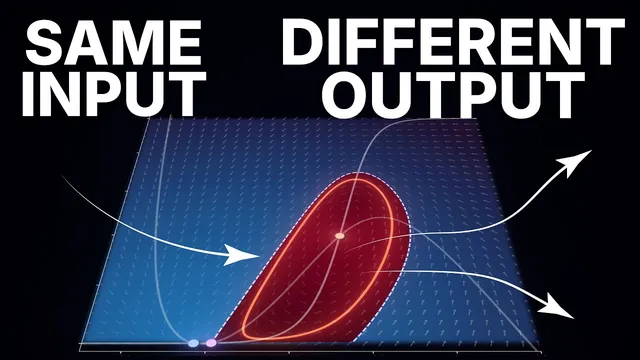
Why Two Identical Neurons Behave Differently
Based on Artem Kirsanov's video on YouTube. If you like this content, support the original creators by watching, liking and subscribing to their content.
Identical neurons can diverge because their internal dynamical state evolves in phase space, where history determines which basin of attraction the system occupies.
Briefing
Two neurons that look identical can behave very differently because their electrical activity depends on where their state sits in an internal “history” of dynamical trajectories. In a simplified two-variable model of a neuron—membrane voltage plus potassium-channel activation—small differences in prior perturbations can place the system on opposite sides of a threshold in phase space. That threshold determines whether the neuron returns to rest after a spike attempt or locks into sustained repetitive firing.
The core mechanism is geometric. Starting from the Hodgkin–Huxley framework, the model reduces fast sodium activation to an instantaneous equilibrium and often omits the inactivation gate, leaving coupled equations for voltage and potassium gating. Plotting these variables as axes produces a phase portrait: arrows show how the neuron’s state moves over time. Where arrows vanish are equilibria—resting states and other fixed points. Some equilibria are stable (nearby trajectories flow back), while others are unstable (trajectories run away). Intersections of nullclines—curves where one variable stays constant—create these equilibria, and their stability shapes what the neuron does after perturbations.
When the neuron receives sustained input current, the phase portrait can support a limit cycle: a closed loop that the system repeatedly traverses, corresponding to rhythmic spiking. Crucially, the model often contains both a stable resting equilibrium and an unstable saddle point whose separatrix acts like a watershed. Perturbations that push the state into the limit cycle’s basin of attraction produce persistent firing; perturbations that fall short return the state to rest. If the push is too strong and overshoots the basin, the neuron can also return to rest after a spike detour. This “sweet spot” produces bistability and hysteresis: the same input current can yield either rest or repetitive firing depending on recent history.
Different neurons achieve different computational behaviors through different bifurcations—qualitative changes in the phase portrait as input current (or biophysical parameters) shift. For bistable integrators, increasing current can trigger a saddle-node bifurcation where a stable node and an unstable saddle collide and annihilate, leaving only the limit cycle; the neuron then spikes repetitively. A closely related case, SNIC (saddle-node on an invariant circle), yields monostable integrators: the resting equilibrium blocks spiking until it disappears, after which repetitive firing emerges.
For resonator behavior, the story shifts to Andronov–Hopf bifurcations. In the supercritical Hopf case, a stable equilibrium loses stability and a small limit cycle emerges gradually, producing monostable resonators with sub-threshold oscillations whose timing matters. In the sub-critical Hopf case, a large stable cycle can coexist with a stable equilibrium, separated by an unstable cyclic threshold; this creates bistable resonators where the neuron can either rest or sustain oscillations at the same input level.
Putting it together yields two key dichotomies—monostable vs bistable, and integrator vs resonator—that map onto four bifurcation types. Integrators accumulate perturbations until crossing a threshold, while resonators respond preferentially to inputs at specific phases of oscillations. The result is a dynamical-systems explanation for why neurons can function as memory-like switches or timing-sensitive oscillators even when their outward structure appears identical.
Cornell Notes
Identical-looking neurons can diverge in behavior because their internal state evolves in phase space, where equilibria, limit cycles, and separatrices create history-dependent outcomes. Reducing Hodgkin–Huxley to voltage plus potassium activation yields a 2D phase portrait whose nullclines and equilibria determine whether perturbations decay back to rest or enter a basin of attraction for repetitive firing. Bistable neurons arise when a stable resting state coexists with a spiking limit cycle, separated by a saddle’s separatrix; the same input current can produce rest or firing depending on prior perturbations (hysteresis). Different bifurcations explain whether neurons act as integrators (threshold crossing) or resonators (timing-sensitive oscillations), linking saddle-node/SNIC and supercritical/sub-critical Hopf regimes to distinct computational roles.
How does a two-variable phase portrait explain why identical neurons can fire differently?
What role does the separatrix play in switching between rest and repetitive firing?
Why do bistable neurons exhibit hysteresis under the same input current?
How do saddle-node and SNIC bifurcations differ in the neuron’s spiking behavior?
What distinguishes integrators from resonators in terms of input timing?
How do supercritical vs sub-critical Hopf bifurcations change the neuron’s response?
Review Questions
- In the reduced V–n model, how do nullclines and their intersections determine the number and type (stable vs unstable) of equilibria?
- What phase-space feature makes a neuron’s response depend on prior perturbations rather than only on current input?
- How do integrator and resonator behaviors map onto saddle-node/SNIC versus supercritical/sub-critical Hopf bifurcations?
Key Points
- 1
Identical neurons can diverge because their internal dynamical state evolves in phase space, where history determines which basin of attraction the system occupies.
- 2
Reducing Hodgkin–Huxley to voltage plus potassium activation enables a geometric phase-portrait explanation of rest, spikes, and repetitive firing.
- 3
Stable equilibria correspond to resting behavior; unstable equilibria and their separatrices create thresholds for switching into spiking attractors.
- 4
Bistability and hysteresis arise when a stable resting state coexists with a stable limit cycle, separated by an unstable saddle structure.
- 5
Saddle-node and SNIC bifurcations produce integrator-like behavior where cumulative perturbations cross a threshold, while Andronov–Hopf bifurcations produce resonator-like behavior where input timing relative to oscillation phase matters.
- 6
Supercritical Hopf bifurcations yield monostable resonators with gradual emergence of oscillations, whereas sub-critical Hopf bifurcations yield bistable resonators with coexisting rest and large-amplitude firing states.