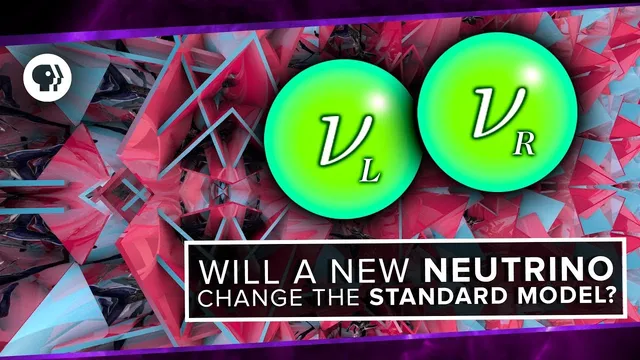
Will A New Neutrino Change The Standard Model?
Based on PBS Space Time's video on YouTube. If you like this content, support the original creators by watching, liking and subscribing to their content.
Sterile neutrinos are hypothetical neutrinos that would not interact through the weak nuclear force, so evidence would likely come from oscillation effects rather than direct detection.
Briefing
A growing set of neutrino measurements points to a possible “sterile neutrino”—a new kind of neutrino that would not interact through the weak nuclear force, making it far harder to detect than the neutrinos already known. The most discussed hint comes from MiniBooNE at Fermilab, which reported a significant excess of electron-like events compared with expectations from standard neutrino oscillations. If the excess is real and can be explained by sterile neutrinos, it would represent the first clear expansion of the Standard Model’s particle roster since the Higgs boson—and it could also reshape ideas about the early universe and dark matter.
Regular neutrinos are “aloof” because they interact only via the weak force and gravity, so they pass through matter with little chance of collision. Sterile neutrinos would be even more isolated: they would not couple to the weak force at all. The physics motivation starts with chirality, a property tied to how particles interact with the weak interaction. In the Standard Model, only left-handed neutrinos and right-handed antineutrinos participate in weak interactions; the opposite chiralities would be effectively invisible to detectors relying on weak-force interactions. That makes sterile neutrinos a natural candidate if neutrinos’ masses arise from mechanisms that allow chirality to mix.
Neutrino oscillations already show that neutrinos have mass, because flavors change as they propagate—electron, muon, and tau neutrinos transform into one another. Over the short baseline of MiniBooNE, the Standard Model predicts only a tiny probability for muon neutrinos to become electron neutrinos. MiniBooNE instead observed more electron neutrinos than expected. One proposed explanation inserts sterile neutrinos into the oscillation chain: muon neutrinos could oscillate into sterile states, and then sterile neutrinos could convert into electron neutrinos, boosting the electron-like signal.
MiniBooNE reported the excess at the 4.8 sigma level. That falls just short of the 5-sigma threshold typically used for discovery claims, so the analysis gained traction by combining MiniBooNE with an older result from LSND at Los Alamos, which had reported a 3.8-sigma excess. Together, the combined significance was claimed to reach 6.1 sigma. In that scenario, the sterile neutrino would have a mass around 1 electronvolt—heavier than known neutrinos but still far too light to serve as conventional dark matter.
The case is not settled. Other constraints conflict with sterile neutrinos, including IceCube’s search for muon-to-electron transitions through Earth, which found no supporting evidence. Cosmological data add another pressure point: analyses of the cosmic microwave background by the Planck satellite align with only three neutrino species. Adding extra neutrino types would have changed the universe’s early expansion rate. The tension leaves two possibilities: MiniBooNE’s excess could reflect an unaccounted-for experimental effect, or it could be the first sign of missing physics. Either way, the sterile-neutrino question has become a focal test of whether the Standard Model needs a new ingredient beyond the Higgs era.
Cornell Notes
Sterile neutrinos are hypothetical neutrinos that would not interact via the weak nuclear force, making them “invisible” to many standard detection methods. The motivation comes from chirality: only left-handed neutrinos and right-handed antineutrinos participate in weak interactions, while the opposite chiralities would be effectively sterile. MiniBooNE at Fermilab reported an excess of electron-like events over the Standard Model expectation for muon-to-electron neutrino oscillations, with a 4.8-sigma significance. When combined with an older LSND excess, the claimed significance rises to 6.1 sigma, and the implied sterile-neutrino mass is about 1 electronvolt. The main challenge is that IceCube and Planck results constrain sterile neutrinos in ways that conflict with the MiniBooNE/LSND interpretation.
Why would sterile neutrinos be hard to detect compared with known neutrinos?
How does chirality connect to the idea of sterile neutrinos?
What did MiniBooNE measure, and why is it relevant to sterile neutrinos?
How strong was the evidence, and what role did LSND play?
What observations challenge the sterile-neutrino interpretation?
If sterile neutrinos exist in this scenario, what mass scale is implied?
Review Questions
- What specific property of neutrinos (chirality) determines whether they interact via the weak nuclear force, and how does that lead to the sterile-neutrino concept?
- Why does an excess of electron-like events at MiniBooNE matter even though sterile neutrinos are not directly detected?
- Which two major lines of evidence—one experimental (IceCube) and one cosmological (Planck)—pull against the sterile-neutrino interpretation, and what do they each constrain?
Key Points
- 1
Sterile neutrinos are hypothetical neutrinos that would not interact through the weak nuclear force, so evidence would likely come from oscillation effects rather than direct detection.
- 2
Chirality controls weak interactions: only left-handed neutrinos and right-handed antineutrinos interact via the weak force, while the opposite chiralities would be effectively sterile.
- 3
MiniBooNE observed an electron-like excess over Standard Model expectations for muon-to-electron oscillations over a short baseline.
- 4
MiniBooNE’s 4.8-sigma result gained additional weight when combined with LSND’s 3.8-sigma excess, yielding a claimed 6.1-sigma signal.
- 5
The sterile-neutrino explanation implies a mass scale around 1 electronvolt, which is too light for conventional dark matter.
- 6
IceCube found no evidence for sterile neutrinos in muon-to-electron transitions through Earth, and Planck’s cosmic microwave background analysis supports only three neutrino types.
- 7
The current picture is tension: the MiniBooNE/LSND hint is intriguing but conflicts with other experimental and cosmological constraints, leaving open the possibility of unaccounted-for systematics or new physics.