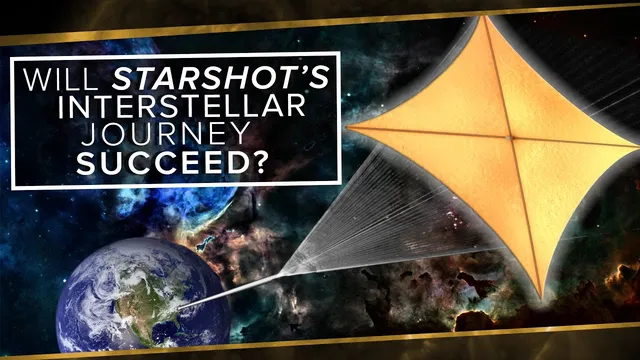
Will Starshot's Insterstellar Journey Succeed?
Based on PBS Space Time's video on YouTube. If you like this content, support the original creators by watching, liking and subscribing to their content.
Breakthrough Starshot targets Alpha Centauri with laser-driven light sails, aiming to return close-up images within about 45–50 years from launch.
Briefing
Breakthrough Starshot aims to send swarms of gram-scale “nanocraft” to Alpha Centauri using laser-driven light sails, with the goal of returning close-up images of alien worlds within roughly half a century. The core pitch is speed without onboard fuel: a ground-based laser array would accelerate ultra-thin, reflective sails to a significant fraction of light speed, letting thousands of tiny probes zip through the target system long enough to capture data before they can’t be slowed or recovered.
The propulsion concept builds on solar-sail experiments but swaps sunlight for lasers. Solar sails work inside the solar system, yet Alpha Centauri sits 4.4 light-years away—far enough that sunlight acceleration would take millennia. Earlier interstellar proposals, such as Robert Forward’s Starwisp (later updated by Geoffrey Landis), used microwave lasers and a large lens to push a kilometer-scale mesh sail to about 10% of light speed. Starshot keeps the same basic “laser + sail” logic while making the craft dramatically lighter—on the order of grams rather than kilograms—so a laser system that can be built on Earth in the coming decades could still reach useful velocities.
Each Starshot unit is envisioned as a sail about a meter across made from an advanced meta-material, potentially involving graphene, and carrying a minimal payload: a wafer of electronics with detectors including a camera, small lasers that can both help with control and serve as communication devices, and possibly a small nuclear battery. A visible-light laser replaces the microwave approach because tighter beam control matters when the sail is so small. The planned power source is a phased array of mini lasers—described as a “light beamer”—capable of producing a combined 100 gigawatts. The concept is to accelerate a craft to around 20% of light speed in minutes, reaching Alpha Centauri in a little over 20 years, with image data taking another 4.4 years to reach Earth.
Because the probes can’t be decelerated at the destination, the mission depends on scale: thousands of nanocraft launched in a long stream. Each craft would have only minutes to photograph planets and collect spectral information as it passes through the system. The expected imaging resolution is ambitious—comparable to what a 300-kilometer telescope on Earth could achieve—potentially enough to resolve continents and oceans on exoplanets around Alpha Centauri. Color-sensitive measurements could also help search for life-related signatures.
The bottlenecks are engineering rather than physics. The sail must be extraordinarily thin and resistant to heating, while surviving tens of thousands of G-forces during acceleration and impacts from interstellar dust and cosmic rays. The laser array must also maintain extreme pointing precision through atmospheric turbulence, and the tiny probes must know where to aim their cameras and how to transmit data back with limited onboard energy.
The program’s timeline leans heavily on continued exponential progress—often framed as Moore’s law—across computing, camera pixel density, and laser power-to-mass ratios. Funding and institutional backing are already in place: Yuri Milner has put $100 million into early work, with completion projected to require several billion. The advisory structure includes high-profile figures such as Stephen Hawking and Mark Zuckerberg, alongside scientists and engineers including Freeman Dyson, Martin Rees, and Saul Perlmutter.
The discussion then pivots to cosmology, using comments about dark energy to revisit how a constant energy density can drive exponential expansion, why dark energy affects intergalactic space more than inside galaxies, and how the “cosmic distance ladder” calibrates standard candles like Type 1a supernovae using Cepheid variables and nearby distance measurements. The segment closes with the grim prospect of heat death—an end state that depends on what dark energy ultimately turns out to be.
Cornell Notes
Breakthrough Starshot proposes laser-driven light sails to reach Alpha Centauri quickly enough for near-future astronomy. The plan uses ultra-light “nanocraft” (gram-scale sails about a meter wide) accelerated by a ground-based phased laser array producing about 100 gigawatts, aiming for roughly 20% of light speed. Thousands of probes would be launched because they can’t slow down at the destination; each would gather only minutes of data while passing through the system. Expected results include high-resolution imaging (continent/ocean-level detail if planets exist) and possible spectral hints of life. Success hinges on extreme miniaturization, sail survivability under tens of thousands of G, precise laser beam control through atmospheric turbulence, and continued technological progress consistent with Moore’s law.
Why can’t sunlight-powered sails realistically reach Alpha Centauri on a human timescale?
How does Starshot differ from earlier laser-sail concepts like Starwisp?
What role does visible-light laser technology play in Starshot’s feasibility?
Why launch thousands of probes instead of one or a few?
What are the biggest technical risks, based on the mission requirements?
How does the segment connect Starshot’s ambitions to broader astronomy methods like distance measurement?
Review Questions
- What specific combination of factors makes laser-powered light sails necessary for interstellar travel to Alpha Centauri?
- Explain why Starshot’s mission design depends on launching thousands of nanocraft and what that implies for data collection.
- List at least three engineering hurdles that must be solved for the sail, the laser array, and the tiny payload to work together.
Key Points
- 1
Breakthrough Starshot targets Alpha Centauri with laser-driven light sails, aiming to return close-up images within about 45–50 years from launch.
- 2
Interstellar travel requires lasers because sunlight acceleration would take many millennia to reach Alpha Centauri’s 4.4-light-year distance.
- 3
Starshot’s main innovation is ultra-low mass nanocraft (grams) with meter-scale reflective sails, enabling acceleration to roughly 20% of light speed using a plausible Earth-based laser system.
- 4
A ground-based phased laser array (“light beamer”) is projected to deliver about 100 gigawatts and accelerate craft in minutes, with visible-light lasers chosen for tighter beam control.
- 5
The mission relies on launching thousands of probes because they can’t slow down at the destination; each craft has only minutes to image and collect spectra.
- 6
Success depends on extreme miniaturization, sail survivability under tens of thousands of G and harsh space conditions, and precise beam steering through atmospheric turbulence.
- 7
The later cosmology discussion ties into how Type 1a supernova distances are calibrated using the cosmic distance ladder and Cepheid variable stars.