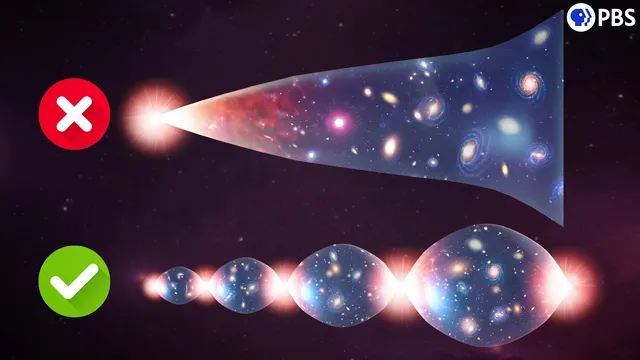
Will The Big Bang Happen AGAIN (and Again)?
Based on PBS Space Time's video on YouTube. If you like this content, support the original creators by watching, liking and subscribing to their content.
Inflation solves the horizon, flatness, and magnetic monopole problems by invoking an early period of extreme exponential expansion.
Briefing
Cyclic cosmology is getting a serious makeover: instead of a universe that bounces but still needs a “first” moment, a modern ekpyrotic model aims to remove the beginning of time while also reproducing the key successes of inflation. The central pitch is that the same kind of scalar field used to drive inflation can be tuned so the universe expands, slows, recollapses, and then regenerates—without a singular start—potentially making the Big Bang part of an endless temporal cycle.
Mainstream Big Bang cosmology fits major observations—galaxy recession indicates expansion, and the cosmic microwave background (CMB) looks like afterglow from an early hot, dense state. But several puzzles remain in the simplest version: the horizon problem (distant regions look too uniform despite lacking time to exchange information), the flatness problem (the universe’s geometry requires an extremely precise balance between matter and dark energy), and the magnetic monopole problem (a hot early phase would produce relics like monopoles that aren’t observed). Inflation is the dominant fix: an early period of extreme, exponential expansion stretches space so distant regions become causally connected, flattens geometry, and dilutes monopoles. It also seeds structure by amplifying quantum fluctuations in an inflaton field, producing the nearly scale-invariant “lumpiness” seen in the CMB.
Yet inflation carries baggage. Many modern versions imply inflation never ends everywhere, spawning an eternally inflating multiverse and bubble universes. Inflation also doesn’t eliminate the beginning-of-time issue: it still points back to a singularity where densities become infinite. That’s where the ekpyrotic approach pivots. Earlier cyclic models struggled because entropy and the universe’s lifetime had to grow with each bounce, preventing an infinite extrapolation backward. The ekpyrotic scenario instead uses a carefully shaped scalar-field potential so that contraction amplifies quantum fluctuations, smoothing the universe and generating the same kind of scale-invariant spectrum inflation predicts—while avoiding arbitrarily high temperatures and thus sidestepping monopole production. In this picture, cycles can extend back indefinitely because successive cycles don’t require ever-increasing “starting conditions.”
The model’s mechanics are tied to a higher-dimensional framework often associated with M-theory. The universe is described as a “brane” (a 3D slice) embedded in a higher-dimensional “bulk,” with additional compact dimensions. A collision between a visible brane and a hidden brane can dump energy into the visible brane, triggering a Big Bang-like expansion. The scalar field value is interpreted as the distance between branes: as the branes approach, the potential energy changes in a way that drives the ekpyrotic contraction phase and then the bounce. Quantum fluctuations on the incoming brane translate into variations in when different regions start expanding, which later show up as density and temperature fluctuations in the CMB.
The big question now is testability. Ekpyrotic cosmology is designed to match inflation’s observables closely, but it may differ in details—especially the spectrum of primordial gravitational waves. Inflation and ekpyrosis both predict a gravitational-wave background from the early energetic phase, but the ekpyrotic case is expected to weight signals toward lower frequencies. No planned detector can currently see these faint relics, though future gravitational-wave instruments—or subtle imprints in CMB polarization—could provide a way to distinguish an eternally inflating multiverse from an endless chain of expansion and contraction.
Cornell Notes
The ekpyrotic cyclic universe aims to replace inflation’s “beginning” with an infinite past by using a scalar field with a special potential. In this model, the universe expands, slows, contracts in an ekpyrotic phase, and then regenerates without reaching a singularity or arbitrarily high temperatures. During slow contraction, quantum fluctuations are amplified in a way that produces the same kind of scale-invariant density pattern seen in the CMB, while smoothing the horizon problem and avoiding magnetic monopole production. A brane-collision picture in a higher-dimensional bulk (often discussed in M-theory contexts) provides a physical interpretation: the scalar field tracks the distance between branes, and their collision triggers the Big Bang-like expansion. The main observational discriminator would be primordial gravitational waves and possibly CMB polarization signatures.
Why does the simplest Big Bang model run into the horizon, flatness, and magnetic monopole problems?
How does inflation fix those problems, and what does it predict that matches observations?
What shortcomings of inflation motivate the ekpyrotic alternative?
How does the ekpyrotic cyclic model eliminate a beginning of time while reproducing inflation-like predictions?
What role do branes and brane collisions play in the ekpyrotic picture?
What observations could distinguish ekpyrosis from inflation?
Review Questions
- What specific early-universe conditions make the horizon, flatness, and magnetic monopole problems difficult for the simplest Big Bang model?
- Compare how inflation and ekpyrosis generate scale-invariant fluctuations and what each predicts about primordial gravitational waves.
- Why do entropy growth and universe lifetime growth undermine earlier cyclic models, and how does the ekpyrotic scenario aim to avoid that limitation?
Key Points
- 1
Inflation solves the horizon, flatness, and magnetic monopole problems by invoking an early period of extreme exponential expansion.
- 2
Inflation’s quantum-fluctuation mechanism also predicts a nearly scale-invariant spectrum of CMB “lumpiness,” matching observations.
- 3
Modern inflationary scenarios often imply eternal inflation and a multiverse, and they still rely on a singular beginning with infinite density.
- 4
The ekpyrotic cyclic model uses a tuned scalar-field potential to create an infinite sequence of expansion and contraction without a singularity or arbitrarily high temperatures.
- 5
During slow contraction in the ekpyrotic phase, amplified quantum fluctuations can reproduce inflation-like scale invariance and smoothness.
- 6
A brane-collision framework (in a higher-dimensional bulk) interprets the scalar field as brane separation and the Big Bang as energy released during collision.
- 7
The most promising discriminator is the primordial gravitational-wave spectrum, potentially supplemented by future CMB polarization measurements.