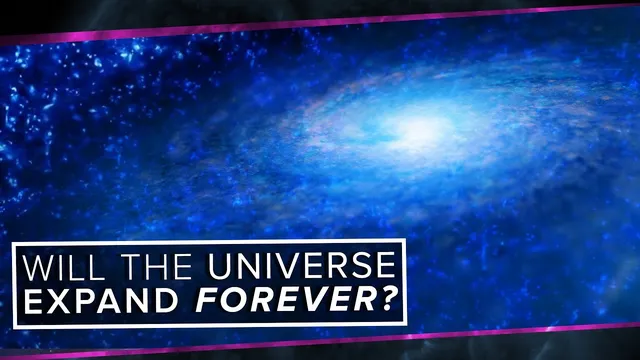
Will the Universe Expand Forever?
Based on PBS Space Time's video on YouTube. If you like this content, support the original creators by watching, liking and subscribing to their content.
The Friedmann equations, derived from Einstein’s general relativity for a smooth universe, determine cosmic fate by comparing expansion-driven terms with gravity-driven terms.
Briefing
The universe’s long-term fate hinges on a simple but powerful comparison: the expansion energy implied by today’s measured expansion rate versus the gravitational “pull back” implied by the universe’s matter density. Using the Friedmann equations—derived from Einstein’s general relativity under the assumption of a smooth, evenly distributed cosmos—cosmologists find that the expansion rate is too large for gravity to ever bring the universe back together. In the language of the equations, the left-hand side stays positive, meaning there is always enough “oomph” for expansion to continue forever rather than grind to a halt or collapse.
For decades, the leading method for deciding between eternal expansion and recollapse was to measure the universe’s density, including dark matter. The logic was straightforward: if there were enough total mass-energy, gravity would eventually overcome the outward motion of space, pushing the universe toward a “Big Crunch.” But the observed density comes up short—roughly only about a quarter of what would be needed to reverse expansion. That shortfall prevents the universe from reaching the critical balance point where expansion would asymptotically approach zero. With the density too low, the equations leave no room for recollapse: the universe expands forever.
The story gets more interesting when the discussion turns to a mismatch inside the Friedmann framework itself. The Friedmann equation contains two sides that must match, yet the measured expansion and density do not fully account for the geometry term that represents the universe’s spatial curvature. That discrepancy signals that something crucial is missing from the “matter-only” version of the calculation. The missing ingredient is dark energy, a mysterious influence that dominates the universe’s future expansion.
Dark energy doesn’t merely allow expansion to continue; it accelerates it. That acceleration means the universe’s expansion will not just persist—it will speed up, pushing distant galaxies beyond our cosmic horizon over billions of years. The result is a future where only the local region around the Milky Way remains observable, while the rest becomes inaccessible.
The transcript also emphasizes why this conclusion is so hard-won: general relativity’s Einstein field equations are complex, but on the largest scales the universe’s near-uniform distribution lets them reduce to the two Friedmann equations. The expansion history then becomes an energy-like balance—kinetic-like expansion versus potential-like gravitational effects—making the fate question calculable.
Finally, the transcript pivots briefly to a related astrophysics theme: where elements come from. It connects element production in dying high-mass stars to fusion pathways that favor even-numbered elements, notes that fluorine may be produced in lower-mass stars during the red giant phase, and explains how the Sun’s material—and the elements in bodies—trace back through generations of stars and supernovae that enriched the Milky Way’s gas long before the Solar System formed.
Cornell Notes
Einstein’s general relativity, applied to a smooth universe, yields the Friedmann equations that predict whether cosmic expansion eventually stops or reverses. In the “no dark energy” version, the key test is whether the universe’s matter density is high enough to balance the expansion rate implied by today’s observations (captured by the Hubble constant). Measurements show the density is only about a quarter of the amount needed to reverse expansion, so the equations require eternal expansion rather than a Big Crunch. However, the Friedmann equation also reveals a mismatch involving spatial curvature, pointing to a missing component: dark energy. Dark energy accelerates expansion, pushing galaxies beyond our horizon over time.
How do the Friedmann equations translate the universe’s fate into an “energy balance” problem?
Why did density measurements used to be the main way to decide between eternal expansion and recollapse?
What observational result forces the conclusion that the universe expands forever (in the matter-only picture)?
What does the curvature mismatch imply, and why does it point to dark energy?
What does dark energy change about the future compared with simple eternal expansion?
Review Questions
- What sign conditions in the Friedmann equation correspond to (a) eternal expansion, (b) near-halt expansion, and (c) eventual collapse?
- Why does a low measured density rule out a Big Crunch in the matter-only model?
- How does the spatial curvature term create a need for an additional component beyond matter and dark matter?
Key Points
- 1
The Friedmann equations, derived from Einstein’s general relativity for a smooth universe, determine cosmic fate by comparing expansion-driven terms with gravity-driven terms.
- 2
The expansion rate today is measured using galaxy redshifts and other methods, summarized by the Hubble constant (about 70 km/s per megaparsec).
- 3
In a matter-only universe, the universe would recollapse only if its total density were high enough to balance expansion; observations find it is far too low (about one quarter of the needed value).
- 4
Because the density is insufficient, the Friedmann equation’s balance stays on the “expansion forever” side, ruling out a Big Crunch in that simplified scenario.
- 5
A mismatch involving the spatial curvature term shows that matter and dark matter alone cannot satisfy the Friedmann equation, implying an additional component.
- 6
Dark energy is introduced to resolve that mismatch and is described as dominating the universe’s future expansion.
- 7
Dark energy accelerates expansion, pushing galaxies beyond our cosmic horizon over time.