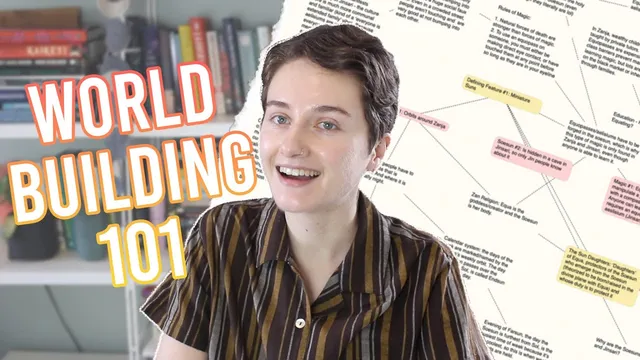
WORLDBUILDING FOR BEGINNERS 🌏 (the web method) + live example
Based on ShaelinWrites's video on YouTube. If you like this content, support the original creators by watching, liking and subscribing to their content.
Prioritize depth over breadth: a smaller set of well-developed, internally consistent elements usually reads richer than a sprawling but thin map.
Briefing
Worldbuilding becomes richer and more believable when writers prioritize “depth” and build outward from a small set of defining features—major disruptions that reshape society through ripple effects. Instead of trying to match the breadth of the real world, the method pushes for a tightly connected world where unique elements (especially those that don’t exist in Earth history) force changes in education, health care, government, religion, daily life, and even etiquette. The result is a setting that feels lived-in not because it has endless details, but because those details interlock in ways that make sense.
A key framework organizes worldbuilding along three axes: “build up” (adding detail within a concept), “build down” (adding mystery, secrets, and lore beneath what’s visible), and “build out” (expanding the number of connected data points). The most common failure, according to this approach, is overemphasizing breadth—creating a vast map with many places—while underinvesting in depth, the intricate workings inside those places. Vastness can work, but only if the specific nodes of the world are developed; otherwise the setting reads as thin. Complexity, in this view, is essentially deep worldbuilding: fewer elements, but more time spent making each one consequential.
The practical engine of the method starts with identifying a world’s defining features: significant, unique touchstones that differ from the real world. Magic is the obvious example, but defining features can also be cultural or geographic. Once those features are chosen, the writer repeatedly asks how they ripple through everything else. If magic exists, it should alter how people learn, how institutions function, what people fear, what they worship, and what kinds of conflict become likely. The defining feature should show up even in small details, not just in big plot mechanics.
To demonstrate, the transcript walks through a personal fantasy setting built around two major disruptions: (1) a pair of “miniature suns” that shape climate and timekeeping, and (2) three distinct magic abilities tied to specific populations and devices. The suns create a world where it is never truly night, driving architecture toward underground sleeping spaces and shade structures, shifting weekly calendars, and shaping religion—night becomes “unholy” because it means losing protection from the sun. The magic system then adds further societal consequences: one form requires an “equal pass” device and strict conditions (including direct eye contact or being in someone’s line of sight), which in turn influences social behavior, dating norms, and etiquette around touching.
The example also shows how identical defining features can produce radically different cultures. Two realms share the same sun and magic types, but class barriers, access to devices, and religious interpretation lead to contrasting societies—one more ancient and protective of tradition, another more class-divided and politically unified, and another shaped by communal trust and broad access. Finally, the transcript argues that when a realm lacks a defining feature, cultural invention becomes the substitute: if magic isn’t a disruptive anchor, a cultural practice (like falconry) can serve as the new ripple source.
Overall, the method treats worldbuilding as a cause-and-effect system. Pick the few things that truly change the world, then follow their consequences until the setting feels coherent, interconnected, and distinct from Earth history.
Cornell Notes
The transcript lays out a worldbuilding method built on two principles: prioritize depth over breadth, and construct the setting outward from a small number of defining features. Defining features are major disruptions—often magic, but also cultural or geographic—that differ from Earth and therefore force ripple effects across society. The framework uses “build out” (more connected elements), “build up” (more detail within elements), and “build down” (mystery and lore beneath them). A live example uses miniature suns that eliminate true night and a three-part magic system tied to specific populations and devices; those disruptions reshape climate, calendars, architecture, religion, education, and etiquette. When a realm lacks a defining feature, the method recommends using a cultural defining feature (e.g., falconry) to generate the same kind of interconnected consequences.
Why does the transcript treat “depth” as more important than “vastness” in worldbuilding?
What are “defining features,” and how do they drive the world outward?
How do the miniature suns in the example reshape everyday life and belief?
What social consequences come from the rules of “equating” magic?
How can the same defining features produce different cultures?
What should a writer do when a realm lacks a defining feature?
Review Questions
- What three “axes” of worldbuilding does the transcript use, and how does each one change what you add to a setting?
- Choose one defining feature (magic, geography, or culture) and list at least four ripple effects it should create across institutions and daily life.
- Why does the transcript claim that identical defining features can still yield very different cultures? What variables drive the divergence?
Key Points
- 1
Prioritize depth over breadth: a smaller set of well-developed, internally consistent elements usually reads richer than a sprawling but thin map.
- 2
Use three modes of expansion—build out (connections), build up (detail), and build down (lore/mystery)—to keep worldbuilding structured.
- 3
Start with defining features (unique, disruptive touchstones) and build outward by asking how they affect education, health care, government, religion, and daily life.
- 4
Treat defining features as cause-and-effect systems: the unique element should show up in both major structures and small social details.
- 5
Avoid assuming “vast” equals “complex.” Complexity comes from deep, interconnected logic, not from matching real-world scale.
- 6
When a realm lacks a magical defining feature, create a cultural defining feature to generate ripple effects and prevent generic “medieval Europe” vibes.
- 7
Use magic rules (limits, costs, and mechanics) to drive social behavior—etiquette, dating norms, class conflict, and institutions.